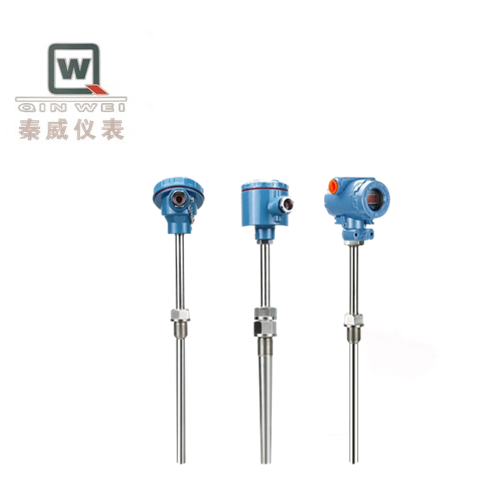
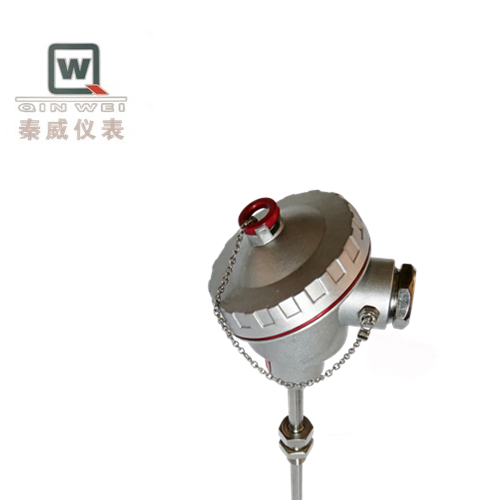
Platinum Resistance Thermometer PT100 With DIN/IEC 60751 Standard, JIS C 1604 Standard, And 3-Wire Configuration
The platinum resistance thermometer PT100 operates based on the resistance-temperature effect of metallic conductors and is named "PT100" because its resistance value is 100Ω at 0℃. It is a reference-level temperature measurement component specified in the International Temperature Scale (ITS-90).
Temperature coefficient (α) - The most important parameter
It defines the sensitivity of the resistance value to temperature changes. There are mainly two standards:
| Standard type |
Temperature coefficient (α) |
Resistance at 0°C (R0) |
Resistance at 100°C |
Remarks |
| DIN/IEC 60751 |
0.003851 Ω/Ω/°C |
100.00 Ω |
138.51 Ω |
The most widely used and mainstream standard globally |
| JIS C 1604 |
0.003916 Ω/Ω/°C |
100.00 Ω |
139.16 Ω |
Primarily used in Japan |
When selecting and using, it is essential to ensure that the input configuration of your measuring instrument (such as PLC, temperature controller) exactly matches the temperature coefficient standard of the Pt100 being used; otherwise, significant measurement errors will occur.
Wiring configuration (2-wire, 3-wire, 4-wire) is a core concept in Pt100 applications, used to eliminate measurement errors caused by the resistance of the connecting wires themselves.
2-wire configuration
- Principle: Both lead resistances (Rw1, Rw2) are included in the measurement result.
- Advantages: Simple wiring and low cost.
- Disadvantages: Large error, significantly affected by wire length and temperature.
- Application scenarios: Only suitable for situations with extremely low precision requirements and very short wires.
Three-wire system
- Principle: Most commonly used in industry. By using a bridge circuit or calculation, it assumes that the resistances of the three wires are equal (Rw1 = Rw2 = Rw3) to offset the influence of lead resistance.
- Advantages: Can effectively compensate in most cases and has a high cost-performance ratio.
- Disadvantages: Requires the three wires to have the same material, length, and temperature.
- Application scenarios: The mainstream choice in industrial sites. The vast majority of industrial temperature controllers and PLCs support it.
4-wire system
- Principle: The highest accuracy. Two wires (I+, I-) provide a constant current, while the other two wires (V+, V-) measure the voltage drop across the Pt100. Due to the extremely high impedance of the voltage measurement circuit, there is no current on the leads, thus completely eliminating the influence of lead resistance.
- Advantages: The highest measurement accuracy.
- Disadvantages: High cost and requires more cables.
- Application scenarios: Mainly used in laboratories, metrology verification, and high-precision measurement situations. It is also the mainstream choice in industrial fields, and the vast majority of industrial temperature controllers and PLCs support it.
Application scenarios
- Industrial automation: Temperature monitoring of chemical reaction vessels, food processing equipment, and semiconductor wafer manufacturing.
- Medical industry: Precise temperature measurement for MRI equipment, blood refrigerators, and surgical instrument sterilization furnaces.
- Scientific research experiments: Reference sensors for laboratory thermostats, low-temperature refrigerators, and material thermal property tests.
- Energy sector: Temperature monitoring of power plant steam turbines and transformer windings (insulation type PT100 required).
- Automotive electronics: Temperature data acquisition for new energy vehicle battery packs and motor controllers (typically micro-film PT100).
In conclusion, when you need a sensor for stable, precise and reliable temperature measurement within the range of -200°C to +500°C, the platinum resistance thermometer Pt100 (especially when using the 3-wire connection method) is usually your best choice.