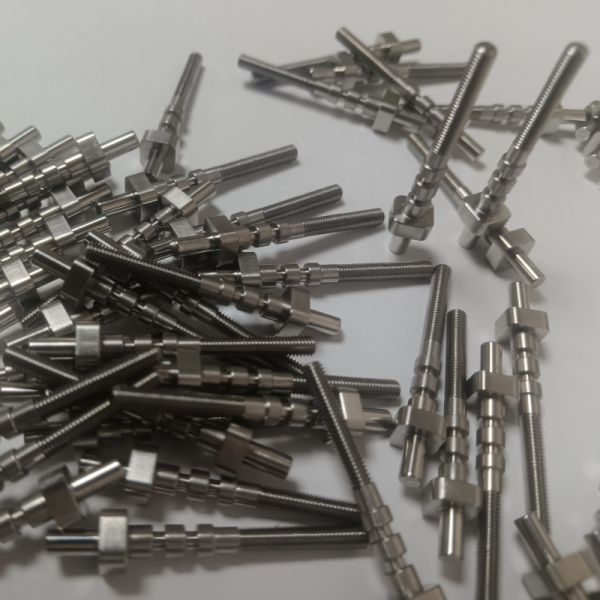
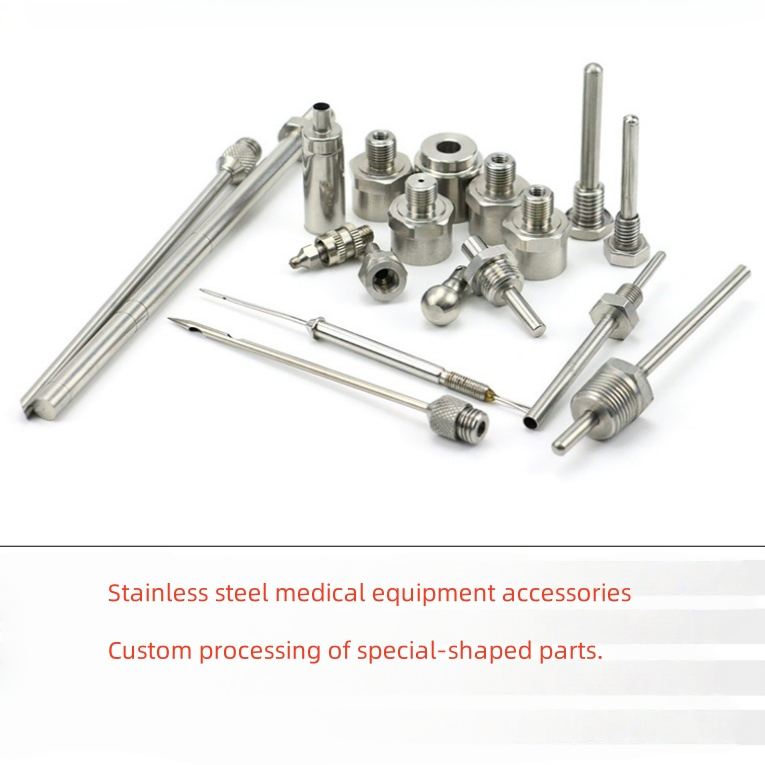
304 316L 17-4PH Stainless Steel Round Bar Tapping Long Axis CNC Milling
This service encompasses the precision machining of 316L stainless steel round bar into specialized components, focusing on two key processes: high-precision internal and external threading (tapping) and the fabrication of long, slender shafts via CNC milling. Utilizing the superior corrosion resistance and biocompatibility of medical-grade 316L stainless steel, this manufacturing capability produces critical parts for medical, marine, pharmaceutical, and high-precision industrial applications where extended length, dimensional stability, and reliable threaded connections are essential.
Material Preparation: Sourcing certified 316L stainless steel round bar (ASTM A276). Precision cutting to required blank lengths, often including stress-relieving for long shafts.
Long Shaft CNC Milling/Turning:
Primary Turning: CNC lathe turning to achieve precise outer diameters, tapers, and preliminary geometries over extended lengths.
Shaft Milling: Utilizing CNC milling centers (often with live tooling lathes or 4/5-axis mills) to create flats, keyways, slots, splines, or complex profiles along the shaft's length.
Process Stability: Employing steady rests, follower rests, and specialized tooling to minimize deflection and vibration during machining of high-aspect-ratio parts.
Precision Threading/Tapping:
Thread Milling: Preferred method for high accuracy and finish. A CNC milling cutter helically interpolates the thread profile into the part. Ideal for large diameters, difficult locations, and both internal/external threads.
Tapping: For smaller or through holes, using rigid tapping cycles on CNC machines with synchronized spindle and feed.
Thread Rolling (for external threads): A cold-forming process that creates stronger, smoother threads by displacing material rather than cutting it.
Heat Treatment (Optional): Solution annealing for 316L to restore optimal corrosion resistance if cold working has been significant.
Surface Finishing:
Deburring & Radiusing: Critical for threads and shaft edges.
Electropolishing & Passivation: To achieve a smooth, clean, corrosion-resistant surface, essential for medical and food-grade applications.
Inspection & Testing:
Dimensional: CMM, laser micrometers, and optical comparators for shaft dimensions.
Thread Inspection: Thread plug/ring gauges (Go/No-Go), thread micrometers, or optical thread profilers.
Material & Corrosion: Certification review and optional salt spray or other corrosion testing.
Medical & Surgical Devices: Implant trial components, long surgical instrument shafts, adjustable mechanism rods, biopsy device parts.
Pharmaceutical & Food Processing: Mixer shafts, agitator arms, valve stems, and connector rods requiring frequent sterilization (CIP/SIP).
Marine & Chemical Equipment: Pump shafts, valve spindles, level gauge components exposed to aggressive environments.
Precision Machinery & Automation: Guide rods, linear motion shafts, lead screws, and actuator components.
Laboratory & Analytical Equipment: Precision stages, adjustment screws, and structural components.
| Parameter Category | Specification | Details & Options |
|---|---|---|
| Base Material | Alloy | 316L Stainless Steel (UNS S31603). Low carbon content (<0.03%) for superior corrosion resistance, especially against weld decay. |
| Standards | ASTM A276 (Bar), ASTM A479 (Stainless Steel for Machine Parts), ISO 5832-1 (Implants). | |
| Key Properties | Excellent corrosion resistance (Mo content), good mechanical properties, non-magnetic in annealed state, biocompatible. | |
| Material Form & Size (Input) | Form | Round Bar (Rod). |
| Diameter Range (Raw Material) | Common: 10 mm - 100 mm diameter. Larger diameters available. | |
| Length (As-supplied) | Standard mill lengths (e.g., 3m, 6m). Cut to required blank length. | |
| Long Shaft Machining | Maximum Finished Shaft Length | Up to 1500 mm (longer possible with specialized setups). |
| Diameter Tolerance (Turned/Milled) | Standard: ±0.025 mm. Precision: ±0.01 mm. High-Precision: ±0.005 mm. | |
| Straightness Tolerance | Critical for long shafts. Achievable: 0.02 mm per 300 mm or better. | |
| Surface Finish (Shaft Body - Ra) | Turned: 0.8 - 1.6 µm. Ground: 0.2 - 0.4 µm. Polished: < 0.1 µm. | |
| Features | Keyways, splines, flats, grooves, cross-holes, tapered sections. | |
| Threading/Tapping | Thread Types | Metric (M), Unified (UNC/UNF), Whitworth, Acme, Buttress, Custom. |
| Thread Standards | ISO (Metric), ASME/ANSI B1.1 (Unified Inch), DIN, JIS. | |
| Thread Size Range | Internal (Tapped Holes): M3 to M30 (or equivalent). External (Threaded Shafts): M6 to M80 and larger. | |
| Thread Quality Class | Metric: 4H, 5H, 6H (internal); 4g, 6g (external). Unified: 2B, 3B (internal); 2A, 3A (external). | |
| Threading Method | Thread Milling (Preferred): Highest accuracy, better surface finish, versatile. Tapping: For smaller through-holes. Thread Rolling: For strong, work-hardened external threads. | |
| Tolerances (General) | Geometric Tolerances | Concentricity, circularity, parallelism, perpendicularity per ISO 1101 or ASME Y14.5. |
| Surface Treatment | Standard Finish | Passivation (per ASTM A967) to maximize corrosion resistance. |
| Enhanced Finishes | Electropolishing: For superior smoothness and cleanability. Bead Blasting: For uniform matte appearance. | |
| Corrosion Resistance | Testing Standard (Optional) | ASTM B117 (Salt Spray), ASTM G48 (Pitting and Crevice Corrosion). |
| Certification & Traceability | Material Certification | Mill Test Certificate (MTC) provided for each heat/lot of material. |
| Part Traceability | Laser marking of part number and lot code possible. | |
| Production Lead Time | Prototype/Small Batch | 4 - 8 weeks (depending on complexity). |
| Production Run | 8 - 14 weeks (volume and complexity dependent). |