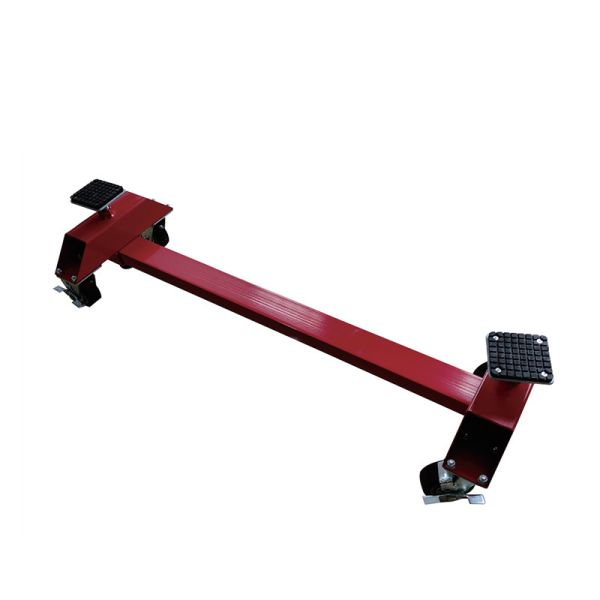
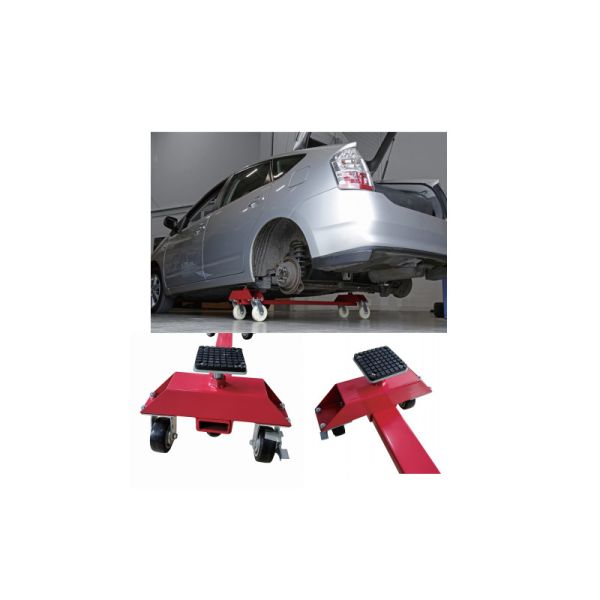
The YD10-012A 2-Tonne Transportacar Trolley is a professional equipment designed specifically for "in-workshop transportation of partially dismantled or severely damaged vehicles". Addressing the pain points of traditional transportation tools—such as "insufficient load capacity, poor model compatibility, and easy vehicle scratching"—it takes "2-tonne heavy load + dual width-height adjustment + rubber protection" as the core, combined with a high-strength steel frame and flexible castors to achieve the core needs of "stable heavy-load support, multi-model compatibility, and scratch-free transportation", providing a reliable vehicle shifting solution for auto repair, bodyshop and other scenarios. Its core advantages are as follows:
-
2-Tonne Heavy-Load Steel Frame, Stable Support for Damaged Vehicles
With an overall load capacity of 2 tonnes, it can easily support the partial or full weight of small and medium-sized sedans (e.g., Toyota Corolla, curb weight approx. 1.3 tonnes) and SUVs (e.g., Honda CR-V, curb weight approx. 1.6 tonnes). The main body is integrally welded from 6mm-thick high-strength steel, with a frame torsional strength of 550N·m, maintaining structural stability without bending even when carrying slightly deformed accident vehicles (e.g., sedans with damaged front faces). Compared with ordinary light transport trolleys (mostly ≤1.5 tonnes load capacity), its heavy-load capacity is increased by 33%, adapting to the "heavy-load damaged vehicle transportation" scenario.
-
Dual Width-Height Adjustment, No Tool Replacement for Multi-Models
- Width-Adjustable: Sliding castor brackets can be flexibly adjusted according to vehicle track or chassis width, with a maximum width of 1420mm, fitting most models from compact sedans (track approx. 1500mm) to medium SUVs (track approx. 1700mm) without replacing trolley specifications;
- Height-Adjustable: The height of rubber-faced support pads can be adjusted between 320-390mm via knobs, ensuring tight fit with vehicles of different chassis heights (e.g., low-profile sedans, high-chassis SUVs) to avoid vehicle shaking, adapting to the "full-scenario model compatibility" demand.
- Rubber Protection + Swivel Castors, Scratch-Free & Flexible Transportation
- Scratch-Proof Design: The surface of support pads is covered with high-elastic rubber (10mm thick), which can buffer pressure when in contact with the vehicle chassis, avoiding chassis scratches caused by direct metal friction, especially suitable for transportation of high-end models (e.g., luxury sedans);
- Flexible Movement: Equipped with 120mm-diameter swivel castors (rubber material, wear resistance coefficient ≥3.6), rolling resistance ≤60N, allowing 2-3 people to push the trolley carrying a 1.5-tonne vehicle. The steering angle is ≥340°, enabling flexible turning even in narrow bodyshops (e.g., 3m-wide workstations), with adjustment efficiency 150% higher than trolleys with fixed-direction castors.
- Rust-Proof & Durable Structure, Worry-Free Long-Term High-Frequency Use
The steel frame is treated with spray-painted anti-rust coating, showing no rust in 180-hour salt spray tests, avoiding rust damage even when used in humid, metal debris-rich bodyshop environments. The castors are equipped with sealed bearings to prevent metal debris from entering and affecting rolling. Under normal use, the castor service life can reach 4-5 years, and the overall trolley service life is 8-10 years, with durability 200% higher than ordinary carbon steel trolleys, adapting to the "long-term high-frequency transportation" scenario.
-
Faulty Vehicle Transportation in Auto Repair Shops
An auto repair shop receives a Volkswagen Lavida (curb weight 1.2 tonnes) with engine failure and needs to transport it from the vehicle-receiving area to the maintenance workstation (15 meters away). Using the YD10-012A trolley: Adjust the sliding castor brackets according to the vehicle track, set the rubber support pads to 350mm height to fit the chassis, and 2 technicians push the trolley for stable transportation without starting the faulty vehicle (avoiding secondary engine damage). The 2-tonne load capacity stably supports the vehicle, with no frame deformation during transportation, adapting to the "efficient transportation of faulty vehicles in auto repair shops" scenario and improving maintenance efficiency.
-
Damaged Vehicle Shifting in Bodyshops
A bodyshop handles a Honda Civic (partial deformation, curb weight 1.3 tonnes) with side collision and needs to adjust the vehicle angle for sheet metal repair. Using the YD10-012A trolley: The swivel castors allow easy rotation of the vehicle to the repair angle (e.g., 45° tilt), and the rubber support pads firmly fix the chassis without scratching. The width-adjustable function fits the vehicle track without replacing the trolley, shortening the single-vehicle angle adjustment time from 20 minutes to 8 minutes, adapting to the "precision repair shifting in bodyshops" scenario and improving repair accuracy.
-
Accident Vehicle Maintenance Handling in 4S Stores
A 4S store conducts chassis inspection on a Mercedes-Benz C-Class (damaged rear bumper, curb weight 1.6 tonnes) involved in a rear-end collision. Using the YD10-012A trolley: Set the support pad height to 380mm to fit the chassis, push the trolley to transport the vehicle to the inspection platform, and the rubber pads avoid scratching the chassis paint. The 2-tonne load capacity supports the vehicle in a fully loaded state (with tools and other items left inside), adapting to the "high-end accident vehicle maintenance in 4S stores" scenario and ensuring vehicle integrity.
-
Awaiting-Repair Vehicle Adjustment in Auto Rescue Stations
An auto rescue station receives multiple family cars stalled after heavy rain and needs to move them from the rescue area to the awaiting-repair area (20 meters away). Using the YD10-012A trolley: Adjust the width and height parameters according to different models, and teams of 2-3 people quickly transport the vehicles. The swivel castors fit the concrete ground of the rescue station, with no slipping even if there is a small amount of standing water on the ground. The rust-proof structure is not afraid of humid environments, and the trolley can be stored after simple wiping, adapting to the "centralized adjustment of multiple vehicles in rescue stations" scenario and improving rescue turnover efficiency.
A1: Regular transportation is not recommended; careful evaluation is required. A 2.1-tonne weight exceeds the trolley's 2-tonne load capacity, and long-term or frequent transportation may cause fatigue deformation of the steel frame, posing safety hazards. For temporary emergency transportation (e.g., short distance ≤5 meters), ensure the vehicle only carries necessary components (e.g., remove spare tires, tools to reduce weight to within 2 tonnes), and 4 people are required to collaborate and push slowly. For long-term transportation of vehicles over 2.1 tonnes, it is recommended to choose the YD10-013 model (3-tonne load capacity) specially designed for medium-heavy vehicles by the manufacturer to ensure load safety.
A2: Sticking is mostly caused by impurities in the bracket rails or insufficient lubrication, which can be resolved in the following steps: ① Adjust the bracket to the middle position, and clean metal debris, dust and other impurities in the rails with a brush; ② Apply a small amount of lithium-based grease to the sliding parts of the rails (maintenance is recommended every 2 months) to ensure even lubrication; ③ Push and pull the bracket repeatedly 5-8 times for running-in, and test the adjustment smoothness. If sticking persists, check if the bracket is deformed; if deformed, contact the manufacturer to replace the original bracket (priced at 190 yuan/set). Forcible pushing and pulling to avoid bracket damage is prohibited.
A3: Yes, they can be replaced individually without replacing the entire support assembly. When the wear depth of the rubber pad surface is ≥5mm (affecting anti-slip effect), contact the manufacturer to purchase original rubber pads (priced at 35 yuan/piece). The replacement steps are as follows: ① Use a wrench to unscrew the fixing screws at the bottom of the support pad; ② Remove the old rubber pad and install the new one by aligning it with the screw holes; ③ Tighten the screws (torque ≤20N·m) to ensure the rubber pad is fixed without loosening. It is recommended to check the wear of rubber pads every 6 months and replace them in time to ensure protection effect.
A4: It can be easily completed by 2 people collaborating; single-person carrying is relatively laborious. The 26 kg weight requires 2 people to hold the handles on both sides of the trolley (reserved anti-slip grips) respectively, with an average load of 13 kg per person, making short-distance transportation (e.g., from trunk to ground, height ≤1m) easy. For temporary single-person carrying, the trolley's built-in tilt design (the front end can be slightly lifted) can be used to move it slowly to the ground, but frequent single-person carrying is not recommended to avoid waist strain. It adapts to the "efficient 2-person collaborative carrying" demand, conforming to the manpower configuration of most auto repair scenarios.