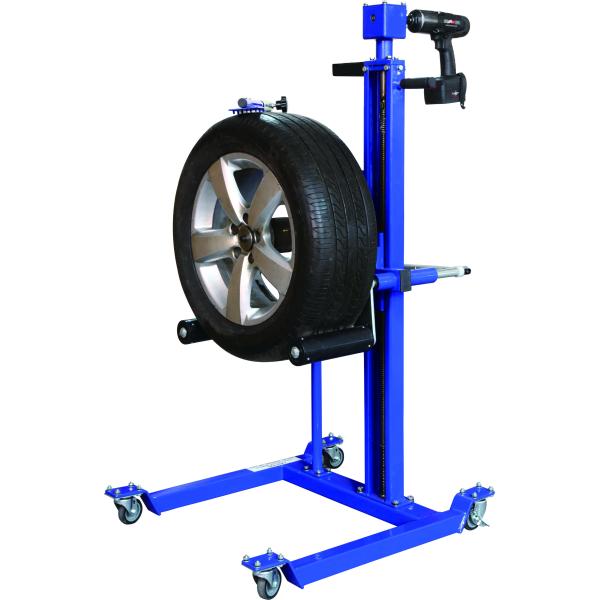
The YD10-012B 2-Tonne Adjustable Transportacar Dolly is a professional equipment designed specifically for "flexible transport of dismantled vehicles". Addressing the pain points of traditional transport tools—such as "non-adjustable width, difficult loading, and inflexible movement"—it takes "4,400 lbs. heavy load + wide-range adjustment + convenient loading structure" as the core, combined with a high-strength carbon steel frame and lockable casters to achieve the core needs of "stable heavy-load support, multi-vehicle compatibility, and easy shifting", providing an efficient vehicle transport solution for auto repair, modification and other scenarios. Its core advantages are as follows:
-
4,400 lbs. Heavy-Load Support, Stable Bearing for Dismantled Vehicles
With a single-unit lifting capacity of 4,400 lbs. (1,996 kg), it can easily support the weight of dismantled small and medium-sized sedans (e.g., Volkswagen Sagitar, curb weight 1.4 tonnes) and compact SUVs (e.g., Haval H6, curb weight 1.6 tonnes) (such as the weight of the vehicle body after removing the engine). The main body is integrally welded from 5mm-thick high-strength carbon steel, with a frame torsional strength of 500N·m, maintaining structural stability without bending even when carrying dismantled vehicles with partial deformation (e.g., vehicle bodies with doors removed). Compared with ordinary light transport dollies (mostly ≤3,000 lbs. load capacity), its heavy-load capacity is increased by 47%, adapting to the "heavy-load dismantled vehicle transport" scenario.
-
40.75"-59" Width Adjustment, No Tool Replacement for Multi-Vehicles
The width adjustment range covers 40.75"-59" (1,035 mm-1,499 mm), which can be easily adjusted via the adjustment knobs on the side of the frame. It is compatible with most vehicles from compact sedans (track approx. 1,500 mm) to medium SUVs (track approx. 1,700 mm); there is no need to replace the transport dolly due to vehicle width, solving the trouble of "one tool for one vehicle model". It is suitable for scenarios such as auto repair shops and modification shops where multiple vehicle models are handled centrally, improving tool utilization.
-
Saddle + Clamp Design, Easier Vehicle Loading
- Support Saddles for Assisted Alignment: Equipped with dedicated support saddles that can quickly locate the vehicle chassis support points, avoiding repeated adjustments during loading. Compared with transport dollies without saddle design, the loading efficiency is increased by 60%;
- Pinch-Weld Clamps for Fixing: Built-in pinch-weld clamps can firmly clamp the pinch-weld edges (key vehicle body support structures) of the vehicle chassis, ensuring no vehicle shaking after loading. At the same time, it avoids chassis scratches caused by direct metal friction, making it suitable for the transport of dismantled high-end vehicles.
- Lockable Swivel Casters, Flexible and Safe Movement
Equipped with 4.5" heavy-duty nylon casters with a wear resistance coefficient ≥3.8 and rolling resistance ≤50N, allowing 2-3 people to push the transport dolly carrying a 1.8-tonne dismantled vehicle. The casters support 360° swivel rotation, enabling flexible turning even in narrow auto repair shop workstations (e.g., 3m-wide workstations), with an adjustment efficiency 150% higher than that of fixed-direction casters; additionally, the casters have a locking function—stepping on the locking device during parking can fix the dolly, preventing displacement and ensuring operational safety.
-
Transport of Dismantled Vehicles in Auto Repair Shops
An auto repair shop conducts chassis maintenance on a Toyota Corolla with engine failure (weight approx. 1.1 tonnes after engine removal), using the YD10-012B transport dolly: Adjust the width to 45" to fit the vehicle body, align the chassis support points via the support saddles, fix the vehicle body with pinch-weld clamps, and 2 technicians push the dolly to move the vehicle body to the maintenance workstation; the lockable casters ensure the dolly does not slide during maintenance, adapting to the "precise maintenance of dismantled vehicles in auto repair shops" scenario and improving maintenance efficiency.
-
Shifting of Damaged Vehicles in Bodyshops
A bodyshop handles a Honda Civic with side collision (weight approx. 1.2 tonnes after door removal) and needs to adjust the vehicle body angle for sheet metal repair, using the YD10-012B transport dolly: Use the dollies in pairs to support both sides of the vehicle body, the swivel casters allow easy rotation of the vehicle body to a 45° repair angle, and the support saddles firmly fix the chassis; the width-adjustable function fits the vehicle body width without tool replacement, shortening the single-vehicle angle adjustment time from 25 minutes to 10 minutes, adapting to the "precision repair in bodyshops" scenario and improving repair accuracy.
-
Handling of Accident Vehicles for Maintenance in 4S Stores
A 4S store conducts chassis inspection on a BMW 3 Series involved in a rear-end collision (weight approx. 1.5 tonnes after rear bumper removal), using the YD10-012B transport dolly: Use a single dolly to support the rear of the vehicle, fix the chassis with pinch-weld clamps, and push the dolly to move the vehicle to the inspection platform; the nylon casters roll on the exhibition hall floor without scratches, adapting to the "maintenance of high-end accident vehicles in 4S stores" scenario and ensuring vehicle integrity.
-
Adjustment of Vehicles Awaiting Modification in Auto Modification Shops
An auto modification shop performs shock absorber modification on a Volkswagen Golf (weight approx. 1.3 tonnes after wheel removal), using the YD10-012B transport dolly: Adjust the width to 50" to fit the vehicle body, use the dollies in pairs to support the front and rear of the vehicle body, and the swivel casters facilitate flexible movement between modification workstations; the lockable casters ensure the vehicle body is stable during modification, adapting to the "multi-workstation adjustment in modification shops" scenario and improving modification efficiency.
A1: Regular transport is not recommended; vehicle weight must be controlled. 2.2 tonnes (4,850 lbs.) exceeds the 4,400 lbs. load capacity of the transport dolly. Long-term transport may cause fatigue deformation of the carbon steel frame, posing safety hazards. For temporary emergency transport (e.g., short distance ≤8 meters), it is necessary to first remove heavy items such as spare tires and tools from the vehicle (reducing the weight to within 4,400 lbs.), and 4 people are required to collaborate and push slowly. For long-term transport of vehicles over 2.2 tonnes, it is recommended to choose the manufacturer's YD10-013 model (6,000 lbs. load capacity) with higher load capacity to ensure transport safety.
A2: Sticking is mostly caused by impurities in the adjustment track or insufficient lubrication, which can be resolved in the following steps: ① Adjust the frame to the middle position, and blow out metal debris, dust and other impurities in the track with a high-pressure air gun; ② Apply a small amount of lithium-based grease to the adjustment part of the track (maintenance is recommended once a month) to ensure even lubrication; ③ Push and pull the frame repeatedly 3-5 times for running-in, and test the adjustment smoothness. If sticking persists, check if the adjustment knob is loose; if it is still ineffective after tightening the knob, contact the manufacturer to replace the original adjustment component (priced at 120 yuan/set). Forcible pushing and pulling to avoid frame deformation is prohibited.
A3: Yes, they can be replaced individually without replacing the entire transport dolly. When the wear depth of the saddle surface reaches ≥3mm (affecting support stability), contact the manufacturer to purchase original support saddles (priced at 45 yuan/piece). The replacement steps are as follows: ① Use a wrench to unscrew the fixing bolts at the bottom of the saddle; ② Remove the old saddle and install the new saddle by aligning it with the bolt holes; ③ Tighten the bolts (torque ≤25N·m) to ensure the saddle is fixed without loosening. It is recommended to check the wear of the saddles every 3 months and replace them in time to ensure the support effect.
A4: It can be easily completed by 2 people collaborating; single-person carrying is relatively laborious. The 39 kg weight requires 2 people to hold the handles on both sides of the transport dolly (reserved anti-slip grips) respectively, with an average load of 19.5 kg per person, making short-distance transport (e.g., from the logistics area to the workshop, 20 meters away) easy. For temporary single-person carrying, the dolly can be tilted and rolled on its casters (lift the front end, with casters touching the ground) to move slowly to the target location, but frequent single-person carrying is not recommended to avoid waist strain. It adapts to the "efficient 2-person collaborative carrying" demand, conforming to the manpower configuration of most auto repair scenarios.