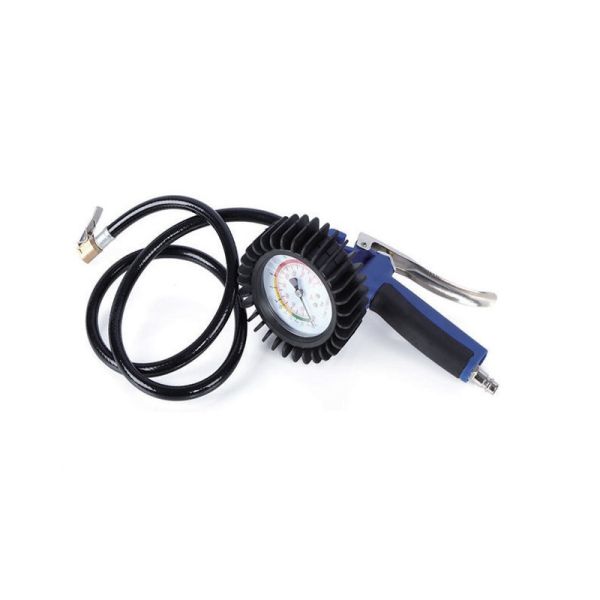
Centered on "accurate pressure measurement + integrated inflation + multi-scenario adaptation", the YD31-001 Tire Air Pressure Gauge with Inflation Gun is optimized to address core pain points of vehicle tire pressure maintenance. Its core advantages are as follows:
Compared with ordinary plastic movement tire pressure gauges, this product adopts a copper precision movement:
- High Measurement Accuracy: The error is ≤±1% within the 0-10 bar range (commonly used tire pressure range for daily vehicles). For example, when the standard tire pressure is 2.5 bar, the measurement error is only ±0.025 bar, far exceeding the industry average accuracy of ±3%. This ensures accurate tire pressure data, avoiding increased fuel consumption and accelerated tire wear caused by incorrect tire pressure;
- Clear Reading: The 60mm large dial is equipped with high-contrast scales (black scales + white dial), displaying both bar and psi units simultaneously. It allows quick reading even in strong light, and is easy for users with presbyopia to identify.
Traditional tire pressure maintenance requires three steps: "measure pressure with a tire pressure gauge → inflate with an inflation gun → re-measure pressure with the tire pressure gauge". This product achieves integration:
- Simplified Steps: Align the gun nozzle with the valve stem to first measure the current tire pressure. If the pressure is insufficient, directly connect to an air source for inflation. During inflation, release the switch at any time to check the pressure until it reaches the standard value. No frequent tool replacement is needed, and the operation time is reduced from 5 minutes to 1 minute;
- Leak-Proof Design: The rubber sealing gasket of the gun nozzle has good elasticity and fits tightly with the valve stem, preventing air leakage during pressure measurement and inflation. This avoids tire pressure detection deviations caused by air leakage of traditional interfaces and reduces air source waste.
- Durable Hose: The PVC reinforced hose balances flexibility and strength. It can be easily bent at -20℃ in winter without jamming when connecting the inflation gun and tire; it does not soften or deform after exposure to the sun in summer, and its service life is twice that of ordinary rubber hoses;
- Rust-Proof Gun Body: The zinc alloy gun body undergoes chrome plating treatment, with no rust after 48-hour salt spray test. Even if it is placed on a damp trunk or repair shop tool rack for a long time, its surface remains bright without rust affecting operation;
- Durable Movement: The copper movement has strong oxidation resistance and can withstand more than 10,000 pressure measurement operations under normal use without accuracy attenuation, eliminating the need for frequent calibration or replacement.
- Flexible Air Source Interfaces: The default air inlet is G1/4", and it can be replaced with G3/8", 1/2" and other specifications (adaptable interfaces need to be purchased separately). It can be connected to different air source equipment such as household small air compressors and large repair shop air sources, avoiding inability to use due to incompatible interfaces;
- Full Vehicle Adaptation: The gun nozzle is compatible with tire valve stems of most vehicle types, including cars (American valves), motorcycles (American/French valves), and bicycles (French valves). Private car owners do not need to purchase separate tools for different vehicles, reducing usage costs.
- Inflation Switch: The push-type switch only requires 5N of force (equivalent to lifting a 0.5kg object), allowing female users to easily press and inflate without hand soreness during long-term inflation;
- Gun Body Weight: The overall weight is only 350g, with no burden during hand-held operation. The gun nozzle can be stably held with one hand during pressure measurement and inflation, no additional support is needed.
- Compact Size: The gun body is 180mm long, and the hose can be wrapped around the gun body when stored. The overall volume is equivalent to a thermos cup, which can be easily placed in a car glove box, motorcycle tail box, or bicycle tool bag for easy access;
- No Additional Accessories: The integrated design eliminates the need to carry separate tire pressure gauges, inflation guns, and hoses. When going on a self-driving tour or cycling trip, only this one tool is needed to meet tire pressure maintenance needs.
Scenario Requirement: The tire pressure of a family car (standard tire pressure 2.5 bar) drops after long-term parking, requiring quick pressure detection and inflation. No professional repair equipment is available, and only a household small air compressor (G1/4" interface) can be connected.
Operation Process:
- Connect to Air Source: Connect the G1/4" air inlet of YD31-001 to the hose of the household air compressor, ensuring a tight seal without air leakage;
- Tire Pressure Detection: Align the gun nozzle with the car tire valve stem, press to seal, and read the dial, showing the current tire pressure is 2.0 bar (lower than the standard value);
- Tire Inflation: Press the inflation switch to start inflating. Release the switch every 10 seconds to check the tire pressure, and repeat until the pressure reaches 2.5 bar;
- Store the Tool: Disconnect the air source, wrap the hose around the gun body, and place it in the car glove box for later use.
Result: No need to go to a repair shop, tire pressure maintenance can be completed at home within 1 minute, avoiding increased fuel consumption (a 10% decrease in tire pressure leads to an approximately 2% increase in fuel consumption) and tire uneven wear, extending tire service life.
Scenario Requirement: A motorcycle rider finds a tire leak during a ride (on a rural road), with the tire pressure dropping to 1.8 bar (standard value 2.2 bar). A portable air compressor (G3/8" interface) is carried, requiring emergency inflation.
Operation Process:
- Replace the Interface: Use a special wrench to replace the air inlet of YD31-001 from G1/4" to G3/8" (adaptable interface purchased in advance), and connect it to the portable air compressor;
- Emergency Pressure Measurement: Align the gun nozzle with the motorcycle tire valve stem (French type) and confirm the current tire pressure is 1.8 bar;
- Quick Inflation: Press the switch to inflate for 30 seconds, release to check the tire pressure, which rises to 2.2 bar, then stop inflating;
- Continue Riding: Store the tool in the motorcycle tail box and continue the journey without waiting for rescue.
Result: Independent emergency tire pressure supplementation can be completed when there is no repair shop outdoors, avoiding inability to ride due to insufficient tire pressure and ensuring travel safety.
Scenario Requirement: Before a race, a road bicycle (standard tire pressure 8-10 bar) needs precise tire pressure adjustment to 9 bar to avoid tire blowout due to excessive pressure or reduced riding efficiency due to insufficient pressure. A large repair shop air source (1/2" interface) is used.
Operation Process:
- Adapt to Air Source: Replace the air inlet of YD31-001 with a 1/2" interface, and connect it to the repair shop air source;
- Accurate Pressure Measurement: The gun nozzle is adapted to the bicycle's French valve stem, and the current tire pressure is measured to be 7.5 bar (insufficient);
- Precise Inflation: Press the inflation switch slowly, release it every 2 seconds to check the tire pressure, and gradually increase the pressure to 9 bar (avoid over-inflation);
- Pre-Race Check: Re-measure the pressure to confirm it is stably maintained at 9 bar, ensuring optimal tire performance during the race.
Result: The tire pressure error is accurately controlled within ≤0.1 bar, meeting the high tire pressure requirements of road bicycles, improving riding speed while avoiding the risk of tire blowout.
A1: It is mostly due to operation methods or calibration issues, not product accuracy faults:
- Operation Correction: Before pressure measurement, ensure the gun nozzle is tightly sealed with the valve stem (press until no air leakage sound is heard). If the seal is not tight, the value will be low; it is recommended to measure the pressure twice continuously and take the average value (normal deviation ≤±0.1 bar);
- Calibration Suggestion: If the deviation exceeds ±0.2 bar, contact the manufacturer or a professional organization for calibration (the product supports free calibration once within 1 year). The copper movement can restore accuracy after calibration, no need to replace the equipment.
A2: It is mostly caused by excessive air source pressure or hose aging; the cause needs to be checked:
- Air Source Pressure Check: The product hose has a pressure resistance of 30 bar. If the connected air source pressure exceeds 30 bar (such as some industrial air sources), the hose will bulge. It is necessary to replace it with a hose with higher pressure resistance (it is recommended to choose a reinforced hose with pressure resistance of 50 bar);
- Hose Aging Judgment: If the hose is used for more than 2 years and shows hardening, cracking, or bulging, it needs to be replaced with a new hose (original accessories can be purchased separately) to avoid air leakage caused by hose rupture.
A3: A dedicated gun nozzle accessory needs to be replaced, following these steps:
- Purchase Adaptable Accessories: Contact the merchant to purchase a dedicated gun nozzle for French valve stems (optional accessory for the product), which includes a rubber sealing gasket and an adapter sleeve;
- Replace the Gun Nozzle: Use a wrench to remove the original gun nozzle, install the adapter sleeve for French valve stems, and then install the dedicated sealing gasket to ensure a tight connection;
- Usage Note: For French valve stems, unscrew the valve core cap first, then align the dedicated gun nozzle and press to seal. The pressure measurement and inflation operations are the same as those for American valve stems.
A4: A slight deviation does not affect accuracy and can be adjusted manually:
- Deviation Judgment: If the pointer deviation from zero is ≤0.1 bar (e.g., stopping at 0.05 bar), subtract the deviation value from the reading during measurement (e.g., if the displayed value is 2.55 bar, the actual tire pressure is 2.5 bar), which does not affect use;
- Adjustment Method: If the deviation exceeds 0.1 bar, open the calibration screw on the back of the dial, gently turn the pointer to the zero position with a small screwdriver. After adjustment, re-measure the pressure for verification (it is recommended to compare with a standard tire pressure device) to ensure normal accuracy.