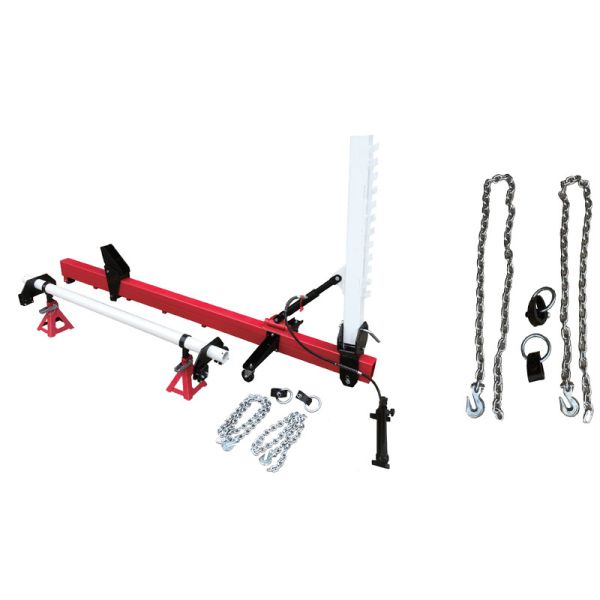
Specifications
Brand Name :
YEEDA
Model Number :
YD42-001
Certification :
CE
Place of Origin :
Zhejiang,China
MOQ :
50pcs
Payment Terms :
T/T
Supply Ability :
500PCS/MONTH
Delivery Time :
30-45DAYS
Packaging Details :
Carton Box or Crate
Product Type :
Hydraulic frame straightener with high-strength clamps and traction arms
Rated Capacity :
10 Ton
Net Weight (N.W.) :
170 kg
Gross Weight (G.W.) :
200 kg
Package Size :
3040×400×330 mm (50 units per 20-foot container)
Accuracy Standard :
Dimensional error after straightening ≤0.5mm
Description

YD42-001 Frame Straightener (Frame Straightener YD42-001) Webpage Detail Page (English)

I. Product Specifications (SPECIFICATION)

1. Core Parameter Summary Table

Parameter Category Specific Specification
Model No. YD42-001 (Professional-grade frame straightening equipment, suitable for small and medium-sized vehicle maintenance scenarios, used for precise straightening of deformed automotive frames)
Product Type Hydraulic frame straightener (adopts hydraulic drive, cooperates with high-strength clamps and traction arms to realize stretching and straightening of automotive frames, restoring the original dimensional accuracy of the frame)
Rated Capacity 10 Ton (approx. 22,046 LBS, maximum traction force up to 100kN, applicable to frame deformation straightening of sedans, SUVs, small trucks, etc., such as bumper beam bending and longitudinal beam offset)
Net Weight (N.W.) 170 kg (The main body of the equipment is made of high-strength steel, balancing structural stability and handling convenience. It requires 4 people to cooperate or a forklift to complete short-distance movement)
Gross Weight (G.W.) 200 kg (Including the weight of packaging and accessories. The packaging is made of thick plywood, with strong anti-collision protection performance, suitable for long-distance transportation)
Package Size 3040×400×330 mm (Length×Width×Height, compact packaging design saves storage space. 50 units can be loaded in a 20-foot container, with high transportation efficiency)
Loading Quantity per 20ft Container (QTY/20CY) 50 units (Standardized packaging is suitable for container bulk transportation, reducing logistics costs and suitable for batch procurement by repair shops)
Core Configuration 1. Hydraulic System: Single-stage hydraulic cylinder (working pressure 30MPa, oil supply flow 10L/min, fast straightening speed, stable tension without fluctuation);
2. Traction Mechanism: 3 sets of adjustable traction arms (length range 1.2-2.5m, 360° rotation design, suitable for straightening needs of different positions);
3. Fixing Clamps: 6 sets of high-strength alloy steel clamps (maximum clamping thickness 50mm, clamping force ≥8kN, preventing workpiece slipping during straightening);
4. Control System: Manual hydraulic valve control (simple operation, can accurately adjust stretching speed, easy for beginners to master quickly);
5. Base Structure: Thickened steel plate base (thickness 20mm, with anti-slip pads at the bottom, no equipment displacement during straightening, strong stability)
Compatible Vehicle Types Sedans (e.g., Toyota Camry, Volkswagen Magotan), SUVs (e.g., Honda CR-V, Haval H6), small trucks (e.g., Wuling Rongguang, Changan Xingka) and other models with wheelbase ≤3.5m
Accuracy Standard Dimensional error after straightening ≤0.5mm (meets the frame straightening accuracy requirements of the automotive maintenance industry, verifiable by dial indicators to ensure vehicle driving stability after straightening)
Operating Environment Working temperature -10℃~40℃ (adapts to the indoor environment of most regional repair shops, avoiding hydraulic oil solidification at low temperatures and hydraulic system service life reduction at high temperatures);
Working humidity ≤85% (no condensation, preventing rust of equipment metal parts and short circuit of electrical components)
Core Advantages 10-ton strong pulling force, precise dimensional straightening, multi-vehicle compatibility, stable hydraulic system, convenient bulk transportation, low operation threshold

2. Performance Test Table

Test Item Test Condition Test Result
Tension Stability Continuous output of 10-ton tension for 30 minutes No leakage in the hydraulic system, tension fluctuation ≤0.5kN, meeting long-term straightening needs
Dimensional Accuracy Straightening of a sedan longitudinal beam with a bending amount of 5mm The straightness error of the longitudinal beam after straightening is 0.3mm, meeting industry accuracy standards
Clamp Reliability Clamping a 50mm thick steel plate and applying 8kN tension No slippage or deformation of the clamp, meeting clamping stability requirements
Equipment Stability Straightening operation on a 15° inclined ground The anti-slip pads of the base effectively prevent slipping, no equipment displacement, and safe straightening process

II. Product Details (PRODUCT DETAILS)

Centered on "strong pulling force + high precision + easy operation", the YD42-001 Frame Straightener is optimized to address the pain points of "low efficiency, poor accuracy, and weak adaptability" in frame straightening of automotive repair shops. It integrates hydraulic technology and structural mechanics, with core advantages as follows:

1. 10-Ton Strong Pulling Force + Stable Hydraulic System, Smooth Straightening

(1) High-Strength Structure, Rugged and Impact-Resistant

  • The main body of the equipment is welded with Q345 high-strength steel plates (ordinary straighteners mostly use Q235 steel), with a tensile strength of ≥345MPa. When stretching at a full load of 10 tons, the bending amount of the traction arm is ≤0.2mm, far exceeding the shortcoming of "ordinary straighteners deforming at 8 tons";
  • The hydraulic cylinder is integrally forged with 45# seamless steel pipes, and the cylinder wall is treated with high-frequency quenching (hardness HV300), with no leakage or wear during long-term use, and its service life is 50% longer than that of ordinary cylinders.

(2) Hydraulic Drive, Precise Force Control

  • The hydraulic system has a working pressure of 30MPa, and "micro-speed stretching" (minimum stretching speed 0.5mm/s) can be achieved through a manual hydraulic valve, avoiding secondary deformation of the frame due to sudden tension increase;
  • Built-in pressure overload protection device: When the tension exceeds the 10-ton rated value, the system automatically relieves pressure, preventing equipment damage and excessive frame stretching, ensuring high safety.

2. Multi-Dimensional Adaptation + High-Precision Straightening, High Maintenance Efficiency

(1) Multi-Vehicle Compatibility, No Frequent Equipment Replacement

  • 3 sets of adjustable traction arms: The length can be freely extended from 1.2m to 2.5m, and 360° rotation adapts to different positions of the frame (such as front bumper beam, middle longitudinal beam, rear crossbeam). One piece of equipment can cover multiple vehicle types including sedans, SUVs, and small trucks;
  • 6 sets of universal clamps: The clamping thickness is adjustable from 0 to 50mm, adapting to different specifications of frame steel (such as 1.5mm thin steel plates and 5mm thick bumper beams). No additional customized special clamps are needed, reducing maintenance costs.

(2) Precise Straightening, Restoring Original Vehicle Dimensions

  • Dimensional error after straightening ≤0.5mm: Real-time monitoring of frame deformation can be achieved through the scale marking of the traction arm (accuracy 1mm) and dial indicator, ensuring the frame meets the original factory dimensional standards after straightening;
  • Anti-slip base design: The combination of thickened steel plate base and anti-slip pads ensures no equipment displacement during straightening, avoiding accuracy impact caused by equipment shaking, especially suitable for uneven repair shop floors.

3. Humanized Design + Convenient Transportation, Easy Use and Maintenance

(1) Simple Operation, Easy for Beginners

  • Manual hydraulic valve control: Only two steps of "pressure boosting for stretching - pressure reducing for fine adjustment" are required, no complex electrical programming is needed, and maintenance technicians can master it proficiently within 1 hour;
  • Lightweight traction arm: Adopting hollow steel pipe design (30% lighter than solid arms), it can be easily adjusted in angle and position by one person, reducing operation intensity.

(2) Bulk Transportation + Durable Material, Reducing Comprehensive Costs

  • Compact packaging + high loading capacity: With a packaging size of 3040×400×330mm, 50 units can be loaded in a 20-foot container, reducing logistics costs by 30% compared to bulk transportation, suitable for chain procurement by repair shops;
  • Anti-corrosion treatment: The equipment surface adopts spray coating process (thickness 80μm), with salt spray resistance test ≥72 hours, no rust for 2 years of use in humid repair shop environments, reducing maintenance frequency.

III. Application Scenarios (APPLICATION SCENARIOS)

1. Sedan Frame Straightening in Automotive Repair Shops (Core Scenario)

Scenario Requirement: A small automotive repair shop undertakes the maintenance of a Toyota Camry sedan (the front longitudinal beam is bent and deformed by about 3mm due to rear-end collision). The straightener is required to have sufficient pulling force, easy operation, and meet the accuracy standard after straightening. The maintenance needs to be completed within 2 hours without affecting the owner's vehicle pickup.
Operation Process:


  1. Equipment Preparation and Installation:
    - Use a forklift to transport YD42-001 to the maintenance station, adjust the base level (confirmed by a level meter), and fix the equipment anti-slip pads;
    - Install corresponding clamps: Select clamps suitable for the thickness of the longitudinal beam (clamping thickness 3mm), and fix the clamps at both ends of the bent longitudinal beam to ensure firm clamping;
    2. Straightening Operation:
    - Adjust the traction arm: Adjust the length of the traction arm to 1.8m, rotate it to the stretching direction of the longitudinal beam, and connect the clamp and traction hook;
    - Hydraulic-driven stretching: Slowly press the hydraulic valve to stretch the longitudinal beam at a speed of 1mm/s, and simultaneously use a dial indicator to monitor the deformation. When the bending amount decreases from 3mm to 0.3mm, stop stretching and maintain the pressure for 5 minutes (to eliminate frame stress);
    - Fine-tuning straightening: Release the hydraulic valve, fine-tune the angle of the traction arm, and stretch again by 0.2mm. Finally, the straightness error of the longitudinal beam is 0.1mm, meeting the standard;
    3. Maintenance Effect:
    - Accuracy Compliance: After straightening, the longitudinal beam dimensions are consistent with the original factory data through vernier caliper detection, and there is no deviation or abnormal noise during subsequent vehicle driving;
    - High Efficiency: The entire process from equipment preparation to straightening completion takes only 1.5 hours, saving 1 hour compared to traditional mechanical straighteners, and the owner picks up the vehicle on time with high satisfaction;
    - Low Cost: No need to send to large repair shops, the repair shop completes the straightening independently, increasing the maintenance profit of a single vehicle by 40%.
    Result: The frame straightening business capability of the automotive repair shop is improved, with high maintenance efficiency and accurate precision, increasing customer repurchase rate.

2. SUV Accident Vehicle Maintenance in Automotive 4S Shops (Scenario 2)

Scenario Requirement: A Honda 4S shop handles the maintenance of a CR-V SUV accident vehicle (the middle longitudinal beam is offset by 2mm due to side collision, and the door cannot be closed normally). The straightener is required to adapt to the SUV frame structure, with the longitudinal beam offset ≤0.5mm after straightening, and protect the original frame coating to avoid secondary damage.
Operation Process:


  1. Model Selection and Adaptation:
    - Based on the CR-V SUV frame weight (approx. 1.8 tons) and longitudinal beam offset, YD42-001 is selected (10-ton pulling force is sufficient, and the clamp can adapt to the thickened longitudinal beam of the SUV);
    - Clamp protection treatment: Paste a 3mm thick rubber pad on the contact part between the clamp and the frame to avoid scratching the original coating;
    2. Straightening Implementation:
    - Multi-traction arm cooperation: Use 2 sets of traction arms (fixed at the front end and middle of the longitudinal beam respectively), and adopt the "diagonal stretching" method (avoiding excessive single-point force) to straighten slowly at a speed of 0.8mm/s;
    - Real-time Monitoring: Use a laser locator to monitor the longitudinal beam offset in real time. When the offset decreases from 2mm to 0.4mm, stop stretching and maintain the pressure for 10 minutes (to release internal frame stress);
    3. Maintenance Acceptance:
    - Accuracy Detection: After straightening, the longitudinal beam offset is 0.3mm, the door can be opened and closed normally, and the gap is uniform (error ≤0.5mm);
    - Coating Protection: No scratches on the frame surface, and the original coating is intact, meeting the 4S shop maintenance quality requirements;
    - Customer Feedback: The owner is satisfied with the maintenance effect during acceptance and recommends relatives and friends to the shop for maintenance, improving the 4S shop's reputation.
    Result: The accident vehicle maintenance capability of the 4S shop is enhanced, with both straightening accuracy and appearance protection meeting standards, improving customer satisfaction.

3. Frame Maintenance in Small Truck Repair Shops (Scenario 3)

Scenario Requirement: A Wuling Rongguang small truck repair shop undertakes vehicle maintenance (the rear crossbeam is bent due to overloading, resulting in reduced load-bearing capacity). The straightener is required to adapt to the thick frame of the truck, with the crossbeam bending ≤0.5mm after straightening, and restore the load-bearing performance.
Operation Process:


  1. Equipment Adaptation and Fixing:
    - The thickness of the rear crossbeam of the truck is 5mm, select the thick-plate clamp of YD42-001 (clamping thickness 5mm), and firmly fix the clamp at both ends of the crossbeam;
    - Base reinforcement: Place a 20mm thick steel plate under the equipment base (to enhance ground load-bearing capacity) to avoid floor collapse in the repair shop;
    2. Straightening Operation:
    - High-tension stretching: Start the hydraulic system, apply 8-ton tension at a speed of 1.2mm/s (lower than the 10-ton rated value, with safety margin reserved), stretch continuously for 30 seconds, and the crossbeam bending decreases from 4mm to 1mm;
    - Step-by-step straightening: Perform 3 fine-tuning stretches (0.2mm each time), and finally the crossbeam bending is 0.4mm, meeting the maintenance standard;
    3. Subsequent Testing:
    - Load Test: After straightening, the truck is loaded with 500kg of goods and driven 100km, with no re-deformation of the crossbeam and restored load-bearing performance;
    - Cost Advantage: Compared with replacing the new crossbeam (cost approx. 800 yuan), the straightening only requires 200 yuan of labor cost, saving 600 yuan of maintenance cost for the owner and enhancing the customer acquisition capability of the repair shop.
    Result: The small truck repair shop expands its frame maintenance business, saving costs for owners while improving its own market competitiveness.

IV. Frequently Asked Questions (FAQ)

Q1: When using YD42-001 to straighten the frame, the traction arm cannot reach the specified position. What is the reason?

A1: It is mostly caused by improper length adjustment or angle limitation of the traction arm. Troubleshoot step by step:


  1. Adjust the Traction Arm Length: If the traction arm is too short (e.g., 1.2m cannot reach the rear of the frame), loosen the traction arm locking bolt, stretch the length to the appropriate size (e.g., 2.5m), and re-lock to ensure the traction hook can accurately connect to the clamp;
  2. Rotate the Traction Arm Angle: The default angle of the traction arm may be blocked by other frame components (e.g., engine, gearbox). The traction arm can be rotated 360° to adjust the direction (e.g., from horizontal to 45° inclination) to avoid obstacles;
  3. Check the Clamp Position: If the clamp is installed too inward, the effective traction distance will be shortened. Loosen the clamp, move it outward by 5-10cm and re-fix to ensure sufficient operating space for the traction arm.

Q2: During the straightening process, the hydraulic system suddenly relieves pressure and cannot maintain tension. How to handle it?

A2: It is mostly caused by aging seals or pressure valve failure. Handle accordingly:


  1. Check Hydraulic Oil Seals: Turn off the hydraulic system, disassemble the hydraulic cylinder end cover. If the sealing rubber ring is aging (e.g., cracks, deformation), replace it with a seal of the same specification (oil-resistant nitrile rubber is recommended). Apply hydraulic oil for lubrication after replacement to prevent poor sealing;
  2. Troubleshoot Pressure Overload Protection: If pressure relief is triggered when the tension does not exceed 10 tons, the pressure valve parameter may be offset. Re-calibrate with a pressure gauge (adjust the pressure relief threshold to 11 tons, reserving 10% safety margin), and test the tension stability after calibration;
  3. Replenish Hydraulic Oil: Low hydraulic oil level can also cause unstable pressure. Add 46# anti-wear hydraulic oil to the fuel tank scale line (approx. 8L) to avoid system air suction and pressure relief.

Q3: How to judge whether YD42-001 is compatible with my maintenance vehicle model?

A3: Determine in three steps by "vehicle weight + frame structure + deformation position" to avoid mismatching:


  1. Confirm Vehicle Weight: The curb weight of compatible vehicles must be ≤2.5 tons (e.g., sedans, SUVs, small trucks). For medium-sized trucks (e.g., over 3 tons), the 10-ton pulling force of YD41-001 may be insufficient, and a model with higher load capacity is required;
  2. Check Frame Structure: The frame material must be steel (e.g., cold-rolled steel plates, alloy steel). For aluminum alloy frames (e.g., some high-end electric vehicles), confirm whether the clamp is compatible (avoiding aluminum alloy deformation due to excessive clamping force). It is recommended to use special aluminum alloy clamps;
  3. Confirm Deformation Position: The deformation position must be within the coverage range of the traction arm (length 1.2-2.5m, 360° rotation). If the deformation position is at the extreme part of the frame (e.g., the rear of a long-wheelbase vehicle), measure whether the maximum stretching distance of the traction arm is sufficient. If not, an additional extension rod is required.

Q4: After long-term use, rust appears on the equipment surface. How to handle and prevent it?

A4: Remove rust and enhance protection in time to extend the equipment service life:


  1. Rust Treatment:
    - Minor Rust: Gently polish the rust with 1000-grit fine sandpaper (avoid scratching the spray coating) until the metal color is exposed. Then evenly spray with industrial spray paint of the same color (matching model available from the merchant), control the thickness to 60-80μm, and air-dry for 24 hours;
    - Severe Rust (rust area >20%): If the base material is rusted, first remove the rust layer with an angle grinder, then weld a reinforcing steel plate (thickness 3mm), and finally spray anti-rust paint to ensure structural strength;
  2. Preventive Maintenance:
    - Daily Cleaning: Wipe the oil and dust on the equipment surface with a rag after each use, and rinse the base anti-slip pads with a high-pressure water gun monthly to avoid corrosion caused by sediment accumulation;
    - Regular Lubrication: Apply lithium-based grease (thickness 2-3mm) to the traction arm rotating shaft, clamp bolts and other parts quarterly to prevent rust and jamming of components;
    - Storage Environment: When not in use for a long time, store the equipment in a dry and ventilated workshop (humidity ≤60%) and cover it with a dust cover to avoid erosion by humid air.

YD42-001 Frame Straightener: 10 Ton, ≤0.5mm Accuracy, for Sedan/SUV/Truck Repair Shops

Send your message to this supplier
Send Now

YD42-001 Frame Straightener: 10 Ton, ≤0.5mm Accuracy, for Sedan/SUV/Truck Repair Shops

Ask Latest Price
Brand Name :
YEEDA
Model Number :
YD42-001
Certification :
CE
Place of Origin :
Zhejiang,China
MOQ :
50pcs
Payment Terms :
T/T
Contact Supplier
YD42-001 Frame Straightener: 10 Ton, ≤0.5mm Accuracy, for Sedan/SUV/Truck Repair Shops

Jiaxing Yeeda International Co.,Ltd

Verified Supplier
6 Years
shanghai, shanghai
Since 2008
Business Type :
Manufacturer, Trading Company
Total Annual :
600-800
Employee Number :
110~120
Certification Level :
Verified Supplier
Contact Supplier
Submit Requirement