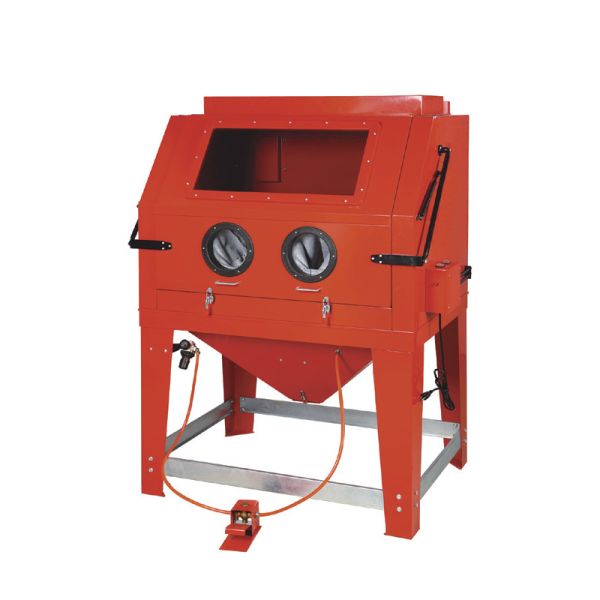
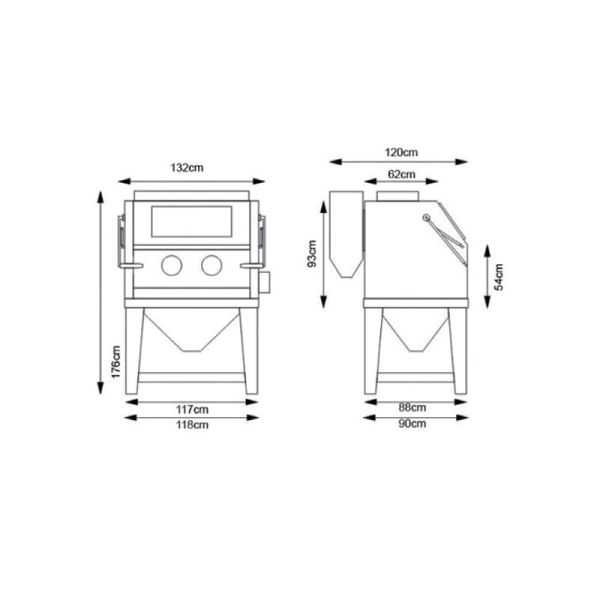
YD45-001 Industrial-Quality Pistol-Grip Blasting Cabinet addresses the pain points of traditional blasting equipment: "uneven media distribution, low durability, and cumbersome operation". With "heavy-duty industrial construction + efficient hands-free operation + integrated safety features" as the core, it sets a new standard for industrial surface treatment, and its key advantages are as follows:
- Reinforced Frame & Panels: The cabinet uses 12-gauge steel legs (thicker than 16-gauge industry averages) and 16-gauge steel panels, ensuring stability even during high-pressure (125 PSI) continuous blasting. The power-coated finish (inside and out) resists corrosion from abrasive media and workshop humidity, extending the cabinet’s service life to 15+ years – 2x longer than standard uncoated cabinets.
- Functional Flooring System: Perforated steel flooring supports heavy workpieces (up to 200kg) without bending, while the integrated separating screen sorts usable abrasive media from debris. The clean-out door allows easy removal of waste, reducing media waste by 30% and cutting down on maintenance time.
- Pistol-Grip Gun + Foot-Pedal Control: The foot-pedal activates the blasting process, freeing both hands to maneuver the pistol-grip gun or adjust workpieces. This design improves blasting precision (e.g., targeting small rust spots on automotive parts) and reduces operator fatigue – critical for long-duration tasks like batch processing of metal components.
- Heavy-Duty Foot Valve: The foot valve features a heavy steel housing and brass flow valve, built to withstand industrial wear. Unlike plastic valves that crack after 1,000 cycles, this valve operates smoothly for 10,000+ cycles, minimizing downtime for replacements.
- No-Suction Media Metering: Eliminating traditional suction tubes/hoses, the integrated media metering valve delivers uniform media flow to the blasting gun. This prevents clogs and ensures consistent surface treatment – a key advantage when preparing workpieces for painting or coating (avoids uneven roughness).
- Adjustable Pressure Regulator: The air regulator + gauge panel allows precise pressure adjustment (90-125 PSI) for different media and tasks. For example, use 90 PSI for delicate glass bead blasting on aluminum parts, and 125 PSI for heavy steel grit rust removal on truck frames – one cabinet handles multiple applications.
- Protective Gloves & Enclosed Design: Natural rubber/vinyl blast gloves shield hands from abrasive media and dust, while the enclosed cabinet contains debris (no workplace contamination). This meets OSHA safety standards for industrial blasting operations.
- External Fluorescent Lighting: The bright external fluorescent system illuminates the cabinet interior, allowing operators to see fine details (e.g., small paint chips) during blasting. This reduces rework rates and ensures high-quality surface finish.
Scenario Requirement: An auto repair shop needs to remove rust from 10 truck frame sections (each 120×80cm, rust thickness 0.8mm) for repainting. The shop requires efficient, uniform blasting and compliance with safety standards.
Operation Process:
- Prep & Setup: Secure the truck frame section inside YD45-001, connect the cabinet to an industrial air compressor (set pressure to 125 PSI), put on the blast gloves, and turn on the fluorescent lighting;
2. Blasting Operation: Activate the foot pedal to start the pistol-grip gun, move the gun evenly over the rusted area – the frame’s rust is completely removed in 12 minutes per section;
3. Media Recycling: After each frame, open the clean-out door to remove debris; 98% of steel grit is recycled for reuse;
4. Completion: 10 frames processed in 2 hours; all surfaces meet painting prep standards (Ra 1.6μm).
Effect: High pressure handles heavy rust; foot-pedal operation saves labor; media recycling cuts costs.
Scenario Requirement: A metalworking factory needs to finish 50 aluminum parts (each 30×20cm) with glass bead blasting (to achieve a matte finish). The factory requires gentle, consistent blasting to avoid part damage.
Operation Process:
- Pressure Adjustment: Set the air regulator to 90 PSI, load glass beads into the cabinet’s media hopper;
2. Batch Blasting: Place 2 aluminum parts inside the cabinet at a time, use the pistol-grip gun (controlled by foot pedal) to blast each part for 3 minutes – the matte finish is uniform across all parts;
3. Efficiency: The hands-free design allows operators to prepare the next set of parts while blasting, completing 50 parts in 4 hours.
Effect: Low-pressure setting protects aluminum parts; uniform media flow ensures consistent finish; high production rate meets batch needs.
Scenario Requirement: A manufacturing plant needs to strip old paint from a 130×90cm industrial machine cover (paint thickness 0.3mm) before applying new heat-resistant paint. The cover is heavy (150kg) and requires stable cabinet support.
Operation Process:
- Workpiece Placement: Use a forklift to place the machine cover on the cabinet’s perforated steel flooring (supports 150kg easily);
2. Blasting Setup: Set pressure to 110 PSI, use steel grit as media;
3. Paint Stripping: Activate the foot pedal, manoeuvre the pistol-grip gun to strip paint – the entire cover is stripped in 18 minutes; no damage to the machine cover’s steel surface;
4. Cleanup: Open the clean-out door to remove paint chips; recycled steel grit is ready for future use.
Effect: Reinforced flooring supports heavy parts; precise pressure removes paint without surface damage; enclosed design keeps the plant clean.
A1: Clogging is usually caused by wet or oversized media. Solutions: 1) Check Media Quality: Ensure media is dry (moisture causes clumping) and within the recommended size range (avoid particles larger than 5mm for the separating screen); 2) Clean the Valve: Turn off the air supply, remove the media metering valve, and flush it with compressed air (100 PSI) to clear clogs; 3) Regular Maintenance: Clean the valve and separating screen weekly (for daily use) to prevent debris buildup. These steps restore smooth media flow.
A2: It is not recommended to use sand or plastic pellets: 1) Sand Risk: Sand contains silica, which produces harmful dust when blasted – this violates respiratory safety standards and can damage the cabinet’s internal components; 2) Plastic Pellets: Plastic is too light and soft to achieve effective rust removal or paint stripping; it also melts under high-pressure air, clogging the metering valve. Stick to recommended media (steel grit, aluminum oxide, glass beads) to ensure safety and performance.
A3: Unresponsiveness typically stems from valve wear or debris. Fixes: 1) Inspect the Brass Flow Valve: Disassemble the foot pedal housing, check if the brass valve is worn or blocked by debris – replace the valve if worn (use original parts for compatibility); 2) Lubricate Moving Parts: Apply industrial-grade lubricating oil to the foot pedal’s hinge and valve stem (avoid excessive oil that attracts dust); 3) Test Pressure: Ensure air pressure is within 90-125 PSI – low pressure can make the pedal feel unresponsive. Regular lubrication (monthly) extends the pedal’s life.
A4: Preserve the power coating with these steps: 1) Clean After Use: Wipe the cabinet exterior with a dry cloth to remove dust and media residue – avoid abrasive cleaners (e.g., steel wool) that scratch the coating; 2) Touch Up Chips: If the coating chips (from heavy impacts), use matching power-coat touch-up paint (available from the manufacturer) to cover exposed steel – this prevents rust from forming; 3) Humidity Control: Store the cabinet in a dry, well-ventilated area (avoid outdoor or unheated workshops in winter) – high humidity accelerates coating degradation. Following these steps maintains the coating for 10+ years.