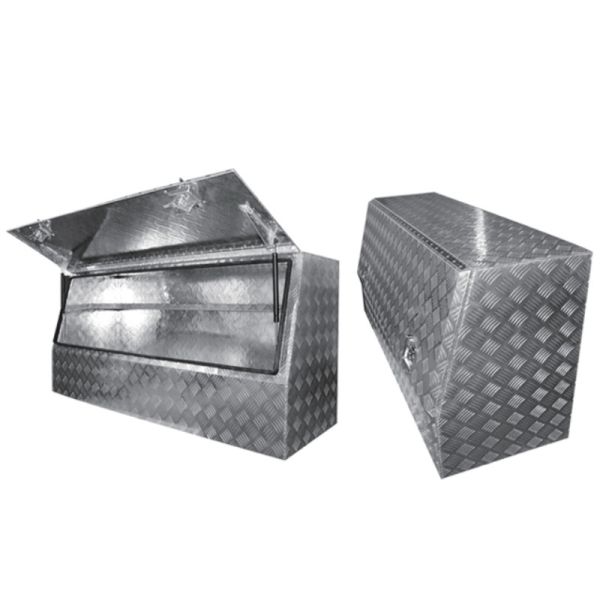
Centered on "heavy-duty load-bearing + industrial-grade protection", the YD33-004 1-Ton Load-Bearing Aluminum Alloy Tool Box is optimized for durability and safety needs in heavy-duty storage scenarios, with core advantages as follows:
- Adopting 6061 aluminum alloy (ordinary tool boxes are mostly made of Q235 steel or thin aluminum alloy), the 2.5mm thickness has a tensile strength of 276MPa, which can bear 1-ton internal storage weight (e.g., storing 5 heavy pneumatic wrenches of 50kg each + 300kg mechanical parts, with no box deformation);
- Excellent impact resistance: In a 1.5m drop test (box loaded with 50kg weight), there is no panel depression or weld cracking (ordinary thin aluminum alloy tool boxes are prone to severe deformation in the same test), making it suitable for high-frequency handling scenarios such as workshops and engineering sites.
- Although it is a 1-ton load-bearing tool box, the aluminum alloy material is 40% lighter than a steel tool box with the same load-bearing capacity (net weight 25.5kg, can be carried by 2 people), avoiding the problem of "heavy-duty = immovable", and adapting to multi-station turnover needs at engineering sites;
- The surface is treated with anodization (coating thickness 15-20μm), which is scratch-resistant and fingerprint-resistant. There are no obvious scratches on the surface when contacting tools or equipment during daily use, maintaining a metallic appearance for a long time.
- Equipped with 2 T-type key locks (ordinary tool boxes mostly have 1 lock), with brass lock core + stainless steel lock catch (5mm thick lock catch). The anti-pry performance is 200% higher than that of single-lock design, and the key interchange rate is ≤0.05% (only 5 out of 10,000 products may have universal keys), suitable for storing valuable heavy tools;
- The lock has an overall sealed design (IP65 grade), even when used in humid workshops or outdoor rainy days, the lock core is rust-free and unlocks smoothly, with a service life of ≥8 years, solving the pain points of "easy rust and poor anti-theft performance of ordinary locks".
- A full-circumference EPDM rubber seal ring is embedded in the edge of the box. After closing, the protection class reaches IP65 (completely dustproof, can withstand low-pressure water spraying without leakage). When used in dusty workshops (such as machinery factories) or outdoor engineering sites, the tools inside are free from dust and moisture (e.g., precision parts stored inside have no rust for 3 months);
- The seal ring has a temperature resistance range of -40-120℃, with no aging or cracking in cold northern or hot southern environments. The sealing performance is stable for a long time, avoiding the problem of "hardening at low temperature and deformation at high temperature" of ordinary rubber seal rings.
- Equipped with 2 heavy-duty gas struts (80kg load-bearing each), which support the lid synchronously after opening (locked at 95° angle). Even if one side gas strut fails temporarily, the other side can still support, with no risk of lid falling (ordinary single-gas-strut tool boxes are prone to safety accidents due to single-strut failure);
- The service life of the gas struts is more than 15,000 cycles (calculated based on 5 openings/closing times per day, can be used for 8 years), far exceeding the industry average standard of 8,000 cycles, adapting to industrial-grade high-frequency use needs.
- When closing, the dual gas struts descend synchronously (descending speed 3cm/s), avoiding the noise caused by "free fall" closing of ordinary tool boxes (closing noise ≤45 decibels, far lower than workshop environmental noise). At the same time, it prevents damage to heavy tools inside the box (such as precision gears and sensors) due to rapid collision;
- It is labor-saving when opening (opening force ≤30N, can be opened by women in cooperation), no need to use additional tools to pry. Compared with traditional heavy-duty tool boxes without gas struts, the opening/closing efficiency is increased by 80%.
Scenario Requirement: A machinery factory needs to store 8 heavy pneumatic wrenches (50kg each), 4 sets of large bearings (80kg each), and 2 small testing equipment (30kg each). The tool box is required to have strong load-bearing, waterproof and dustproof (coolant splashes in the workshop), and anti-theft (to avoid tool loss).
Operation Process:
- Classified Tool Storage:
- Lower Layer Inside the Box: Place 8 pneumatic wrenches (total weight 400kg) according to usage frequency; middle layer: place 4 sets of bearings (total weight 320kg); upper layer: place testing equipment (total weight 60kg) separated by partitions. Total weight: 780kg (not exceeding the 1-ton limit);
- Temporary Top Placement: Place a 150kg accessory box on the top during maintenance for easy access;
2. Protection and Safety:
- Waterproof and Dustproof: IP65 sealing prevents coolant from seeping in when coolant splashes in the workshop, and tools inside are free from moisture and rust;
- Anti-Theft Lock: Lock the 2 T-type locks before closing every day, reducing the tool loss rate from 3 times per month to 0;
3. Maintenance Convenience: Check the gas strut bolts monthly (no looseness), and drop lubricating oil into the lock core every quarter, with no faults after 1 year of use.
Result: Tools change from "scattered at workstations" to "centralized management". The time for taking tools is reduced from 10 minutes to 2 minutes, and workshop tidiness is improved by 50%. The box has no deformation after 2 years of use, fully adapting to the needs of heavy-duty repair scenarios.
Scenario Requirement: A construction site needs to store 2 small hydraulic pumps (80kg each), 50 meters of high-pressure oil pipes (total weight 120kg), and 3 sets of maintenance tools (total weight 150kg). The tool box is required to be movable (multi-station turnover), waterproof (used in outdoor rainy days), and have strong load-bearing.
Operation Process:
- Accessory Loading:
- Inside the Box: Place hydraulic pumps in the lower layer (total weight 160kg); roll high-pressure oil pipes into bundles and place in the middle layer (total weight 120kg); place maintenance tools in storage boxes in the upper layer (total weight 150kg). Total weight: 430kg;
- Mobile Turnover: 2 people cooperate to move the tool box from the equipment area to the maintenance area (25.5kg net weight is relatively convenient), avoiding multiple handling losses of accessories;
2. Outdoor Protection:
- Rainy Day Use: IP65 sealing prevents rainwater leakage, accessories inside are free from moisture, and hydraulic pumps can be used immediately after power-on;
- Scratch Prevention: The anodized surface has no obvious scratches when contacting construction materials (such as steel bars), and the appearance remains intact;
3. Opening/Closing Safety: Supported by dual gas struts, the lid has no shaking when opened in outdoor windy environments, and there is no need to worry about falling when taking accessories.
Result: The turnover efficiency of accessories at the engineering site is increased by 70%, maintenance is not delayed on rainy days, and the accessory loss rate is reduced from 2 times per month to 0, adapting to complex outdoor use environments.
Scenario Requirement: An automobile manufacturing workshop needs to store 6 robot maintenance tools (60kg each), 2 sets of precision sensors (total weight 40kg), and 1 small calibration equipment (50kg). The tool box is required to have strong load-bearing, dustproof (metal dust in the workshop), and lockable (to avoid unauthorized use).
Operation Process:
- Tool Management:
- Inside the Box: Place robot maintenance tools in the lower layer (total weight 360kg); place sensors in shockproof boxes in the middle layer (total weight 40kg); place calibration equipment in the upper layer (total weight 50kg). Total weight: 450kg;
- Lock Authorization: Only authorized maintenance personnel hold keys to avoid incorrect operation of tools by non-professionals;
2. Dustproof and Durability:
- Metal Dust Protection: IP65 sealing isolates dust, sensors are free from dust interference, and calibration accuracy remains stable;
- Long-Term Use: The workshop opens and closes it 3 times a day. After 1 year of use, the gas struts are still smooth, the box has no deformation, and the locks are rust-free;
3. Space Utilization: The 1445mm width can be placed next to workshop equipment without occupying core operating space, improving the rationality of workshop layout.
Result: Tool management is standardized, maintenance efficiency is increased by 60%, and the sensor calibration cycle is extended by 30%, fully meeting the long-term storage needs of heavy tools in factory workshops.
A1: It is mostly caused by uneven force on the gas struts or loose bolts. Troubleshoot step by step:
- Check Bolt Tightness: Loose connection bolts between the gas strut and the box/lid will cause deviation of the support point — use a 12mm wrench to tighten the upper and lower connection bolts of the gas struts on both sides respectively (ensure consistent torque to avoid one side being too tight), and re-open the lid to test if it is balanced;
- Confirm Gas Strut Status: If the bolts are not loose, one side gas strut may have internal seal failure (such as a "hissing" air leakage sound) — contact the merchant to replace the heavy-duty gas struts of the same model (80kg load-bearing each). After replacement, ensure that the gas struts on both sides work synchronously;
- Avoid Unilateral Overload Opening: If heavy objects are placed on one side of the lid (e.g., tools are placed only on one side), it will cause uneven force on the gas struts — remove the heavy objects on the lid before opening to ensure no additional load on the lid.
A2: It is mostly caused by local damage to the surface anodized layer. Handle and prevent accordingly:
- Spot Treatment: Gently polish the oxidation spots with fine sandpaper (800 mesh) (avoid scratching the surrounding coating) until the metal color is exposed. Then spray and cover with aluminum alloy-specific anti-oxidant (the merchant can provide matching products), and let it dry for 4 hours;
- Find the Cause of Damage: Check if there are hard object impact marks at the spot (such as coating peeling caused by tool or equipment collision) or long-term contact with acidic liquids (such as rain mixed with industrial pollutants) — when using outdoors, avoid the box contacting corrosive substances, and regularly wipe the surface with clean water;
- Preventive Maintenance: Apply a thin layer of aluminum alloy maintenance wax (food-grade, non-corrosive) on the box surface every quarter to enhance anti-oxidation ability and extend the appearance retention time.
A3: "Special load-bearing partitions + anti-slip pads" are recommended to ensure layered safety without modifying the box:
- Special Load-Bearing Partitions: Contact the merchant to purchase suitable aluminum alloy load-bearing partitions (size 1445×500mm, thickness 1.5mm, single partition load-bearing 300kg). 1-2 layers can be installed inside the box. The partitions are fixed to the reserved holes on the inner wall of the box with buckles (no drilling required). Place light tools in the upper layer and heavy tools in the lower layer;
- Anti-Slip Pad Paving: Lay rubber anti-slip pads (thickness 5mm, friction coefficient 0.9) on the partition surface and box bottom to avoid tool sliding causing local overload (e.g., heavy wrenches shift during handling, focusing pressure on the partition);
- Weight Distribution Principle: Follow the principle of "heavy at the bottom and light at the top" when storing in layers. The lower layer load-bearing shall not exceed 600kg, and the upper layer shall not exceed 400kg to avoid the risk of the box tipping due to upward center of gravity.
A4: It can pass through a standard industrial door without disassembly. Pay attention to the tilt angle and cooperative coordination:
- Size Adaptation Calculation: The box width is 1445mm, and the industrial door width is 900mm, but the box depth is only 500mm. Tilt the box to a 60° angle with the ground (push along the door diagonal in the width direction). At this time, the horizontal projection width is about 1250mm (the height of industrial doors is mostly 2100mm, which meets the tilt height requirement);
- Passing Method: With the cooperation of 2 people, one person holds the top of the box in front, and the other pushes the bottom of the box behind. Slowly tilt and push the box into the door (avoid colliding with the door frame). During the pushing process, ensure the lid is closed (to prevent internal tools from shifting);
- Special Cases: If the workshop door has a threshold (height >5cm), place a steel plate (length ≥1m) at the threshold as a transition ramp to avoid collision between the box bottom and the threshold causing deformation.