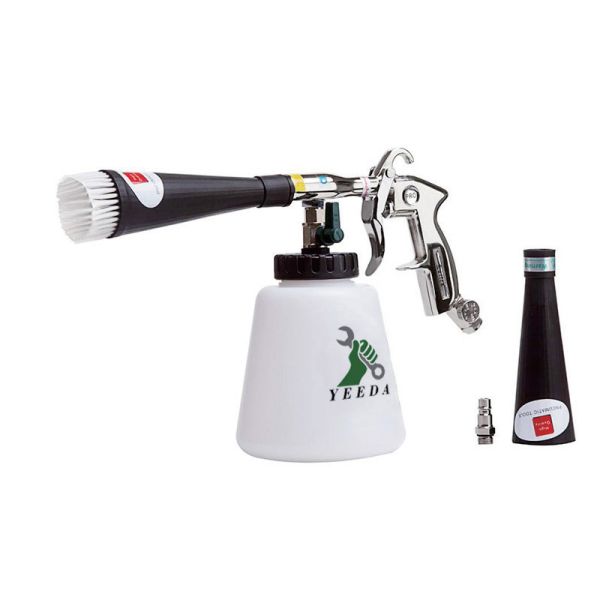
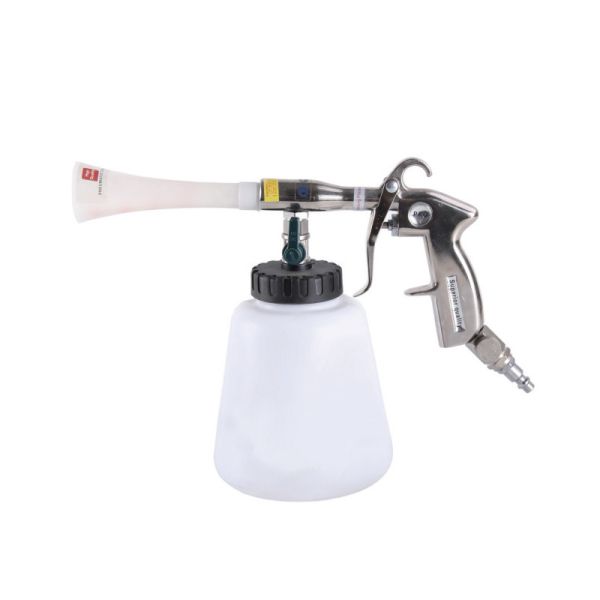
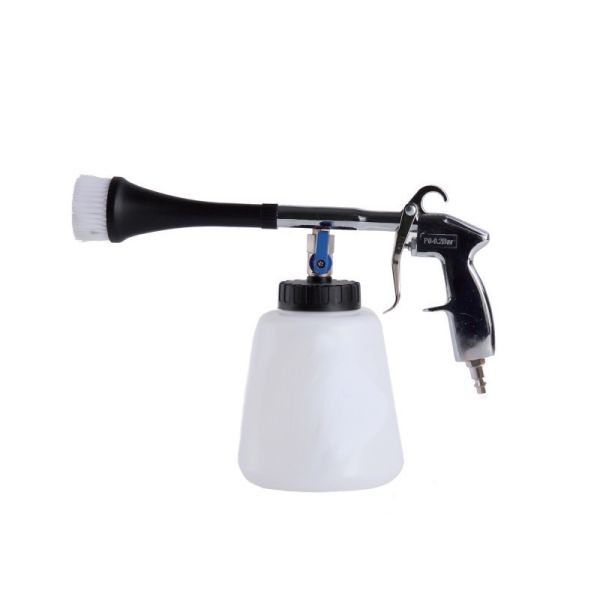
- Connect Air Source: Insert one end of the 1/4" air hose into the air compressor (displacement ≥0.3m³/min) and the other end into the cleaning gun air inlet until a "click" sound is heard (locked);
2. Add Cleaner: Open the liquid tank lid, pour diluted cleaner (no more than 1L capacity, 1:10 dilution for foam type), and tighten the tank lid;
#### (2) Model-Specific Operation
- YD32-017:
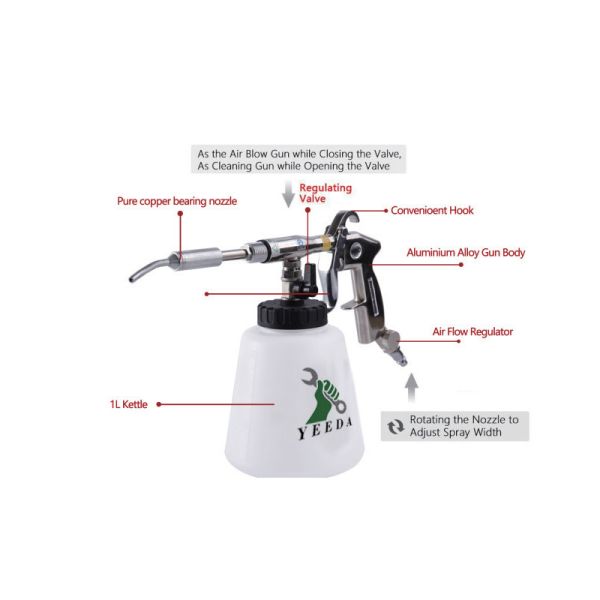
1. Foam Cleaning: Open the valve, rotate the nozzle to adjust spray width, aim at interior gaps (e.g., seat gaps, instrument panel) and press the trigger to spray foam;
2. Air Blowing Drying: Close the valve, switch to air blowing mode, and dry residual foam and moisture;
- YD32-018:
1. Pulse Rotation: Open the pulse valve, install the horn head, aim at large-area stains (e.g., door panels) and press the trigger, rotate the nozzle to expand the cleaning range;
2. Normal Cleaning: Close the pulse valve, directly use the nozzle for targeted cleaning of stubborn stains;
- YD32-019:
1. High-Pressure Water Jet: Rotate the water flow knob to fine water jet, aim at oil stains (e.g., engine compartment oil stains) and press the trigger to rinse;
2. Wide Water Spray: Adjust to wide mode for cleaning large areas such as walls and floors|
All three cleaning guns are centered on "multi-function integration + scenario-based cleaning", optimized for different cleaning needs with core advantages as follows:
- Fine Foam with No Residue: The built-in foam generator converts diluted cleaner into 0.5-1mm fine foam, which penetrates into areas hard to reach by traditional tools (e.g., seat gaps, instrument panel grooves). After absorbing dust and oil stains, it can be wiped clean with a rag, avoiding cleaner residue that corrodes interiors;
- Air Blowing Saves Time: When the valve is closed, it automatically switches to air blowing mode (airflow speed ≥80m/s), which can quickly dry residual foam and moisture (e.g., door interior panels after cleaning can be dried in 30 seconds), eliminating the need to wait for natural drying and improving cleaning efficiency by 50%.
- Rotatable Width Adjustment: The copper bearing nozzle can rotate 360°, with adjustable spray width of 5-15cm (narrow width for gaps, wide width for large-area interiors). Compared with fixed nozzles, cleaning flexibility is increased by 40%;
- 1L Large-Capacity Tank: One refill can clean the interiors of 2 family cars (including seats, instrument panels, and doors) without frequent refilling. The high-transparency design allows real-time observation of foam solution level, avoiding "dry spraying" that damages the nozzle.
- Pulse Mode for Strong Stain Removal: Equipped with a built-in pulse control valve, the nozzle rotates at 1500 rpm when activated, forming pulsed airflow + cleaner spray. The cleaning range is doubled compared to traditional cleaning guns (e.g., 1㎡ door panel can be cleaned in 1 minute). The rotating impact can loosen stubborn stains (e.g., long-term accumulated interior oil stains), reducing manual wiping effort;
- Dual Horn Heads for Multi-Scenarios: Equipped with 2 engineering plastic horn heads of different calibers (5cm/8cm diameter). The small caliber is suitable for narrow gaps (e.g., seat rails), and the large caliber for large areas (e.g., car roof), no need for additional tool replacement.
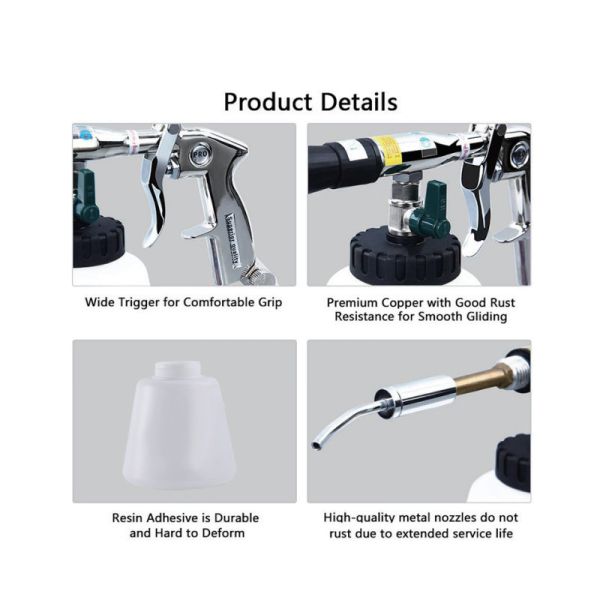
- The aluminum alloy gun body weighs only 550g (about the weight of a bottle of mineral water), paired with a wide anti-slip trigger (contact area ≥5cm²), causing no hand soreness even after 1 hour of continuous cleaning;
- The center of gravity of the gun body is concentrated in the middle, with no "top-heavy" deviation during rotational cleaning. Even when cleaning high areas such as the car roof, stable control is maintained.
- 1.5mm Fine Water Jet: The metal nozzle has an aperture of only 1.5mm, forming a high-pressure water jet (range ≥1.5m) under 90 PSi pressure, which can remove stubborn stains such as engine compartment oil stains and wheel brake dust (one wheel oil stain can be rinsed clean in 10 seconds). Compared with ordinary low-pressure cleaning guns, efficiency is tripled;
- Adjustable Water Flow for Wide Adaptation: Rotate the water flow knob to switch between fine water jet (strong stain removal) and wide water curtain (large-area cleaning). The fine water jet is used for mechanical part oil stains, and the wide water curtain for wall and floor cleaning—one gun replaces two.
- The nozzle adopts brass + chrome plating process (rust protection grade IP54), with no rust even after long-term contact with water and cleaners (ordinary plastic nozzles age in 3 months, while this product can be used for more than 2 years);
- The nozzle has a built-in anti-clog filter (100-mesh) that filters impurities in the cleaner, avoiding pressure drop caused by clogging and ensuring long-term stable use.
Scenario Requirement: A car beauty shop provides "full-car detailed cleaning" for 5 family cars (including interior gap cleaning, exterior wheel cleaning, and engine compartment oil removal). YD32-017 (interior), YD32-018 (large-area interior), and YD32-019 (exterior + engine compartment) are used, matching a 0.5m³/min air compressor, with cleaner diluted at 1:10.
Operation Process:
- Interior Cleaning (YD32-017 + YD32-018):
- YD32-018: Install the large horn head, use pulse mode to clean door panels and car roof (20 minutes per car);
- YD32-017: Use foam mode to clean seat gaps and instrument panel grooves (15 minutes per car), and air blowing mode to dry moisture (5 minutes per car);
2. Exterior & Engine Compartment (YD32-019):
- Fine Water Jet Mode: Rinse engine compartment oil stains and wheel brake dust (20 minutes per car);
- Wide Mode: Clean the car body surface (10 minutes per car);
3. Final Inspection: Wipe residual moisture with a rag and check for no stains in gaps (5 minutes per car).
Result: Detailed cleaning of 5 cars is completed in only 4 hours (6 hours with traditional tools). No dust remains in interior gaps, and the engine compartment oil removal rate reaches 98%. Customers feedback that "the cleaning is more meticulous than before, and drying is fast", with satisfaction increasing from 92% to 98%.
Scenario Requirement: A machinery factory maintains 10 assembly line motors (including exterior dust cleaning and bearing oil stain removal). YD32-018 (dust cleaning) and YD32-019 (oil stain removal) are used, with the air compressor output pressure of 90 PSi and industrial degreaser diluted at 1:8.
Operation Process:
- Dust Cleaning (YD32-018):
- Install the small horn head, use pulse mode to clean motor exterior dust and heat sink gaps (10 minutes per motor), rotating the nozzle to expand the range with no dust residue;
2. Oil Stain Removal (YD32-019):
- Fine Water Jet Mode: Rinse motor bearing oil stains (15 minutes per motor), with concentrated water flow that does not damage internal motor parts;
3. Drying Treatment: Use YD32-018 normal mode to blow air and dry the motor surface moisture (5 minutes per motor).
Result: Maintenance of 10 motors is completed in 3 hours (5 hours with traditional brushes + low-pressure water guns). The motor heat dissipation efficiency is increased by 15% (no dust blocking heat sinks), and the bearing failure rate is reduced from 2 times per month to 1 time per quarter, with maintenance costs reduced by 40%.
Scenario Requirement: A household cleans balcony tiles (8㎡, moss + dust) and a shop glass door (10㎡, stains). YD32-019 (tile cleaning) and YD32-017 (glass cleaning) are used, matching a household 0.3m³/min air compressor, with household cleaner diluted at 1:15.
Operation Process:
- Balcony Tiles (YD32-019):
- Fine Water Jet Mode: Rinse moss (10 minutes), wide mode to clean tile surfaces (5 minutes), no water accumulation residue;
2. Glass Door Cleaning (YD32-017):
- Foam Mode: Spray glass cleaner (5 minutes), scrape clean with a squeegee, and air blowing mode to dry water stains (3 minutes);
3. Storage: Empty the liquid tank, wipe the gun body, and store in the tool cabinet (compact size, no space occupation).
Result: Household cleaning is completed in 1 hour (2.5 hours with traditional mops + rags). No moss remains on tiles, and no water marks on the glass door. Cleaning efficiency is increased by 60%, with no need to bend over and wipe hard—labor-saving and efficient.
A1: It is mostly caused by improper cleaner dilution or insufficient air source. Troubleshoot step by step:
- Adjust Dilution Ratio: Foam-type cleaner needs to be diluted at 1:10 (1 part cleaner + 10 parts water). Over-concentration causes thick foam that is hard to spray, while over-dilution causes little foam—re-dilute, pour into the liquid tank, shake well, and retest;
2. Check Air Compressor Flow: If the air compressor displacement is <0.3m³/min (e.g., small household air compressors), the foam generator cannot fully mix gas and liquid—replace with an air compressor of ≥0.3m³/min, or use "intermittent spraying" (10s spraying + 5s pause) to avoid insufficient flow;
3. Clean the Foam Generator: Clogging of the generator (e.g., dried residual cleaner) causes little foam—remove the liquid tank, rinse the generator filter (100-mesh) with clean water, dry, and reinstall.
A2: Slight noise is normal. Abnormal noise is mostly caused by improper installation or part wear, which can be handled accordingly:
- Normal Noise Range: During pulse rotation, the high-speed rotating nozzle produces 60-70 decibels of noise (similar to a household hair dryer), which is normal working sound and requires no handling;
2. Abnormal Noise Handling:
- If there is a "sharp friction sound": It is mostly due to the horn head not being installed in place—remove the horn head, re-align with the slot, and install to ensure no looseness;
- If the noise suddenly increases: Internal parts of the pulse valve may be worn—contact the merchant to replace the pulse valve accessories (accessories are cheap, and normal operation can be restored after replacement);
3. Usage Suggestion: Keep the gun body horizontal during cleaning to avoid uneven force on the nozzle due to tilting, which can reduce noise.
A3: It is mostly caused by a clogged nozzle or air leakage in the hose. Handle quickly:
- Clear Nozzle Clogging: Impurities in the cleaner can clog the 1.5mm nozzle—remove the nozzle, unclog with a thin iron wire (or rinse with clean water), check if the built-in filter is damaged (replace if damaged), and retest after reinstallation;
2. Check Hose Connection: Loose quick connectors cause air leakage and pressure drop—disconnect the connector, reinsert until a "click" sound is heard (ensure locking), and check if the connector sealing ring is deformed (replace if deformed);
3. Check Air Compressor Pressure: If the air compressor output pressure is <90 PSi, the water jet pressure will be insufficient—adjust the air compressor pressure to 90 PSi (via the air compressor pressure valve) and ensure stable pressure before use.
A4: A 0.25m³/min air compressor is only suitable for small-area emergencies. ≥0.3m³/min is recommended for large-area/high-demand scenarios:
- Small-Area Emergencies (e.g., 1㎡ interior cleaning, single wheel cleaning): Can be used temporarily, but "intermittent operation" (10s spraying + 5s pause) is required to avoid air compressor overload and pressure drop. The single cleaning area should not exceed 2㎡;
2. Large-Area/High-Demand Scenarios (e.g., full-car cleaning, mechanical maintenance): Must replace with an air compressor of ≥0.3m³/min. Otherwise, problems such as "little foam (YD32-017), weak pulse rotation (YD32-018), and insufficient water jet pressure (YD32-019)" will occur, affecting cleaning effects;
3. Adaptation Suggestion: Choose a 0.3m³/min portable air compressor for households (small size, easy storage), and an air compressor of ≥0.5m³/min for commercial use (e.g., beauty shops) to ensure cleaning efficiency and effects.