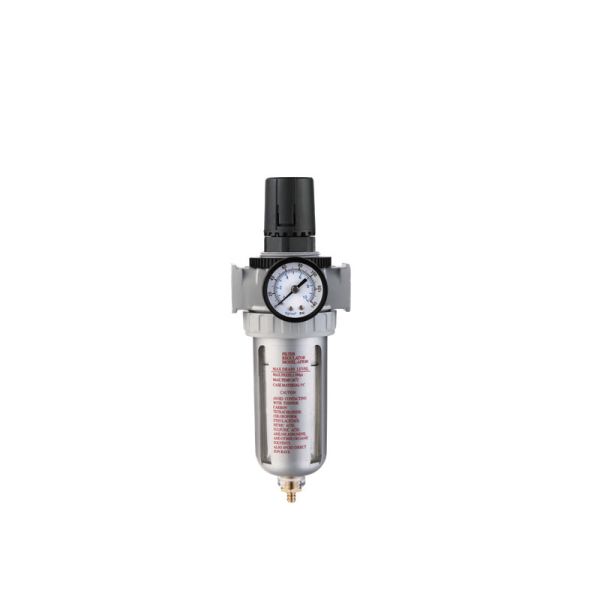
Centered on "efficient purification + precise pressure stabilization", the YD32-015 Pneumatic Dual Unit is optimized for the core needs of front-end protection of pneumatic systems, with core advantages as follows:
Moisture, oil, and dust in compressed air are the main "sources of wear" for pneumatic equipment — moisture causes rust on cylinder inner walls and jamming of solenoid valves; oil (residual from air compressor lubricating oil) contaminates sprayed workpieces and clogs spray gun nozzles; dust wears internal parts of pneumatic tools (e.g., gears of pneumatic wrenches).
The 40μm polyester fiber filter element of YD32-015 can realize:
- Liquid Impurity Filtration: Intercept water droplets and oil droplets ≥40μm (e.g., air compressor condensed water, lubricating oil mist) with a filtration efficiency of 98%, preventing moisture from entering the cylinder and causing seal aging (extending service life by 2 times), and avoiding oil contamination of sprayed paint surfaces (reducing rework rate);
- Solid Impurity Interception: Block dust and metal debris ≥40μm (e.g., impurities from aging air compressor pipelines), preventing clogging of pneumatic tool nozzles (e.g., 6mm nozzle of sandblast guns) and wear of cylinder pistons (reducing equipment failure rate by 30%).
- Float-Type Automatic Drain Valve: The automatic drain valve at the bottom of the filter cup triggers the valve to open when water accumulates to 1/3 volume (the float rises), draining water automatically without manual monitoring (especially suitable for unattended workshop production lines). In low-temperature environments (<5℃), a heating jacket (optional accessory) can be installed to prevent water from freezing and blocking the drainage channel;
- High-Transparency Filter Cup: The transparent PC cup allows real-time observation of water level and filter element contamination. When obvious impurities adhere to the filter element surface, reverse blowing with compressed air can restore filtration capacity (no need to replace the filter element, saving approximately 200 yuan in filter element costs per year).
Different pneumatic equipment has significant differences in pressure requirements: pneumatic screwdrivers require 40-60 PSi, pneumatic wrenches require 80-100 PSi, and small cylinders require 10-30 PSi — the 10-120 PSi wide pressure regulation range of YD32-015 can fully cover these needs, eliminating the need to equip multiple regulators for different equipment:
- Low-Pressure Adaptation: 10-30 PSi low-pressure output is suitable for small precision pneumatic equipment (e.g., pneumatic engraving pens, micro cylinders), avoiding high-pressure damage to precision components (e.g., plastic gears);
- High-Pressure Stability: 80-120 PSi high-pressure output is suitable for high-load equipment (e.g., pneumatic sandblast guns, high-torque wrenches), with an output pressure fluctuation of ≤±2 PSi (e.g., when set to 80 PSi, the actual output is 78-82 PSi), ensuring stable torque of pneumatic wrenches and uniform sandblasting of sandblast guns.
- Shock-Proof Pressure Gauge: Adopts an oil-filled shock-proof structure. Under workshop vibration environments (e.g., machine operation, production line work), the pointer has no obvious jitter, and the reading precision reaches ±1.5% (±2.5% for ordinary pressure gauges), avoiding pressure setting errors caused by inaccurate pressure gauges (e.g., poor atomization due to insufficient spray gun pressure);
- Labor-Saving Pressure Regulation Knob: The knob adopts an anti-slip texture design with moderate rotation resistance (5 PSi pressure adjustment per full rotation), making fine adjustment convenient. Beginners can master pressure regulation operation in 5 minutes by referring to the manual, no professional training required.
Three common interfaces (G1/4", G3/8", G1/2") are provided, which can be directly connected to air compressors and pneumatic equipment of different specifications:
- Small household air compressors (mostly G1/4" interfaces) and industrial-grade air compressors (mostly G3/8"/G1/2" interfaces) can be directly connected without additional adapters (reducing air leakage risks);
- The interface thread precision meets ISO 228 (British pipe thread), compatible with most pneumatic accessories on the market. There is no need to replace the dual unit when replacing equipment, reducing equipment upgrade costs.
- Wall-Mounted Installation: A mounting bracket is included for fixing on workshop walls or tool cabinet sides, saving floor/table space (suitable for repair shops and DIY studios);
- Pipeline-Type Installation: Can be connected in series in the main pneumatic pipeline (suitable for centralized air supply systems of factory production lines). Multiple dual units can be connected in parallel to adapt to multiple pneumatic equipment, realizing "one air compressor driving multiple equipment with independent and stable pressure for each equipment".
Scenario Requirement: An electronics factory has 5 automated assembly lines (each line includes 8 cylinders and 4 pneumatic grippers). The air compressor output pressure is 120 PSi. It is necessary to stabilize the pressure at 80 PSi and remove moisture from compressed air (workshop humidity is 70%, air compressors are prone to generating condensed water) to avoid cylinder rust and gripper jamming.
Operation Process:
- Installation & Configuration: Select YD32-015 with G3/8" interface, install one unit on each production line between the air compressor and equipment, connect in series in a pipeline-type manner, and fix it on the production line bracket;
- Debugging & Operation: Turn on the air compressor, rotate the regulator knob to adjust the pressure to 80 PSi, and lock the knob; observe the filter's automatic drain valve (timely water discharge) and pressure gauge (reading stable at 80±1 PSi);
- Daily Maintenance: Check the water accumulation in the cup before work every day (no intervention required if the automatic drain valve works normally), reverse blow the filter element once a week with compressed air, and calibrate the pressure gauge once a month.
Result: The cylinder failure frequency of the assembly line is reduced from 4 times per month to 1 time per quarter, and the cylinder service life is extended from 1 year to 2.5 years. Each production line saves approximately 3,000 yuan in maintenance costs per year; the moisture content of compressed air is reduced from 0.12g/m³ to 0.01g/m³, with no cylinder rust or gripper jamming. The production line qualification rate is increased by 2%.
Scenario Requirement: An auto repair shop has 6 pneumatic tools (3 pneumatic wrenches, 2 pneumatic spray guns, 1 pneumatic sander). The air compressor output pressure is 100 PSi. It is necessary to adjust the pressure for different tools (90 PSi for wrenches, 50 PSi for spray guns, 70 PSi for sanders), and filter oil (to avoid contaminating car paint) and dust (to protect internal tool parts) from the air.
Operation Process:
- Installation & Configuration: Select YD32-015 with G1/4" interface, install it at the main air outlet of the air compressor, connect each tool through a diverter valve downstream, and fix it in a wall-mounted manner next to the maintenance station;
- Scenario-Specific Pressure Regulation: Adjust to 90 PSi when using the wrench (to ensure sufficient torque for bolt removal), 50 PSi when using the spray gun (to ensure uniform paint atomization), and 70 PSi when using the sander (to avoid excessive speed causing paint scratches);
- Maintenance & Cleaning: After each use, manually open the filter drain valve to discharge residual moisture (high usage frequency in repair shops, assisting automatic drainage), and reverse blow the filter element once every 2 weeks.
Result: The bolt removal efficiency of the pneumatic wrench is increased by 15% (no insufficient torque caused by pressure fluctuation), the spray gun sprays paint without oil spot contamination (customer satisfaction increases from 92% to 98%), the failure frequency of pneumatic tools is reduced from 2 times per month to 1 time every 2 months, and tool replacement costs are reduced by 40%.
Scenario Requirement: A DIY user uses a pneumatic nail gun (requires 60 PSi) and a small pneumatic sander (requires 40 PSi) in a home woodworking workshop, equipped with a 0.3m³/min household air compressor (output pressure 80 PSi). It is necessary to stabilize the pressure (to avoid nail gun jamming and uneven sanding marks from the sander) and filter moisture from the air (to prevent wood moisture absorption).
Operation Process:
- Installation & Configuration: Select YD32-015 with G1/4" interface, place it on the desktop (compact size, no space occupation), connect the inlet end to the air compressor, and the outlet end to the tool adapter;
- Operation & Debugging: Adjust the pressure to 60 PSi when using the nail gun (to ensure nails are fully driven into the wood); adjust to 40 PSi when using the sander (to avoid excessive sanding marks), and observe the pressure gauge to ensure stable reading;
- Simple Maintenance: After each use, manually discharge the water in the filter (low usage frequency at home, preventing bacteria growth from long-term water accumulation in the cup), and reverse blow the filter element once every 3 months.
Result: The pneumatic nail gun has no nail jamming (previously 1-2 times per week without filtration), the sander polishes the wood surface more smoothly (no uneven sanding marks caused by pressure fluctuation), the tool service life is extended from 8 months to 1.5 years, no frequent part replacement is needed, and DIY operation efficiency is increased by 30%.
A1: It is mostly caused by mismatched filtration precision or incorrect air flow direction. Troubleshoot step by step:
- Filtration Precision Check: If the downstream equipment is a precision component (e.g., small solenoid valve, micro cylinder), the 40μm filtration precision cannot intercept tiny water mist ≤40μm — a high-precision dryer (optional accessory, filtration precision ≤1μm) should be installed downstream of YD32-015, or replaced with a dual unit with drying function (e.g., YD32-015D model);
- Air Flow Direction Check: If the air flow direction is opposite to the "IN-OUT" mark, the filter cannot work normally (impurities bypass the filter element and enter the downstream) — turn off the air compressor, remove the dual unit, reinstall it according to "IN connected to air compressor, OUT connected to equipment", and ensure the air flow direction is correct;
- Ambient Humidity Handling: If the ambient humidity is >75% (e.g., rainy season in southern China), the air compressor generates more condensed water. The drainage interval should be shortened (from automatic drainage to manual drainage 1-2 times a day), and a pre-filter with 100-mesh should be installed at the air compressor outlet (to roughly filter large particle impurities).
A2: It is mostly caused by aging of the regulator diaphragm or blocked filter element. Handle accordingly:
- Diaphragm Inspection & Replacement: The sealing diaphragm (nitrile rubber material) inside the regulator loses elasticity after long-term use, causing pressure to fail to maintain — turn off the air compressor, remove the regulator top cover, replace it with an original diaphragm (accessories are cheap, it is recommended to prepare 1-2 backups), and ensure the gasket is not damaged during installation;
- Filter Element Blockage Cleaning: Blockage of the filter element causes insufficient air intake and unstable pressure — remove the filter element, blow off impurities from the reverse direction with compressed air (replace with a new filter element if it is damaged), and reinstall after cleaning;
- Air Compressor Matching Check: If the air compressor displacement is < the total air consumption of the pneumatic equipment (e.g., 0.2m³/min air compressor driving 3 pneumatic tools), it will also cause pressure drop — the air compressor should be replaced with one with larger displacement (e.g., ≥0.3m³/min), or the number of equipment used simultaneously should be reduced.
A3: It is mostly caused by blocked drain valve or stuck float. Handle quickly:
- Drain Valve Blockage Cleaning: Impurities in water (e.g., rust, dust) block the drain valve core — turn off the air compressor, remove the drain valve, unclog the valve core channel with a thin iron wire, rinse with clean water (to avoid residual impurities), and test after reinstallation;
- Float Stuck Check: The float in the cup is stuck by impurities (e.g., large dust particles) and cannot rise normally to trigger drainage — remove the filter cup, pour out accumulated water and impurities, wipe the float with a soft cloth (to avoid scratches), and test after reinstallation;
- Preventive Suggestion: Remove and clean the drain valve once a month to avoid impurity accumulation; install a 100-mesh pre-filter at the filter inlet to reduce large particle impurities entering the cup.
A4: It is fully compatible. Pay attention to interface selection and pressure setting, and use it with confidence:
- Interface Compatibility: Most small household air compressors have G1/4" interfaces, so YD32-015 with the corresponding interface can be selected (no adapter required). If the air compressor interface is of other specifications (e.g., 1/4" NPT), a dedicated adapter can be purchased (supplied by the merchant);
- Pressure Compatibility: The output pressure of household air compressors is mostly 80-100 PSi, which is fully covered by the 10-120 PSi pressure regulation range of YD32-015. It can be set according to tool needs (e.g., 60 PSi for pneumatic nail guns, 40 PSi for sanders). The ±2 PSi regulation precision can meet household scenario needs;
- Usage Suggestion: Household air compressors are used infrequently. After each use, manually discharge the water in the filter (to avoid cup rust); the filter element reverse blowing cycle can be extended to once every 6 months, no frequent maintenance required.