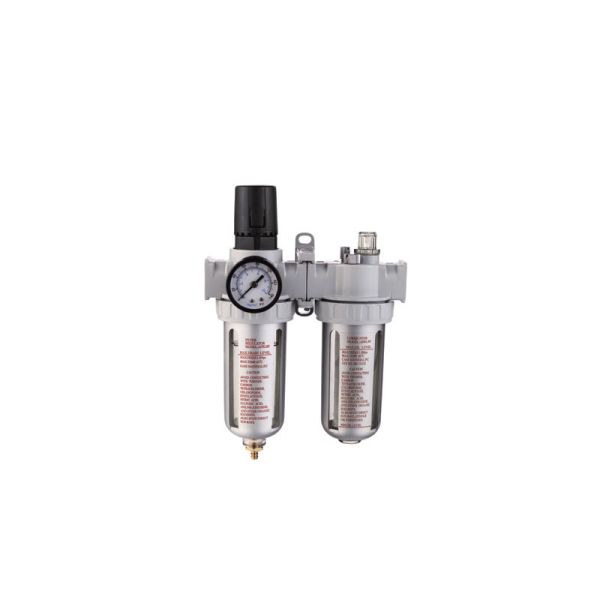
Centered on "three-in-one integration of purification + pressure stabilization + lubrication", the YD32-012 Pneumatic Triple Unit is optimized for the core needs of front-end protection of pneumatic systems, with core advantages as follows:
Moisture, oil, and dust in compressed air are the main "killers" of pneumatic components (e.g., spray gun nozzles, cylinder seals) — moisture causes component rust, dust scratches the sealing surface, and oil (residual from air compressor lubricating oil) contaminates coatings/workpieces.
The YD32-012 filter uses a 40μm polyester fiber filter element to simultaneously intercept:
- Liquid Impurities: Water droplets and oil droplets ≥40μm (e.g., condensed water discharged by air compressors) with a filtration efficiency of 98%, preventing moisture from entering the spray gun and deteriorating the coating, or entering the cylinder and causing inner wall rust;
- Solid Impurities: Dust and metal debris ≥40μm (e.g., impurities from aging air compressor pipelines), preventing blockage of spray gun nozzles and wear of cylinder pistons, extending the service life of downstream equipment by more than 3 times (compared to systems without filtration).
- Automatic Drain Valve: A float-type automatic drain valve is installed at the bottom of the filter cup. When water accumulates to 1/3 of the cup volume, the valve opens automatically for drainage, eliminating the need for frequent manual operation (especially suitable for unattended production lines). If the ambient temperature is below 5℃, a heating jacket (optional accessory) can be installed to prevent water accumulation from freezing and blocking the drain valve;
- High-Transparency Water Cup: The transparent PC water cup allows real-time observation of water accumulation and filter element contamination. When obvious impurities accumulate on the filter element surface, it can be cleaned in time (by reverse blowing with compressed air, no need to replace the filter element, reducing maintenance costs).
Different pneumatic equipment has large differences in pressure requirements: pneumatic spray guns require 45-60 PSi, pneumatic wrenches require 80-100 PSi, and small cylinders require 10-30 PSi — the 10-120 PSi wide pressure regulation range of YD32-012 can fully cover these needs, eliminating the need to equip multiple regulators for different equipment:
- Low-Pressure Adaptation: 10-30 PSi low-pressure output can be used for small pneumatic tools (e.g., pneumatic engraving pens) to avoid high-pressure damage to precision components;
- High-Pressure Stability: 80-120 PSi high-pressure output is suitable for high-pressure demand equipment such as pneumatic sandblast guns and large-diameter cylinders. The output pressure fluctuation is ≤±2 PSi (e.g., when set to 50 PSi, the actual output is between 48-52 PSi), ensuring uniform atomization of spray guns and stable operation of cylinders.
- Shock-Proof Pressure Gauge: Adopts oil-filled shock-proof design. Under workshop vibration environments (e.g., operation of production line equipment), the pointer has no obvious jitter, and the reading is accurate (precision ±1.5%), avoiding pressure setting errors caused by inaccurate pressure gauges;
- Labor-Saving Pressure Regulation Knob: The knob adopts an anti-slip texture design. Rotate clockwise to increase pressure and counterclockwise to decrease pressure. Each full rotation changes the pressure by approximately 5 PSi, making fine adjustment convenient. Beginners can also quickly set the pressure to the target value.
Long-term operation of downstream pneumatic components (e.g., cylinder pistons, spray gun valves) without lubrication will accelerate wear due to increased friction — the YD32-012 lubricator atomizes lubricating oil into 5-10μm tiny oil droplets through a Venturi tube, which are evenly attached to the friction surface of components with air flow:
- High Lubrication Efficiency: The oil mist coverage rate is over 90%, which can effectively reduce cylinder piston wear (extending service life by 2 times) and reduce the probability of spray gun valve jamming (from 1-2 times per month to 1 time per quarter);
- Oil Volume Controllable: The oil mist volume (1-5 drops per minute) can be controlled through the adjustment screw on the top of the lubricator, and adjusted according to equipment needs (e.g., spray guns require a small amount of oil mist, cylinders require a little more), avoiding lubricating oil waste.
- Multi-Interface Options: Three common interfaces (G1/4", G3/8", G1/2") are provided, which can be directly connected to small household air compressors (mostly G1/4"), industrial-grade air compressors (mostly G3/8"/G1/2"), and pneumatic equipment of different specifications, eliminating the need for additional adapters and reducing installation complexity;
- Dual Installation Methods: A wall-mounted bracket is included for fixing on the wall (saving floor space); it can also be directly installed in the pneumatic pipeline (suitable for centralized air supply systems of production lines). The horizontal design of the valve body ensures uniform atomization of the lubricator (tilted installation will cause uneven oil mist).
Scenario Requirement: An electronics factory has 10 automated assembly lines (each line includes 5 cylinders and 2 pneumatic grippers). The air compressor output pressure is 100 PSi. It is necessary to stabilize the pressure at 80 PSi, remove moisture from compressed air (workshop humidity is 60%, air compressors are prone to generating condensed water), and lubricate the cylinders to avoid frequent failures.
Operation Process:
- Installation & Configuration: Select YD32-012 with G3/8" interface, install one unit on each production line between the air compressor and pneumatic equipment, fix it in a wall-mounted manner, and fill the lubricator with #20 pneumatic special oil (96 mL);
- Debugging & Operation: Turn on the air compressor, rotate the regulator knob to adjust the pressure to 80 PSi, observe the pressure gauge (reading is stable at 80±1 PSi), and check the filter automatic drain valve (timely water discharge) and lubricator atomization (1-2 drops per minute);
- Daily Maintenance: Check the lubricator oil level before work every day (replenish oil when below 1/4), and clean the filter element once a week (by reverse blowing with compressed air).
Result: The cylinder failure frequency of the assembly line is reduced from 3 times per month to 1 time per quarter, and the cylinder service life is extended from 1 year to 2.5 years. Each production line saves approximately 2,000 yuan in maintenance costs per year. The moisture content of compressed air is reduced from 0.1g/m³ to 0.01g/m³, and there is no component rust caused by moisture.
Scenario Requirement: An auto repair shop has 5 pneumatic tools (2 pneumatic wrenches, 2 pneumatic spray guns, 1 pneumatic sander). The air compressor output pressure is 120 PSi. It is necessary to adjust the pressure for different tools (90 PSi for wrenches, 50 PSi for spray guns, 70 PSi for sanders), filter oil from the air (to avoid contaminating the car paint), and lubricate the internal components of the tools.
Operation Process:
- Installation & Configuration: Select YD32-012 with G1/4" interface, install it at the main air outlet of the air compressor, connect each tool through a diverter valve downstream, and fill the lubricator with #10 pneumatic special oil (80 mL);
- Scenario-Specific Pressure Regulation: Adjust to 90 PSi when using the pneumatic wrench (to ensure sufficient torque); adjust to 50 PSi when using the spray gun (to ensure uniform atomization); adjust to 70 PSi when using the sander (to avoid excessive speed);
- Maintenance & Cleaning: After each use, open the filter drain valve to discharge residual moisture, check the lubricator oil level once a week (replenish oil 1-2 times), and clean the filter element once a month.
Result: The torque stability of the pneumatic wrench is increased by 15% (making bolt removal easier), the spray gun sprays paint without oil spot contamination (customer satisfaction increases from 90% to 98%), the failure frequency of pneumatic tools is reduced from 2 times per month to 1 time every 2 months, and the tool maintenance cost is reduced by 40%.
Scenario Requirement: A DIY user uses a pneumatic nail gun (requires 60 PSi) and a small pneumatic sander (requires 40 PSi) in a home woodworking workshop, equipped with a 0.3m³/min household air compressor (output pressure 80 PSi). It is necessary to stabilize the pressure, filter moisture from the air (to avoid wood moisture absorption), and lubricate the internal parts of the nail gun (to extend service life).
Operation Process:
- Installation & Configuration: Select YD32-012 with G1/4" interface, install it directly at the air outlet of the air compressor, place it on the desktop (compact size, no space occupation), and fill the lubricator with #10 pneumatic special oil (50 mL);
- Operation & Debugging: Adjust to 60 PSi when using the nail gun (to ensure nails are fully driven into the wood); adjust to 40 PSi when using the sander (to avoid excessive sanding marks), and observe the pressure gauge to ensure stable pressure;
- Simple Maintenance: After each use, manually open the filter drain valve (household air compressors are used infrequently, and the automatic drain valve can be assisted by manual drainage), and check the lubricator oil level every 2 weeks (replenish oil once).
Result: The pneumatic nail gun has no nail jamming (previously 1-2 times per week without the triple unit), the sander polishes the wood surface more smoothly (no uneven sanding marks caused by pressure fluctuations), the tool service life is extended from 6 months to 1.5 years, and there is no need for frequent part replacement.
A1: It is mostly caused by mismatched filtration precision or incorrect installation direction. Troubleshoot step by step:
- Filtration Precision Check: If the downstream equipment is a precision component (e.g., small cylinder, spray gun nozzle), the 40μm filtration precision may not intercept tiny moisture (e.g., water mist ≤40μm) — a high-precision dryer (optional accessory, filtration precision ≤1μm) should be installed downstream of YD32-012, or replaced with a triple unit with drying function (e.g., YD32-012D model);
- Installation Direction Check: If the air flow direction is opposite to the "IN-OUT" mark on the valve body, the filter cannot work normally (moisture and impurities will bypass the filter element and enter the downstream) — turn off the air compressor, remove the triple unit, reinstall it according to "IN connected to air compressor, OUT connected to equipment", and ensure the air flow direction is correct;
- Ambient Humidity Handling: If the ambient humidity is >70% (e.g., rainy season in southern China), the air compressor generates more condensed water. The filter drainage interval should be shortened (from automatic drainage to manual drainage 1-2 times a day) to avoid moisture accumulation.
A2: It is mostly caused by insufficient oil volume, blocked oil passage, or low pressure. Handle accordingly:
- Check Oil Volume and Quality: When the lubricator oil level is below 1/4, the atomization component cannot absorb oil — unscrew the cup lid and add #10-#30 pneumatic special oil (do not use engine oil or gear oil instead, as it will block the oil passage); if the oil is turbid (e.g., mixed with impurities), pour out the old oil, clean the oil cup with kerosene, and add new oil;
- Unclog the Oil Passage: Blockage of the lubricator oil passage (e.g., dried lubricating oil) will cause no oil discharge — turn off the air compressor, remove the lubricator, unclog the oil passage with a thin iron wire (from the bottom of the oil cup to the atomization component), and then blow off residual impurities with compressed air;
- Check Pressure: When the pressure is below 10 PSi, the Venturi tube cannot generate enough suction to absorb oil — increase the regulator pressure to above 10 PSi (e.g., adjust to 60 PSi for pneumatic nail guns), then test the oil mist output (observe whether there is oil mist discharged from the air hole on the top of the lubricator).
A3: It is mostly caused by aging of the regulator diaphragm or blocked filter element. Handle step by step:
- Regulator Diaphragm Check: Aging of the internal diaphragm of the regulator (decreased elasticity after long-term use) will cause pressure to fail to maintain — turn off the air compressor, remove the regulator top cover, replace it with an original diaphragm (accessories are cheap, it is recommended to prepare 1-2 backups), and ensure the gasket is not damaged during installation;
- Filter Element Blockage Check: Blockage of the filter element will cause insufficient air intake and unstable pressure — remove the filter element, blow it reversely with compressed air (if the filter element is damaged, replace it with a new one), and reinstall it after cleaning;
- Air Compressor Matching Check: If the air compressor displacement is < the air consumption of the pneumatic equipment (e.g., 0.2m³/min air compressor driving 2 spray guns), it will also cause pressure drop — the air compressor should be replaced with one with larger displacement (e.g., ≥0.3m³/min), or the number of pneumatic equipment used simultaneously should be reduced.
A4: It is fully compatible. Pay attention to interface selection and pressure setting, and use it with confidence:
- Interface Compatibility: Most small household air compressors have G1/4" interfaces, so YD32-012 with the corresponding interface can be selected (no adapter required). If the air compressor interface is of other specifications (e.g., 1/4" NPT), a dedicated adapter can be purchased (supplied by the merchant);
- Pressure Compatibility: The output pressure of household air compressors is mostly 80-100 PSi, which is fully covered by the 10-120 PSi pressure regulation range of YD32-012. It can be set according to the needs of downstream tools (e.g., 60 PSi for pneumatic nail guns, 40 PSi for small sanders). The pressure regulation precision of ±2 PSi can meet the needs of household scenarios;
- Usage Suggestion: Household air compressors are used infrequently. After each use, manually discharge the water in the filter (to avoid rusting of the water cup during long-term storage). The lubricator oil volume can be filled to 1/2 capacity (to reduce oil replenishment frequency), and the filter element can be cleaned once a month.