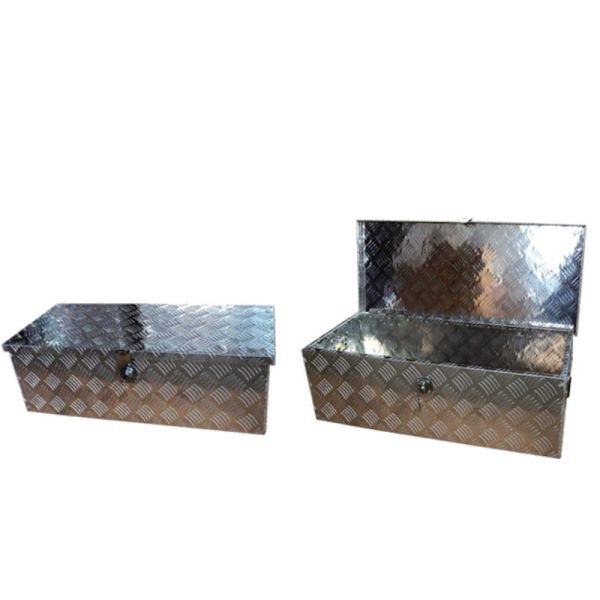
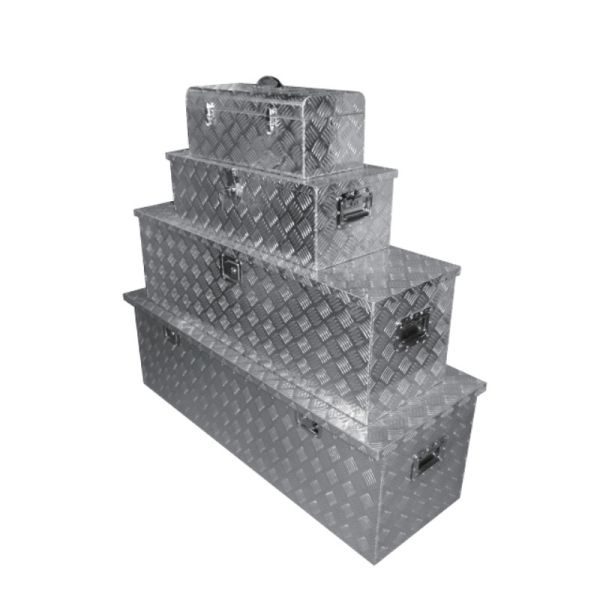
Centered on "medium capacity + durable portability", the YD33-010 Aluminum Alloy Checker Plate Tool Box is optimized for practicality and flexibility needs in small and medium-sized tool storage, with core advantages as follows:
- Adopting 3003 aluminum alloy (ordinary medium-sized tool boxes are mostly made of plastic or thin iron sheets), the 1.5mm thick box body has a compressive strength of 180MPa, which can withstand long-term storage of 15kg tools (e.g., storing 5 wrenches + 3 sets of screwdrivers + 2 parts boxes, with no box depression or deformation);
- 1m drop test (empty box): No obvious damage to the panel, no loosening of snaps and handles (ordinary plastic boxes are prone to cracking, and thin iron boxes are prone to depression in the same test), adapting to high-frequency use scenarios such as homes and workshops.
- The checker plate on the box surface has a friction coefficient of ≥0.8, so it is not easy to slide even with slight collision when placed flat (e.g., placed on a workshop workbench or car trunk, no displacement during vehicle vibration). Its safety is 60% higher than that of flat panels;
- The checker pattern can hide fine scratches during daily use (e.g., tool contact, desktop friction). The hard anodized surface prevents oil penetration, and oil stains can be wiped clean with a cloth, maintaining a neat appearance for a long time, avoiding the problems of "plastic boxes being easy to yellow and iron boxes being easy to rust".
- The hidden handles on both sides adopt a "press-to-pop" design (completely embedded in the box side when not in use, no additional space occupation). When transporting, just pop out the handles with both hands and carry stably. The grip is comfortable (plastic coating prevents hand discomfort), and one person can easily move the 6kg box (e.g., from the workshop shelf to the work station, or from the trunk to the outdoor operation site);
- The handle load-bearing reaches 15kg. Even if the box is fully loaded with 15kg tools, there is no risk of handle breakage or deformation, solving the pain point of "easy handle breakage and laborious transportation of ordinary tool boxes".
- The internal capacity of approximately 60L can hold: 6 wrenches of different specifications (total weight 3kg) + 4 sets of screwdrivers (including bits, total weight 1.5kg) + 1 multimeter (0.5kg) + 3 parts boxes (for screws and washers, total weight 2kg) + 2 rolls of insulating tape (0.2kg), fully meeting the daily tool storage needs of home maintenance and small workshops;
- Customizable partitioning is supported: Plastic divider boxes (recommended size ≤200×150×80mm) or partitions can be used to refine the internal space, avoiding mixing of tools and parts, and making it easy to find items during retrieval, reducing search time.
- Equipped with 2 cold-rolled steel galvanized snaps (ordinary tool boxes mostly use plastic snaps), with a latching force of ≥20N. Even with severe vibration (e.g., car transportation) after closing, the lid does not loosen and there is no collision noise of internal tools, solving the problem of "easy breakage and loose latching of plastic snaps";
- The snaps open and close smoothly without forceful pulling (switching force ≤8N), and can be easily operated by the elderly and women, suitable for all groups.
- A rubber seal strip is built into the edge of the box (hidden design, no impact on appearance), with a protection grade of IP54 (completely dustproof, can withstand mild water spraying without leakage). When used in humid workshops, outdoor rainy days, and dusty environments, the tools inside are free from moisture and dust accumulation (e.g., the stored multimeter has no faults for 3 months);
- It has strong low-temperature adaptability: At -20℃, the aluminum alloy does not become brittle, and the handles and snaps can still operate smoothly, adapting to the outdoor operation needs of cold northern regions.
Scenario Requirement: A family needs to store maintenance tools (6 wrenches, 4 sets of screwdrivers, 1 multimeter, 2 parts boxes, total weight 7.2kg). The tools are required to be clearly classified (to avoid scattering), portable (can be moved to the balcony/bathroom for use), and space-saving (can be placed in the storage room).
Operation Process:
- Tool Classification:
- Lower Layer Inside the Box: Place 6 wrenches (total weight 3kg) and 1 multimeter (0.5kg) by size; upper layer: place 4 sets of screwdrivers (1.5kg) and 2 parts boxes (2.2kg) with divider boxes. Total weight: 7.2kg (not exceeding the 15kg limit);
- Daily Use: When repairing water pipes, pop out the handles to move the tool box to the bathroom, open the lid to access wrenches without back-and-forth tool transportation;
2. Space Adaptation:
- Storage Placement: After use, place the tool box in the corner of the storage room (the 765×335mm size does not occupy space). The checker plate on the surface is dustproof, no additional covering is needed;
- Anti-Slip Stability: When placed on the balcony tile floor, the anti-slip pattern prevents the box from sliding, making tool retrieval safer;
3. Durability: Used 3-4 times a month, no box deformation after 6 months, snaps still close tightly, and handles have no loosening.
Result: Home tools are changed from "scattered in drawers" to "classified and orderly". The time for tool retrieval is reduced from 5 minutes to 1 minute, and the tidiness of the storage room is improved by 40%, fully adapting to home maintenance scenarios.
Scenario Requirement: A small electronic workshop needs to store equipment accessories (circuit boards, resistors and capacitors, welding tools, total weight 12kg). The accessories are required to be moisture-proof (humid workshop), portable (can be moved to the production line), and scratch-proof (to avoid accessory damage).
Operation Process:
- Accessory Storage:
- Inside the Box: Place welding tools (total weight 5kg) in the lower layer; place circuit boards, resistors and capacitors (total weight 7kg) in anti-static divider boxes in the upper layer. Total weight: 12kg;
- Moisture-Proof Protection: IP54 grade can isolate humid air in the workshop, and accessories have no oxidation or damage after 3 months of storage;
2. Transportation and Use:
- Production Line Adaptation: When equipment maintenance is needed, one person carries the tool box to the production line and opens the lid to access accessories, no need to go back and forth to the warehouse, improving maintenance efficiency by 50%;
- Scratch-Proof: The anodized layer on the box surface is scratch-proof against tools. Even if welding sparks splash on the surface, there are no obvious marks;
3. Maintenance: Wipe dust on the box surface with a dry cloth every week. After 1 year of use, there is no rust, and the snaps and handles still work smoothly.
Result: The workshop accessory management efficiency is increased by 60%, and the accessory loss rate is reduced from 3 times per month to 0, fully adapting to the high-frequency operation needs of small workshops.
Scenario Requirement: Outdoor power inspection needs to store inspection tools (electrical testers, insulating gloves, small pliers, total weight 8kg). The tool box is required to be portable (can be carried to the utility pole), waterproof (outdoor rainy days), and durable (scratch-proof from branches).
Operation Process:
- Tool Storage:
- Inside the Box: Wrap insulating gloves (total weight 1kg) in a waterproof bag; place electrical testers and pliers (total weight 7kg) in the lower layer. Total weight: 8kg;
- Waterproof Protection: IP54 grade can resist mild rain in rainy days. After inspection, the tools inside are free from moisture, and the insulating gloves perform normally;
2. Outdoor Adaptation:
- Portable Transportation: With 6kg net weight + hidden handles, inspectors can easily carry it to the utility pole without additional backpack loading;
- Scratch-Proof: The checker plate is resistant to scratches from branches. Even when moving through woods, there are no obvious scratches on the box surface;
3. Practicality: Open the lid to access tools during inspection, no need to place items on the ground, improving operation safety.
Result: Outdoor inspection efficiency is increased by 40%, inspection is not delayed on rainy days, and the tool damage rate is 0, fully adapting to complex outdoor operation environments.
A1: It is mostly caused by aging handle springs or offset snap positions. Handle step by step:
- Check Handle Springs: The reduced elasticity of the built-in handle springs (service life about 2 years) causes failure to lock after popping out — contact the merchant to obtain springs of the same model (1.2mm diameter, 25mm length), remove the plastic shell of the handle and replace, restoring the fixing effect;
- Adjust Handle Snaps: The handle snaps shift after long-term use, leading to loose fixing — use a small screwdriver to pry the snaps and fine-tune to align with the handle card slots, testing whether the handle is stable after popping out;
- Temporary Treatment: If no accessories are available temporarily, stick a layer of double-sided tape (1mm thick) at the contact between the handle and the box to increase friction and reduce shaking.
A2: It is mostly caused by offset or wear of the snaps. Repair quickly:
- Adjust Snap Positions: The snaps shift after long-term use, leading to loose latching — loosen the snap fixing screws (Phillips screwdriver), move the snaps 1-2mm toward the box, re-tighten the screws, and test the latching tightness;
- Repair Snap Wear: Wear on the snap contact surface (obvious scratches) leads to reduced latching force — gently polish the snap contact surface with sandpaper (800 mesh), remove burrs and apply a small amount of petroleum jelly to enhance latching friction;
- Replace Snaps: If the snaps are severely deformed (e.g., broken, bent), contact the merchant to purchase snaps of the same model (cold-rolled steel material), remove the old snaps and replace to ensure tight latching.
A3: "Adjustable plastic partitions + transparent parts boxes" are recommended, no box modification required:
- Adjustable Partitions: Purchase plastic partitions with a width of 335mm (matching the box depth) and height ≤150mm, fix them through the reserved card slots on both sides of the box, and adjust the partition spacing according to tool size to divide the interior into 2-3 areas;
- Transparent Parts Boxes: Choose transparent plastic parts boxes with size ≤150×100×50mm (with label slots). 4-5 boxes can be placed flat inside the box to store small parts such as screws, washers, and resistors separately for easy identification and retrieval;
- Homemade Dividers: Make size-adapted dividers with cardboard (paste waterproof tape on the surface), cut according to part size, and temporarily divide the space (suitable for users with limited budgets). Replace regularly.
A4: It can be easily placed in the trunk of most family cars and elevator cars without disassembly:
- Family Car Trunk: The trunk of most cars has a width ≥900mm, depth ≥500mm, and height ≥300mm. The 765×335×245mm tool box can be placed flat or sideways without occupying excessive space, and can be stored with other items at the same time;
- Elevator Car: The internal size of ordinary elevator cars is ≥1.1×1.4×2.2m. Whether placed flat or vertically, the tool box will not affect the normal operation of the elevator or the entry and exit of personnel;
- Adaptation Suggestion: When placing it in the trunk, a non-slip mat can be placed under the tool box (to enhance stability); when placing it in the elevator, avoid collision between the box and the elevator door or inner wall to prevent surface scratches.