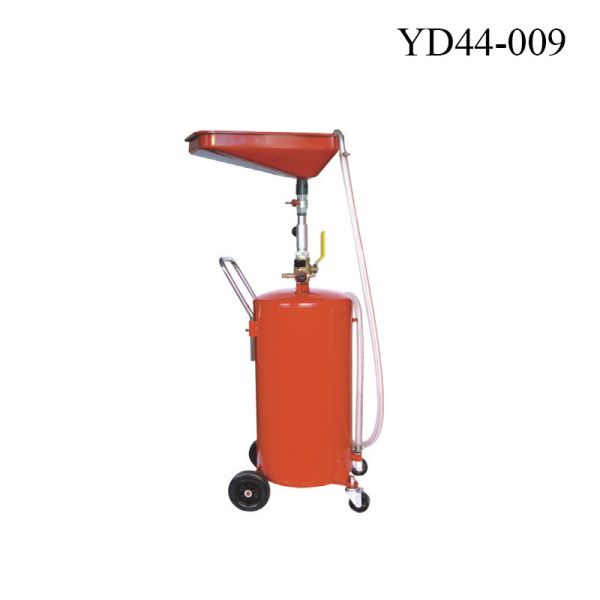
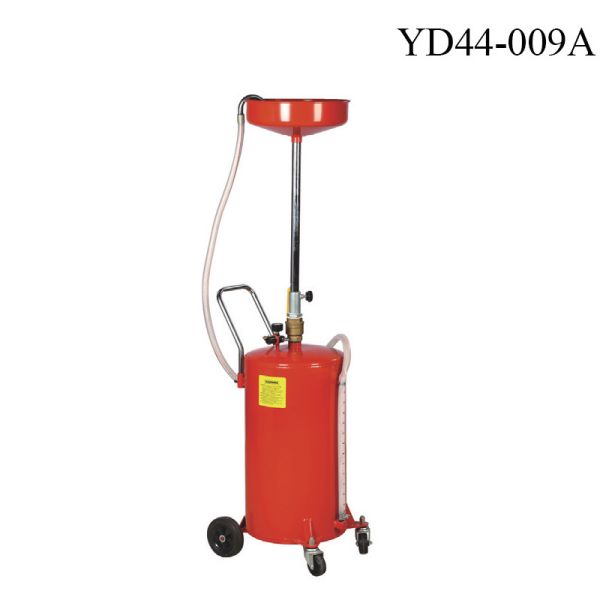
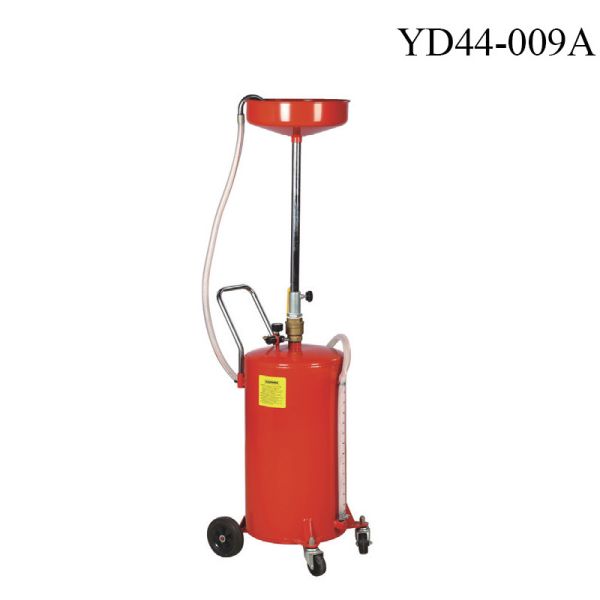
Centered on "efficient self-evacuation + heavy-duty stability", the YD44-009/YD44-009A 18 Gallon Self-Evacuating Heavy-Duty Mobile Oil Drainers are optimized to address the pain points of traditional oil drainers such as "laborious manual dumping, easy spillage during drainage, and difficulty adapting to high-chassis equipment". The two models feature detailed upgrades for different scenarios, with core advantages as follows:
- Strong Single Collection Capacity: The 18-gallon capacity can handle oil change volume of 3 heavy-duty trucks (20-25L each) or 2 large tractors (30-35L each). During batch operations in repair shops, there is no need for frequent downtime to dump waste oil, increasing efficiency by 60%. For example, a large heavy-duty truck repair shop serving 3 vehicles at the same time requires 2 dumps with a traditional 8-gallon oil drainer, while this product completes the task in 1 dump, saving 30 minutes of operation time;
- Real-Time Level Monitoring: The 8-inch discharge hose is equipped with a built-in fluid level gauge, allowing clear observation of oil volume changes, avoiding overflow risks caused by "unknown oil volume" and enabling accurate control even for novice operators.
- Hose Advantages: The 8-inch caliber is 60% larger than that of ordinary oil drainers (5 inches), with a waste oil flow rate of 4.2-4.4L/minute. 75L of waste oil can be drained in 17-18 minutes. The hose can be bent 360°, enabling accurate connection to waste oil recycling tanks of different heights and avoiding the problems of "difficult connection and easy spillage" with traditional rigid pipes;
- Air Pressure Valve Control: The oil drainage speed can be adjusted by the air pressure valve. For high-viscosity gear oil, slow down the flow rate to prevent blockage; for low-viscosity engine oil, speed up the flow rate to improve efficiency, adapting to drainage needs of different types of waste oil.
- Heavy-Duty Casters: 2×6-inch fixed-axle wheels (single-wheel load capacity ≥50kg) ensure no deviation during straight-line movement, and 2 swivel casters facilitate steering in narrow workstations. The stability is 40% higher than that of oil drainers with full swivel casters. Even when fully loaded with 75L of waste oil, it can move smoothly on uneven workshop floors;
- Powerful Braking: The casters are equipped with metal brake pads, keeping the equipment stable without displacement after locking. Even during oil changes on a 10° inclined ground, the funnel can be accurately aligned with the oil drain port, reducing the risk of waste oil spillage to zero.
- Minimum 46 Inches for Adaptation: Easily aligns with the oil drain ports of medium-duty trucks (chassis 110-120cm) without raising the equipment; maximum 70 inches for adaptation: accurately aligns with high-chassis equipment such as large combine harvesters (chassis 170-180cm) and mining excavators (chassis 160-170cm), solving the industry pain point of "difficult oil collection for high-chassis equipment";
- Stable Adjustment Structure: Buckle-type locking design, no tools required for adjustment. The pipe positioning grooves closely engage with the buckles. Even in the idle vibration environment of equipment, the funnel can always remain aligned, achieving a 100% waste oil collection rate.
- Advantages: 26kg weight + 44×42×96cm size, stronger stability, suitable for high-frequency, large-flow oil change scenarios such as large heavy-duty truck repair shops and mining equipment maintenance stations. A 20-foot container can hold 155 units, resulting in lower transportation costs for bulk purchases;
- Applicable Scenarios: Heavy-duty equipment maintenance institutions with daily oil changes of 10+ units, scenarios requiring high caster stability and drainage efficiency.
- Advantages: 25kg weight (1kg lighter than YD44-009) + 93×45×52cm compact size, saving 12% storage space compared to YD44-009, suitable for scenarios with limited space such as community repair shops and small agricultural machinery cooperatives. The thicker wheel surface rubber improves wear resistance by 20%, suitable for low-frequency, multi-type equipment oil change needs;
- Applicable Scenarios: Maintenance institutions with daily oil changes of ≤5 units and narrow warehouse space, scenarios balancing stability and storage flexibility.
Scenario Requirement: A large repair shop undertakes oil change business for 5 Dongfeng Tianlong heavy-duty trucks (each needing to collect 22L of waste engine oil). It is required to complete batch oil change within 2.5 hours, with the equipment needing stable movement, efficient drainage, and no waste oil spillage.
Operation Process (YD44-009):
- Equipment Preparation and Adjustment:
- Two maintenance personnel push YD44-009 to the first truck, press the buckle to adjust the height to 50 inches (127cm), align it with the truck's oil drain port, and press the caster brake to lock;
- Check that the discharge hose is tightly connected, open the air pressure valve to test the flow rate (adjust to medium speed for engine oil), and confirm the fluid level gauge displays normally;
2. Batch Oil Change and Self-Evacuation Operation:
- Perform oil changes for 5 trucks in sequence: Collect 22L of waste oil from the first truck in 18 minutes, move the equipment to the second truck, repeat the operation, and complete collection of 5 trucks (total 110L, 1 drainage required) in 2 hours;
- Drainage Operation: Connect the hose to the waste oil recycling tank, adjust the air pressure valve to high flow rate, drain 110L of waste oil in 25 minutes, and the fluid level gauge displays oil volume in real time to avoid overflow;
3. Operation Effect:
- High Efficiency: Large capacity + self-evacuation design saves 1 hour compared to traditional oil drainers for batch oil changes, enabling 3 more trucks to be served daily;
- Stable and Safe: Fixed-axle wheels prevent movement deviation, no displacement after brake locking, and no spillage during oil changes of 5 trucks;
- Low Cost: A 20-foot container can hold 155 units, resulting in 8% lower transportation costs for bulk purchases compared to YD44-009A.
Scenario Requirement: A community repair shop changes oil for 3 Foton Ollin light trucks (each needing to collect 15L of hydraulic oil). The maintenance workstation is only 1.8×2.5 meters, and the warehouse space is narrow. The equipment is required to be easy to store, flexible to move, and complete oil change within 1.5 hours.
Operation Process (YD44-009A):
- Equipment Preparation and Space Adaptation:
- One maintenance personnel (able to push alone due to 1kg lighter weight) pushes YD44-009A to the corner of the workstation, adjusts the height to 48 inches (121.9cm), aligns it with the light truck's oil drain port, and locks the brake;
- The hose is folded and stored next to the equipment, not occupying the maintenance passage, meeting the workstation space constraints;
2. Oil Change and Drainage Operation:
- Perform oil changes for 3 light trucks in sequence, collecting 15L from each (15 minutes per truck), and complete collection of 3 trucks (total 45L) in 1 hour;
- During drainage, pull the hose to the waste oil barrel, slow down the flow rate (adapting to high viscosity of hydraulic oil), and drain 45L in 12 minutes. The fluid level gauge displays clearly with no blockage;
3. Operation Effect:
- Space Adaptation: The 93×45×52cm size can be stored in the warehouse corner, saving 0.2㎡ space compared to YD44-009;
- Flexible and Labor-Saving: The 25kg weight allows single-person movement, reducing the physical burden of maintenance personnel;
- Excellent Durability: No obvious wear on the wheel surface after 1 month of use, 30% longer service life than ordinary oil drainer casters.
Scenario Requirement: An agricultural machinery cooperative replaces the gear oil of 2 John Deere 8R tractors (each needing to collect 35L of waste oil). The operation site is a field gravel road. The equipment is required to move stably, adapt to high-viscosity oil drainage, and complete maintenance within 2 hours.
Operation Process (Taking YD44-009 as an Example):
- Equipment Movement and Adjustment:
- Two people push YD44-009 to the tractor (no slipping of fixed-axle wheels on the gravel road), adjust the height to 68 inches (172.7cm), align it with the gear oil drain port, and lock the brake;
2. Waste Oil Collection and Drainage:
- Collect 35L of gear oil from each tractor in 25 minutes, completing collection of 2 tractors (total 70L) in 1 hour;
- During drainage, adjust the air pressure valve to low flow rate to avoid blockage of the hose by high-viscosity gear oil, and drain 70L in 22 minutes. The fluid level gauge monitors oil volume in real time;
3. Maintenance Effect:
- Ground Adaptation: The casters move smoothly on the gravel road, saving 50% of pushing force compared to small-diameter caster oil drainers;
- Viscosity Adaptation: The air pressure valve adjusts the flow rate, enabling unobstructed drainage of high-viscosity oil, 30% more efficient than oil drainers without air pressure valves.
A1: It can be solved through three steps: "pre-treatment + unblocking + daily maintenance". Specific methods are as follows:
- Pre-Treatment Before Drainage: For high-viscosity gear oil, preheat the oil drainer to 15-20℃ first (place it in a warm workshop for 1 hour in winter) to reduce oil viscosity; at the same time, adjust the air pressure valve to the minimum flow rate to prevent oil accumulation in the hose due to excessive flow rate;
- Unblocking After Blockage: If blocked, close the air pressure valve, disassemble the connection between the hose and the oil tank, and rinse the hose in reverse from the end with a high-pressure water gun (pressure adjusted to 0.3MPa) to flush out blocked impurities. For stubborn impurities, pour 50ml of diesel (to dissolve oil stains), let it stand for 10 minutes, then rinse again;
- Daily Maintenance: After each drainage, rinse the inner wall of the hose with a small amount of diesel, air-dry it before storage; check the hose for aging cracks weekly, and replace it in time if cracks are found (the merchant provides matching 8-inch hose accessories).
A2: Judge based on three aspects: "daily oil change volume + site space + purchase scale". Specific suggestions are as follows:
- Choose YD44-009 if:
- Daily oil changes ≥8 heavy-duty equipment units (e.g., heavy-duty trucks, mining excavators);
- Maintenance site ≥300㎡ with sufficient warehouse space;
- Single purchase ≥50 units, requiring lower transportation costs (more units in a 20-foot container); - Choose YD44-009A if:
- Daily oil changes ≤5 small/medium-sized equipment units (e.g., light trucks, tractors);
- Maintenance site <200㎡ with narrow warehouse space;
- Emphasizing equipment flexibility, requiring single-person pushing operation, or having higher requirements for caster wear resistance (thicker wheel surface); - Universal Scenario: If daily oil changes are 5-8 units and site space is moderate, the choice can be based on purchase cost (choose YD44-009 for bulk purchases) or flexibility needs (choose YD44-009A).
A3: This is mostly caused by brake pad wear or loose caster screws. Handle accordingly:
- Check and Tighten Screws: Use a wrench to check the screws at the connection between the casters and the equipment. If loose, tighten them clockwise (moderate force to avoid damaging the equipment frame), then test the brake locking effect;
- Replace Brake Pads: If displacement still occurs after tightening the screws, disassemble the caster brake pads (matching accessories provided by the merchant), check for wear or oil stains. If severely worn, replace with new brake pads; if there is oil stain, wipe it clean with alcohol and reinstall;
- Auxiliary Fixation on Inclined Ground: If the operation ground has an inclination >10°, place a 1-2cm thick rubber pad next to the fixed-axle wheels to increase friction and further prevent displacement.
A4: This is mostly caused by oil stain accumulation on the gauge surface or internal water ingress. Restore it through step-by-step processing:
- Clean Surface Oil Stains: Wipe the surface of the fluid level gauge with a rag dipped in a small amount of diesel to remove oil stains (avoid using strong acid/alkali cleaners to prevent damaging the gauge shell);
- Check for Internal Water Ingress: If it is still blurred after cleaning, check for water droplets inside the fluid level gauge. If there is water, disassemble the gauge, pour out the water, dry the interior with a hair dryer (cold air), and reinstall;
- Daily Protection: Avoid excessive bending of the hose during drainage to prevent pressure damage to the fluid level gauge; wipe the surface of the gauge with a dry rag after each use to keep it clean and extend its service life.