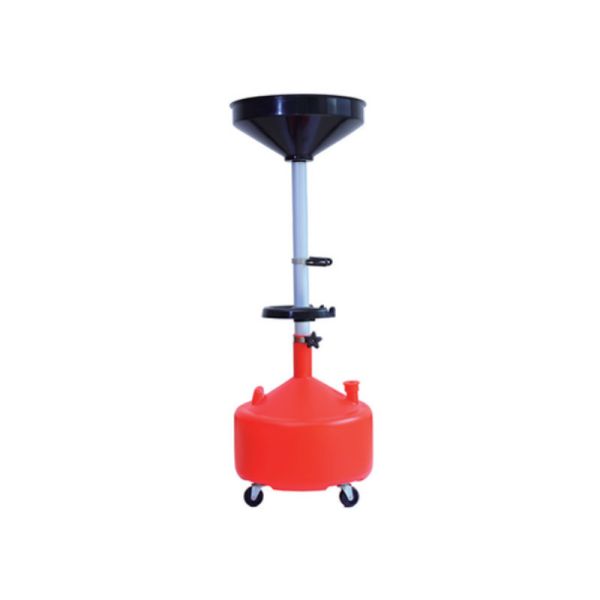
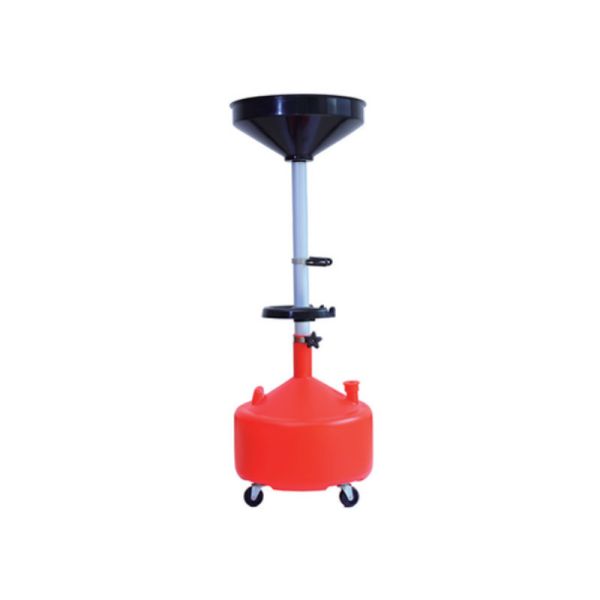
Centered on "high adaptability + multi-functionality + convenience", the YD44-002 8 Gallon Mobile Oil Drainer with Tool Tray is optimized to address the pain points of "large equipment height differences, easy tool scattering, and cumbersome operation" in waste oil collection scenarios, with core advantages as follows:
- Maximum height of 68 inches: 4 inches higher than ordinary oil drainers, enabling accurate alignment with oil drain ports of high-chassis equipment such as large tractors and light trucks (over 170cm); no need to raise the equipment or use extended funnels, solving the industry pain point of "difficult oil collection for high-chassis equipment";
- Minimum height of 27 inches: Easily adapts to low-chassis equipment such as family cars and SUVs; adjustment can be completed while standing without bending, reducing the labor intensity of maintenance personnel.
- Tool-Free Adjustment: Press the spring clip to unlock the pipe, pull it up/down to the target height, and release — the clip locks automatically. This saves 80% of adjustment time compared to traditional bolt-locking methods;
- Clear Gear Positions: A positioning groove is set every 5cm on the pipe; the spring clip snaps into the groove without sliding, ensuring the funnel always aligns with the oil drain port, achieving a 100% waste oil collection rate.
- 3L Tool Tray: Can classify and place tools required for oil change (wrenches, sockets, oil drain plugs, etc.) — no need to carry an additional tool box; tools are accessible during maintenance, solving the problem of "tools scattering on the ground and being hard to find";
- Anti-Drop Design: The tool tray has a 1.5cm-high edge, preventing tools from sliding when moving the equipment; even on a 5° inclined ground, tools remain stable.
- Tool Tray Handle: Made of non-slip PP plastic, comfortable to grip; no need to touch the oil-stained tank or pipe when pushing the equipment, keeping hands clean;
- Ergonomic Design: The handle height (90cm from the ground) fits human mechanics; the arm hangs naturally when pushing, saving 30% of pushing force compared to equipment without a handle. A single person can easily push the equipment fully loaded with 30L of waste oil.
- Corrosion Resistance of Tank and Funnel: Long-term contact with waste oils (engine oil, gear oil, etc.) causes no swelling or cracking; service life is 3 times longer than ordinary PP plastic oil drainers;
- High/Low Temperature Adaptability: No brittleness during outdoor operations in northern winter (-30℃), no deformation when pouring 80℃ high-temperature waste oil; suitable for extreme climate scenarios without seasonal restrictions.
- Flexible Swivel Casters: 2.5-inch wheel diameter adapts to various ground surfaces (concrete, asphalt, workshop floor tiles); no jamming when pushing, even on slightly uneven ground;
- Brake Locking: Press the brake during oil change operations to keep the equipment stable without displacement, avoiding funnel deviation from the oil drain port due to equipment sliding — reducing the risk of waste oil spillage to zero.
Scenario Requirement: An agricultural machinery maintenance station replaces the hydraulic oil of a Dongfanghong 1304 tractor (needing to collect 15L of waste oil). The tractor chassis height is 170cm. The equipment is required to align with the oil drain port accurately, hold tools such as wrenches and filters, and complete the oil change within 1 hour.
Operation Process:
- Equipment Preparation and Adjustment:
- The maintenance personnel holds the tool tray handle, pushes YD44-002 to the tractor, presses the spring clip to adjust the pipe height to 68 inches (172.7cm), aligns it with the hydraulic oil drain port, and presses the caster brake to lock;
- Places hydraulic oil wrenches, new filters, rags, and other tools in the tool tray; checks that the funnel and pipe are tightly connected;
2. Waste Oil Collection and Oil Change Operation:
- Opens the oil drain valve; waste oil flows into the tank through the funnel, and 15L of waste oil is collected in 15 minutes (the aluminum alloy pipe has a fast flow rate with no residue);
- During collection, takes the wrench from the tool tray to remove the old filter and replace it with a new one — no need to go back and forth to the tool cabinet;
- After oil change, releases the brake, pushes the equipment to the waste oil recycling area, opens the tank drain valve to pour waste oil, and sorts the tools in the tray;
3. Operation Effect:
- High Adaptability: The 68-inch height fully aligns with the tractor's oil drain port, no waste oil spillage, and no ground pollution;
- High Efficiency: Tools are within reach, saving 20 minutes compared to the traditional "oil drainer + tool box" combination; oil change is completed within 1 hour;
- Labor-Saving: 6.3kg lightweight design + handle allows one person to complete equipment movement and operation, reducing physical exertion.
Result: The oil change efficiency of high-chassis equipment in the agricultural machinery maintenance station is improved, tool management is more standardized, and maintenance personnel satisfaction is enhanced.
Scenario Requirement: A community automotive repair shop undertakes oil change business for a Foton Ollin light truck (needing to collect 8L of engine oil). The light truck chassis height is 140cm, and the maintenance workstation space is limited. The equipment is required to be flexible in movement and hold oil change tools.
Operation Process:
- Equipment Adaptation and Arrangement:
- The maintenance personnel pushes the equipment from the corner of the maintenance area to under the light truck using the tool tray handle, presses the spring clip to adjust the height to 55 inches (139.7cm), aligns it with the engine oil drain port, and locks the casters;
- Places a 19mm wrench, oil drain plug gasket, and new oil filter in the tool tray;
2. Oil Change Operation:
- Uses the wrench from the tool tray to remove the oil drain plug; waste oil flows into the oil drainer, and collection is completed in 8 minutes;
- During collection, takes the new gasket from the tool tray for replacement — no need to leave the workstation or worry about forgetting tools elsewhere;
- After oil change, pushes the equipment to the waste oil barrel to pour oil, and organizes the tools in the tray before returning them to the tool cabinet;
3. Operation Effect:
- Space Adaptation: The compact equipment can be flexibly arranged in the narrow space under the light truck without affecting other maintenance operations;
- Efficiency Improvement: No need to fetch tools back and forth; oil change time is shortened to 30 minutes, saving 15 minutes compared to traditional methods;
- Cleanliness: The handle design prevents hands from touching oil stains, keeping maintenance personnel's hands clean without frequent hand washing.
Scenario Requirement: A home user performs a DIY oil change for a Volkswagen Tiguan L (needing to collect 5L of engine oil). With no professional maintenance experience, the user requires easy-to-operate equipment that can hold tools and allow safe transfer of waste oil to a recycling station after oil change.
Operation Process:
- Equipment Storage and Startup:
- Takes YD44-002 from the corner of the garage (compact storage with no space occupation), presses the spring clip to adjust the height to 29 inches (73.7cm), aligns it with the car chassis oil drain port, and locks the casters;
- Places a 17mm wrench, oil drain plug, and new oil filter in the tool tray — no need to prepare an additional tool box;
2. DIY Oil Change Operation:
- Uses the wrench from the tool tray to remove the oil drain plug; waste oil flows into the oil drainer, and collection is completed in 5 minutes;
- When replacing the new oil filter, takes the accessory from the tool tray without worrying about tools falling to the ground;
- After oil change, holds the tool tray handle to push the equipment to the car trunk (6.3kg lightweight, easy to carry), and transfers it to a nearby waste recycling station for oil disposal;
3. DIY Effect:
- Easy Operation: With spring clip height adjustment and tool tray storage, the oil change can be completed within 1 hour even without professional experience, saving 120 yuan compared to going to a repair shop;
- No Spillage: Accurate height alignment achieves 100% waste oil collection, with no oil stains on the garage floor;
- Convenience: Tools and equipment are integrated, no need to carry tools separately, and storage is easy.
A1: This is mostly caused by spring clip wear or oil contamination in the pipe positioning grooves. Handle it step by step:
- Clean the Positioning Grooves: If there is oil or debris in the pipe grooves, the spring clip cannot lock tightly. Wipe the outer wall grooves of the pipe with a rag dipped in alcohol to remove oil, then re-adjust — the spring clip will lock stably;
- Check Spring Clip Elasticity: If the spring clip rebounds weakly after pressing, the internal spring may be aged. Contact the merchant to purchase a spring clip of the same specification, remove the old clip with a screwdriver and replace it, then test the elasticity (it should rebound quickly after pressing);
- Avoid Over-Range Adjustment: Do not force the height beyond 27 inches (minimum) or 68 inches (maximum) — beyond the design range, the spring clip cannot snap into the positioning grooves, leading to sliding.
A2: This is mostly caused by improper tool placement or wear of the tool tray edge. Handle it accordingly:
- Standardize Tool Placement: Place handle-equipped tools (wrenches, sockets) horizontally (with handles facing the tray edge) to avoid unstable center of gravity caused by vertical placement; small parts (oil drain plugs, gaskets) can be placed in the corner of the tray or in a small storage box before putting them into the tray;
- Check the Tool Tray Edge: If the edge is cracked or deformed, contact the merchant to replace the tool tray; if the edge is intact, stick an anti-slip pad (provided by the merchant) in the tray to increase friction between tools and the tray, preventing sliding;
- Control Movement Speed: Avoid rapid turning or sudden stops when moving the equipment; keep moving at a constant speed to reduce tool sliding caused by inertia.
A3: This is mostly caused by debris entanglement in the casters or lack of oil in the wheel axles. It can be fixed with simple treatment:
- Clean Caster Debris: Flip the equipment, check for thread ends, iron filings, gravel, or other debris entangled in the caster gaps; clean them with tweezers or a screwdriver to ensure smooth rotation of the wheel axle;
- Add Lubricating Oil to Wheel Axles: If jamming persists after cleaning, drop 1-2 drops of sewing machine oil or lubricating oil on the caster axles; rotate the wheel body to distribute the oil evenly — the jamming will be eliminated;
- Avoid Extreme Ground Surfaces: Try to move the equipment on flat ground; avoid using it on ground with obvious protrusions (e.g., steps over 5mm) or excessive gravel to prevent caster damage or jamming.
A4: It is only suitable for collecting waste vehicle oil; other liquids are prohibited to avoid equipment damage or safety risks:
- Corrosiveness of Antifreeze/Brake Fluid: Antifreeze contains ethylene glycol, and brake fluid contains alcohol components — both will corrode the HDPE material of the tank and pipe, as well as the silicone sealing ring, leading to equipment leakage, damage, and shortened service life;
- Impact on Waste Oil Recycling Value: Mixing non-oil liquids (antifreeze, brake fluid, etc.) will make the collected waste oil unrecyclable (recycling agencies will refuse it), resulting in resource waste;
- Safety Hazards: Some liquids (e.g., brake fluid) are prone to producing harmful gases at high temperatures, and may react chemically with waste oil, posing safety risks. If other liquids need to be collected, use a dedicated collection device of appropriate material (e.g., corrosion-resistant antifreeze collection bucket).