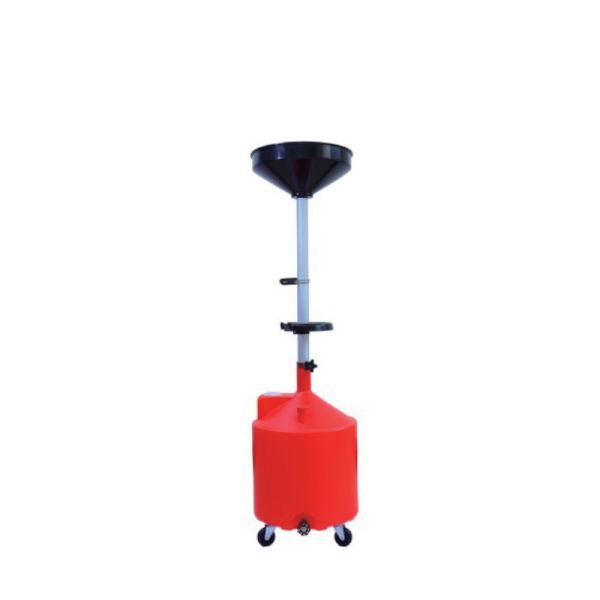
Centered on "extra-large capacity + ultra-high adaptability + tool integration", the YD44-005 18 Gallon Heavy-Duty Mobile Oil Drainer with Tool Tray is deeply optimized to address the pain points of "large waste oil displacement, high equipment chassis, and difficult tool storage" in heavy-duty equipment oil change scenarios, with core advantages as follows:
- Strong Single Collection Capacity: The 18-gallon capacity can handle oil change volume of 3 heavy-duty trucks (20-25L each) or 2 large tractors (30-35L each). During batch operations in heavy-duty truck repair shops, there is no need for frequent trips to the waste oil recycling area, increasing efficiency by 60%. For example, a traditional 8-gallon oil drainer requires 2 dumps to service 3 trucks, while this product completes the task in 1 dump, saving 40 minutes of operation time;
- High Liquid Level Safety Design: Clear scales are marked on the side of the oil tank, with a 5cm safety height reserved from the tank mouth to prevent overflow during large-displacement oil drainage, ensuring accurate control even for novice operators.
- Advantages of 3/4-Inch Valve: 50% larger than ordinary 1/2-inch valves, with a waste oil discharge flow rate of 2L/minute. 75L of waste oil can be drained in 40 minutes, saving 25 minutes of discharge time compared to small-caliber valves;
- Leak-Proof and Durable: The valve is made of HDPE material with no metal parts, completely avoiding rust. It has no leakage or jamming even after more than 5000 switches, and its maintenance cost is 80% lower than that of metal valves.
- Minimum 37 Inches for Adaptation: Easily aligns with the oil drain ports of medium-duty trucks (chassis 90-100cm) without raising the equipment; maximum 76 inches for adaptation: accurately aligns with high-chassis equipment such as mining excavators (chassis 190cm) and large combine harvesters (chassis 180cm), solving the industry pain point of "difficult oil collection for ultra-high equipment";
- Stable Adjustment Structure: The spring clip tightly engages with the pipe positioning groove. Even in the idle vibration environment of equipment, the funnel can always align with the oil drain port, achieving a 100% waste oil collection rate.
- 3-Inch Wheel Diameter + Wear-Resistant Rubber: 20% larger than ordinary 2.5-inch wheel diameters, it can easily handle complex ground surfaces such as gravel, mud, and uneven workshop floor tiles with low pushing resistance. Two people can push the equipment fully loaded with 83kg (including waste oil + tools), saving 40% of pushing force compared to small-diameter caster oil drainers;
- Strong Brake Locking: Metal brake pads combined with rubber wheel surfaces ensure no equipment displacement after locking, even on a 10° inclined ground, eliminating safety hazards during oil changes of extra-large equipment.
- Tools Within Reach: The tool tray can classify and place tools needed for oil changes (wrenches, sockets, oil drain plugs, etc.), eliminating the need for an additional tool cart. Maintenance personnel can access tools with a reach, solving the problem of "tools scattering on the ground and being hard to find" and shortening maintenance time by 20%;
- Handle as Push/Pull Grip: The tool tray handle adopts a non-slip texture design. There is no need to touch the oil-stained tank when pushing the equipment, keeping hands clean. Meanwhile, the handle height (90cm from the ground) fits ergonomics, allowing the arm to hang naturally when pushing for labor-saving comfort.
- 5mm Thickened Tank: 2mm thicker than ordinary HDPE oil drainers, it has strong impact resistance and can withstand 15kg heavy object impact without cracking. It has no swelling or deformation when in long-term contact with high-viscosity gear oil and hydraulic oil, and its service life is 4 times longer than that of ordinary oil drainers;
- Full HDPE Corrosion Resistance: The oil tank, funnel, and valve are all made of HDPE material with no metal parts. It has no corrosion risk when used in deicing salt environments in northern winter and humid environments in southern China, with wider applicable regions.
Scenario Requirement: A mining equipment maintenance station replaces the hydraulic oil of a Sany Heavy Industry SY750H excavator (chassis height 190cm, needing to collect 50L of waste oil). The operation site is a mining gravel road. The equipment is required to be height-adaptable, have sufficient capacity, hold tools such as hydraulic oil wrenches, and complete the oil change within 2 hours.
Operation Process:
- Equipment Preparation and Adjustment:
- Two maintenance personnel hold the tool tray handle and push YD44-005 to the excavator (no caster jamming on the gravel road). They press the spring clip to adjust the height to 76 inches (193cm), align it with the hydraulic oil drain port, and press the brake to lock;
- Place hydraulic oil-specific wrenches, new filters, rags, and other tools in the tool tray; check that the funnel and pipe are tightly connected;
2. Waste Oil Collection and Oil Change Operation:
- Open the oil drain valve; waste oil flows into the 18-gallon tank through the funnel, and 50L of waste oil is collected in 40 minutes (no mid-process dumping required due to sufficient capacity);
- During collection, take the wrench from the tool tray to remove the old filter and replace it with a new one, no need to go back and forth to the tool cart, saving 20 minutes;
- After oil change, release the brake and push the equipment to the waste oil recycling tank, open the 3/4-inch valve to drain 50L of waste oil in 35 minutes, and sort the tools in the tool tray;
3. Operation Effect:
- Ultra-High Adaptability: The 76-inch height fully aligns with the excavator's oil drain port, no waste oil spillage, and no pollution to the mining ground;
- High Efficiency: Tools are accessible + large capacity reduces dumping, completing the oil change within 2 hours, saving 1 hour compared to traditional equipment;
- Complex Ground Adaptation: The 3-inch casters move smoothly on the gravel road with no sinking risk, ensuring safe operation.
Result: The oil change efficiency of ultra-high chassis equipment in the mining equipment maintenance station is improved, the labor intensity of maintenance personnel is reduced, and tool management is more standardized.
Scenario Requirement: A heavy-duty truck repair shop undertakes oil change business for 4 Jiefang J7 trucks (each needing to collect 22L of waste engine oil). The maintenance workstation space is limited. The equipment is required to be flexible in movement, have sufficient capacity, hold oil change tools, and complete batch oil change within 3 hours.
Operation Process:
- Equipment Arrangement and Tool Preparation:
- Two people push YD44-005 to the first truck, press the spring clip to adjust the height to 40 inches (101.6cm), and lock the casters;
- Place a 19mm wrench, oil drain plug gasket, and new oil filter in the tool tray;
2. Batch Oil Change Operation:
- Perform oil changes for 4 trucks in sequence: Collect 22L of waste oil from the first truck (25 minutes), move the equipment to the second, third, and fourth trucks, repeat the operation, and complete collection of 4 trucks (total 88L, 1 dump required) in 2 hours;
- During collection, take tools from the tray without carrying them separately, ensuring a smooth oil change process;
- Centralized Discharge: Push the equipment to the waste oil barrel, drain 88L of waste oil in 30 minutes, and no dripping after valve closing;
3. Operation Effect:
- Sufficient Capacity: The 18-gallon capacity reduces dumping frequency, increasing batch oil change efficiency by 50%;
- Space-Friendly: The compact equipment moves flexibly in the workstation without affecting other maintenance operations;
- Tool Integration: Tool tray storage avoids scattering, keeping the maintenance area tidy.
Scenario Requirement: A large agricultural machinery cooperative replaces the gear oil of a Kubota PRO1108Q combine harvester (chassis height 180cm, needing to collect 35L of waste oil). The operation site is a muddy field. The equipment is required to be height-adaptable, stable in movement, and able to hold maintenance tools.
Operation Process:
- Equipment Adaptation and Mobility:
- Two people push YD44-005 to the combine harvester (no caster slipping on the muddy ground), press the spring clip to adjust the height to 72 inches (182.9cm), align it with the gear oil drain port, and lock the brake;
- Place gear oil wrenches, new sealing rings, and other accessories in the tool tray;
2. Maintenance Operation:
- Open the oil drain valve; 35L of waste oil flows into the tank in 30 minutes. During this period, take tools from the tool tray to remove the old sealing ring and replace it with a new one;
- After maintenance, push the equipment to the cooperative's waste oil recycling area, open the valve to drain the waste oil in 30 minutes, and organize the tools in the tray for storage;
3. Maintenance Effect:
- Precise Height: 72 inches adapts to the combine harvester's chassis, no waste oil spillage;
- Ground Adaptation: The 3-inch casters move stably on the muddy ground, saving 50% of pushing force compared to small-caster equipment;
- Efficiency Improvement: Tool integration + large capacity shorten maintenance time to 1.5 hours, saving 1 hour compared to traditional methods.
A1: This is mostly caused by aging of the internal spring of the spring clip or impurity jamming. Restore the locking effect through step-by-step processing:
- Clean Spring Clip Impurities: Use tweezers or a thin iron wire to clean oil stains, iron filings, and other impurities in the spring clip gaps, then drop 1-2 drops of lubricating oil (e.g., sewing machine oil) and press the clip 10 times repeatedly to restore elasticity;
- Replace Spring Clip Core: If elasticity is still weak after cleaning, contact the merchant to purchase a spring clip core of the same specification (special accessory). Remove the old clip with a screwdriver, replace it with a new core, and test the locking strength after installation (no pipe sliding is acceptable);
- Avoid Over-Range Adjustment: Do not force the pipe to be adjusted below 37 inches or above 76 inches (beyond the design range) to prevent long-term overload of the spring clip and extend its service life.
A2: Collision can be reduced through "partitioned storage + anti-slip treatment". Specific methods are as follows:
- Partitioned Storage: Place plastic partition boxes (e.g., multi-compartment parts boxes) in the tool tray to classify and store wrenches, sockets, bolts, etc., avoiding mutual collision;
- Stick Anti-Slip Pads: Stick silicone anti-slip pads (matching pads provided by the merchant) on the bottom and inner wall of the tool tray to increase friction between tools and the tray, reducing shaking and collision;
- Control Tool Weight and Quantity: The maximum load capacity of the tool tray is 3kg. Do not overload it to avoid noise caused by tool stacking and extrusion. Meanwhile, prioritize placing commonly used tools to reduce redundancy.
A3: Safe movement can be ensured through "path planning + auxiliary coordination". Specific methods are as follows:
- Plan a Flat Path: Observe the ground before moving, prioritize routes with a slope <5°, and avoid deep pits and protrusions. If it is necessary to pass through inclined ground, keep the equipment moving perpendicular to the slope direction to avoid side turning caused by parallel movement;
- Two-Person Cooperative Movement: One person guides the direction in front of the equipment, and the other pushes from behind. Adjust in time when deviation occurs to avoid offset caused by blind spots in the view of a single operator;
- Check Caster Status: Regularly check whether the caster screws are loose and the wheel surface is worn. Tighten loose screws in time and replace casters when they are severely worn to ensure movement stability.
A4: It is only suitable for collecting waste vehicle oil. Use industrial gear oil with caution to avoid equipment blockage or damage:
- Viscosity Adaptation Limit: The equipment is designed to adapt to vehicle oil (viscosity ≤200cSt). Most industrial gear oils have a viscosity ≥300cSt, which may cause pipe blockage and valve jamming, affecting normal use;
- Material Compatibility Risk: Some industrial gear oils contain extreme pressure additives, which may accelerate the aging of HDPE material. Long-term use may cause tank swelling and leakage;
- Testing Suggestion: If use is really necessary, conduct a small-dose test first (pour 1L of industrial gear oil into the tank, observe for no swelling after 24 hours, then test whether the flow and discharge are smooth). Only use small amounts if there is no abnormality; long-term collection is not recommended.