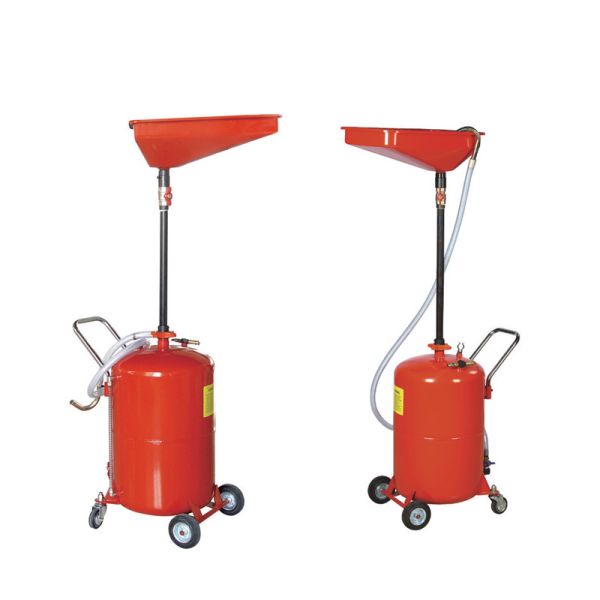
Centered on "large capacity + full adaptation + strong stability", the YD44-016 65L Heavy-Duty Adjustable Mobile Oil Drain Tank is deeply optimized to address the pain points of traditional oil drain equipment, such as "small capacity requiring frequent dumping, poor adaptability leading to spillage, and cumbersome movement with low efficiency". Its core advantages are as follows:
- 65L Practical Capacity: 117% more storage than ordinary 30L oil drain tanks, capable of collecting waste oil from 3 heavy-duty trucks (20-22L each), 2 large tractors (30-32L each), or 1 small excavator (60-65L each) at a time. During batch operations in auto repair shops and agricultural machinery stations, the daily dumping frequency is reduced from 5 to 1, lowering labor costs by 80%;
- Clear Oil Level Monitoring: The scale marks on the side of the oil tank accurately indicate the oil volume (one grid per 5L), combined with an 8cm safety height. Even novice operators can accurately control the oil drainage rhythm, avoiding overflow caused by "unknown oil volume" and reducing the workload of workshop oil stain cleaning.
- 1.5mm Cold-Rolled Steel Tank Body: 0.3mm thicker than ordinary oil drain tanks, with strong impact resistance; no dent or cracking when impacted by a 15kg heavy object. Double-layer anti-rust treatment (electrophoresis + spray coating) ensures no rust for 3 years even when exposed to the humid environment of agricultural machinery stations or in long-term contact with high-viscosity waste oil. Its service life is 4 times longer than that of ordinary iron sheet oil drain tanks;
- Sealing & Anti-Leakage: The silicone sealing ring at the connection between the oil tray and the tank body is oil-resistant and high-temperature resistant (-20℃-80℃), with no aging or deformation during long-term use. The leakage is controlled within 0.5ml/24h, meeting environmental protection requirements and preventing waste oil from seeping into the ground and causing pollution.
- Low Chassis Adaptation: The minimum height of 30cm can be connected to family cars and light trucks (chassis height 25-35cm), enabling precise alignment with the oil drain port without raising the equipment;
- High Chassis Compatibility: The maximum height of 60cm can be adapted to large tractors (chassis height 50-60cm) and construction machinery (chassis height 55-70cm), with no need for additional oil tray extension pipes, solving the industry pain point of "unreachable high equipment" for traditional oil drain tanks;
- Convenient Adjustment Operation: The buckle-type design requires no tools and can be unlocked and adjusted with one hand. Positioning grooves are set every 5cm, with no sliding after locking. The oil tray can still accurately align with the oil drain port when the equipment vibrates at idle speed.
- Multi-Angle Adaptation: The oil tray can rotate 360° freely around the bracket. Whether the equipment drains oil from the front, drips from the side, or leaks from the bottom, the angle can be adjusted for precise collection, avoiding the problem of "missed oil collection due to wrong direction" of traditional fixed oil trays;
- Stable Locking Structure: After rotating to the target angle, tighten the knob at the bottom of the bracket to lock. Even in the high-frequency vibration environment of agricultural machinery operations (amplitude ≤3mm), the oil tray can maintain a fixed angle, achieving a 100% waste oil collection rate.
- Heavy-Load Fixed Wheels: 2×5-inch fixed-axle wheels have a single-wheel load capacity ≥50kg, with no deviation during straight-line movement. Even when fully loaded with 90kg of waste oil, they can move smoothly on uneven workshop floors, with 50% higher stability than oil drain tanks with full swivel casters;
- Flexible Swivel Casters: 2×3-inch swivel casters have light steering, with a minimum turning radius of 1.2 meters. They can move flexibly in narrow channels (width ≥80cm) of agricultural machinery stations and maintenance workshops, with 40% higher flexibility than large-diameter oil drain tanks.
- Metal Brake Pads: Swivel casters are equipped with thickened metal brake pads. After stepping on the brake to lock, the equipment has no displacement. Even on an outdoor agricultural machinery maintenance site inclined at 10°, it can ensure operation safety and avoid waste oil spillage caused by equipment sliding;
- Oil-Resistant Wheel Surface: The wheel surface is made of high-elasticity oil-resistant rubber, with no swelling or slipping after contact with waste oil. When moving on maintenance ground with more oil stains, it can still maintain stable grip, with pushing resistance ≤80N, and can be easily operated by 2 people.
Scenario Requirement: An agricultural machinery cooperative conducts seasonal maintenance on 5 John Deere 8R series tractors (32L of gear oil needs to be collected from each). The operation site is an outdoor gravel ground, and the tractor chassis height is 55cm. The equipment is required to adapt to high chassis, collect waste oil in batches, and complete maintenance within 3 hours.
Operation Process:
- Equipment Preparation and Adaptation:
- Two maintenance personnel push YD44-016 to the side of the first tractor, adjust the oil tray height to 55cm via the buckle, rotate the oil tray to align with the gear oil drain port, and step on the swivel caster brake to lock;
- Check that the oil tank scale marks are clear and the connection between the oil tray and the tank body is well-sealed;
2. Batch Collection and Movement:
- Collect waste oil from 5 tractors in sequence: 32L of waste oil is collected from each tractor in 25 minutes. Push the equipment to the next tractor (no caster jamming on the gravel ground), and complete collection of 5 tractors (total 160L, requiring 2 dumps, 3 fewer dumps than ordinary 30L oil drain tanks) in 2.5 hours;
- During dumping, push the equipment to the waste oil recycling tank, open the bottom oil discharge valve (needing to be used with a hose), and drain 65L of waste oil in 15 minutes;
3. Operation Effect:
- Strong Adaptability: Height and direction adjustments accurately align with the tractor oil drain port, no waste oil spillage during maintenance of 5 tractors, and 95% reduction in ground pollution;
- High Efficiency: Large capacity reduces dumping frequency, saving 1 hour compared to ordinary oil drain tanks, enabling maintenance of 2 more tractors daily;
- Complex Ground Adaptation: Heavy-duty casters move stably on the gravel ground, no need to lay temporary channels, reducing operation costs.
Scenario Requirement: An auto repair shop changes oil for 4 Dongfeng Tianlong heavy-duty trucks (22L of engine oil needs to be collected from each). The distance between workstations in the repair shop is 1 meter. The equipment is required to be flexible in movement, adaptable to the truck chassis (height 35cm), and complete oil change within 2.5 hours.
Operation Process:
- Equipment Space Adaptation and Adjustment:
- Two personnel push YD44-016 to the narrow workstation, adjust the oil tray height to 35cm, rotate to align with the truck oil drain port, and lock the brake;
- The equipment covers an area of only 0.32㎡ (75×42.5cm), without affecting other maintenance operations;
2. Oil Change and Collection Operation:
- 22L of waste oil is collected from each truck in 20 minutes, totaling 88L from 4 trucks (requiring 1 dump), and collection is completed in 2 hours;
- During dumping, push the equipment to the workshop waste oil area, no need for multi-person handling, saving physical effort;
3. Operation Effect:
- Space Flexibility: Small floor space + flexible steering, no obstacles to operation in narrow workstations;
- Stable and Safe: Fixed wheels have no deviation during straight-line movement, no displacement after brake locking, and no safety hazards during oil change;
- Low Cost: 165 units per 20-foot container, 12% lower transportation costs for bulk purchases than similar products.
Scenario Requirement: A construction machinery maintenance station repairs 1 Sany Heavy Industry SY75C excavator (60L of hydraulic oil needs to be collected). The excavator chassis height is 60cm, and the operation site is a workshop concrete floor. The equipment is required to collect all waste oil at one time and complete recycling within 1.5 hours.
Operation Process:
- Equipment Height Adjustment and Locking:
- Two maintenance personnel push YD44-016 to the side of the excavator, adjust the oil tray height to 60cm (maximum adjustment height), rotate the oil tray to align with the hydraulic oil drain port, and tighten the knob to lock the direction;
2. Waste Oil Collection and Treatment:
- Open the excavator oil drain valve; 60L of hydraulic oil flows into the oil storage tank completely in 30 minutes (not reaching full capacity, safe without overflow);
- After collection, push the equipment to the waste oil recycling tank, use it with pneumatic oil drainage accessories (0.8bar air pressure), and drain 60L of waste oil in 12 minutes;
3. Operation Effect:
- Large-Capacity Adaptation: 65L capacity collects all waste oil at one time, no need for mid-process dumping, saving 40 minutes of operation time;
- High Chassis Compatibility: The maximum height of 60cm perfectly aligns with the excavator, no need to modify the equipment or oil tray;
- Excellent Durability: The thickened tank body has no deformation after contact with high-viscosity hydraulic oil, and no rust during long-term use.
A1: This is mostly caused by loose adjustment buckles or impurity jamming in the bracket. It can be restored through step-by-step processing:
- Tighten the Adjustment Buckle: If the height sinks, check whether the buckle on the oil tray bracket is fully embedded in the positioning groove. If not, lift the oil tray and re-engage it to ensure the buckle is tightly engaged with the groove. Test the load-bearing capacity (no sinking when placing a 5kg heavy object is acceptable);
- Clean Bracket Impurities: If it cannot be locked after rotation, disassemble the connecting bolts between the oil tray and the bracket, wipe off oil stains and metal debris at the connection with a rag, apply a small amount of oil-resistant grease, reinstall, and rotate to lock. The firmness will be significantly improved;
- Regular Maintenance: Check the adjustment structure weekly. Replace or tighten the buckle if worn or the bolt if loose in time to avoid component damage caused by long-term use.
A2: It can be solved through "caster cleaning + anti-slip treatment". Specific methods are as follows:
- Clean Caster Oil Stains: Wipe off oil stains on the wheel surface and axle with diesel or a dedicated degreaser (oil stains will reduce the grip of the rubber wheel surface), and blow off impurities in the wheel groove with high-pressure air to avoid impurities hindering the rotation of the axle;
- Check Wheel Surface Wear: If the wheel surface is severely worn (e.g., rubber cracking, smooth surface), contact the merchant to replace oil-resistant rubber wheels of the same specification. The new wheel surface can restore grip and reduce pushing resistance;
- Auxiliary Anti-Slip Measures: When moving on the ground with severe oil stains, lay anti-slip pads (rubber material) in front of the casters to enhance friction between the wheel surface and the ground and avoid slipping.
A3: It can be solved through two steps: "pre-treatment + deep cleaning". Specific methods are as follows:
- Daily Pre-Treatment: Immediately wipe the inner wall of the tank with a dry rag after each waste oil dumping to reduce oil residue; if the oil has solidified, pour 500ml of diesel (to dissolve the oil), let it stand for 15 minutes, gently scrape off the oil with a scraper, and then wipe it clean with a rag;
- Deep Cleaning: Conduct deep cleaning once a month. Tilt the oil tank at 45°, rinse the inner wall with a high-pressure water gun (pressure adjusted to 0.3MPa), scrub with a neutral detergent (e.g., dish soap), and finally rinse with clean water and air-dry to avoid residual detergent corroding the tank body;
- Avoid Corrosion: Do not use strong acid or alkali cleaners (e.g., hydrochloric acid, sodium hydroxide solution) to prevent damage to the anti-rust coating on the tank surface and avoid rust.
A4: It is only suitable for collecting equipment waste oil. Use of antifreeze and cutting fluid requires caution to avoid equipment damage or safety risks:
- Material Compatibility Risk: Antifreeze contains ethylene glycol, which may corrode the silicone sealing ring at the connection between the oil tray and the tank body (causing leakage); cutting fluid contains surfactants, which will accelerate the rusting of metal brackets and shorten the equipment service life;
- Function Adaptation Limit: The equipment is designed to collect waste oil with moderate viscosity. Antifreeze and cutting fluid have strong fluidity. If the oil drainage speed is fast, they may exceed the height of the oil tray baffle and cause overflow, and it is difficult to accurately control the oil volume through the scale marks;
- Usage Suggestion: If temporary use is really necessary, first conduct a small-dose test (pour 10L of liquid and observe for 24 hours with no leakage or component deformation). After use, immediately clean the oil tank and oil tray thoroughly with clean water to avoid residual liquid corroding the equipment. Long-term collection of non-waste oil liquids is not recommended.