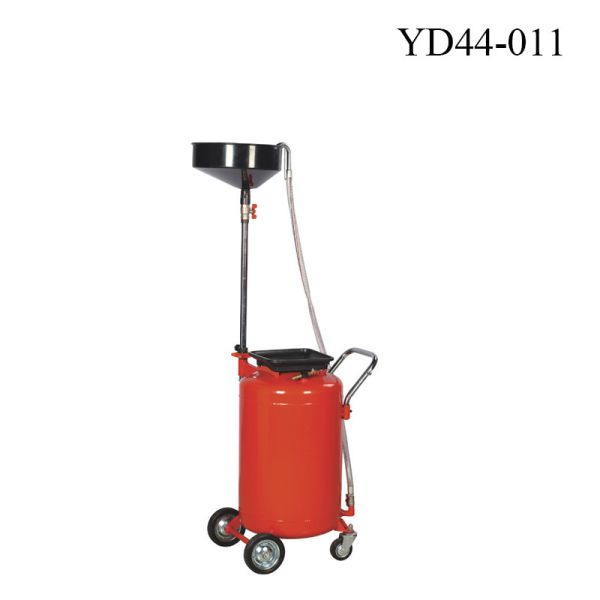
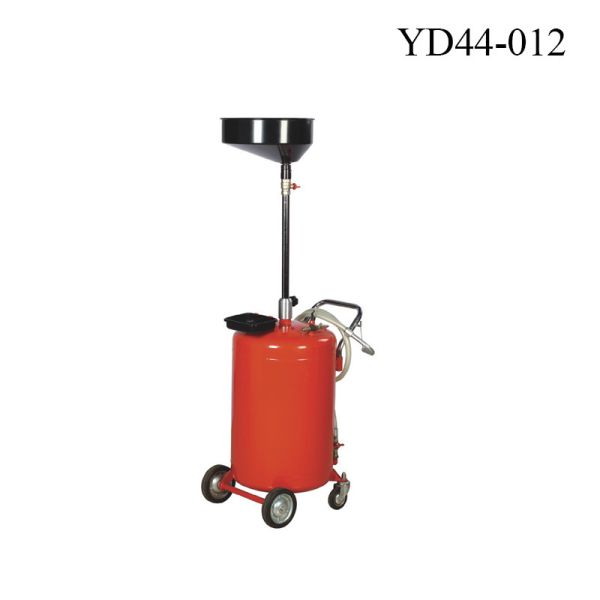
Centered on "precise adaptation to lift scenarios + pneumatic efficient treatment", the YD44-011/YD44-012 30 Gallon Pneumatic Heavy-Duty Oil Drainers for Vehicle Lifts are optimized to address the pain points of "difficult height matching, low waste oil treatment efficiency, and inflexible equipment movement" in vehicle lift scenarios. The two models feature detailed upgrades for repair shops of different scales while sharing consistent core functions, with core advantages as follows:
- Strong Batch Collection Capacity: The 30-gallon capacity is 67% larger than that of ordinary 18-gallon oil drainers, capable of collecting oil change volume of 5 family cars (approx. 5-6L each) or 3 light trucks (approx. 30L each) at a time. When auto repair shops conduct batch operations using vehicle lifts, there is no need for frequent downtime to dump waste oil, reducing 4-5 downtime instances per day and increasing lift utilization by 30%;
- Precise Oil Level Monitoring: The oil level sight gauge clearly displays the oil volume, avoiding overflow discovered only after the lift is lowered and reducing rework time.
- Compatibility with Standard Workshop Air Pressure: No additional high-pressure equipment is required; it can be directly connected to the 7PSI standard air compressor in auto repair shops. 113.6L of waste oil can be emptied in 37-38 minutes, 4 times faster than natural drainage. The operation can be completed by 2 people, saving 50% of physical effort compared to manual dumping;
- Flexible Connection with Long Hose: The 27-1/2-inch emptying hose can be bent to reach the waste oil recycling tank, eliminating the need to move the heavy oil drainer. It is especially suitable for narrow spaces beside lifts, avoiding equipment collision with lift rails.
- Exclusive Adaptation for Lift Scenarios: The minimum height of 122cm (YD44-011)/125cm (YD44-012) is suitable for lifted family cars (chassis height 80-120cm), and the maximum height of 179cm is suitable for lifted light trucks (chassis height 150-175cm). It perfectly matches mainstream vehicle lifts (lift height 80-180cm), solving the contradiction of traditional oil drainers being "unreachable for lifted vehicles and too high for non-lifted ones";
- Stable Adjustment Structure: The segment-type buckles closely engage with the pipe positioning grooves, with no looseness after adjustment. Even if the lift vibrates slightly, the funnel can always align with the oil drain port, achieving a 100% waste oil collection rate.
- Balanced Load-Bearing and Steering: 2×7-inch fixed wheels (single-wheel load capacity ≥40kg) ensure no deviation during straight-line movement, and 2×4-inch swivel casters facilitate small-radius steering beside the lift (minimum turning radius 1.5 meters). The stability is 40% higher than that of oil drainers with full swivel casters, and it can move smoothly even when fully loaded with 150kg;
- Powerful Brake Locking: The casters are equipped with metal brake pads, keeping the equipment stable without displacement after locking. Even on a 5° inclined ground beside the lift, it can ensure operation safety and avoid waste oil spillage contaminating lift rails.
- Large-Caliber Anti-Spillage: The 40cm-diameter funnel is 20% larger than ordinary funnels, capable of quickly catching waste oil dripping from lifted vehicles. Even with fast oil drainage, spillage is avoided; the funnel edge is rounded to prevent scratches on operators;
- Built-In Filter Screen for Anti-Blockage: The 5mm-aperture filter screen can filter metal debris and impurities in waste oil, avoiding blockage of the pneumatic emptying pipe and extending the service life of pneumatic components. The filter screen is detachable for cleaning, resulting in low reuse costs.
- 1.5mm Thickened Oil Tank: 0.3mm thicker than ordinary oil drainers, it has strong impact resistance, withstanding 25kg heavy object impact without deformation. It has no rust when in long-term contact with high-viscosity waste oil, and its service life is 5 years longer than that of ordinary oil drainers;
- All-Metal Pneumatic Components: The brass valve body is resistant to compressed air corrosion, and the oil-resistant rubber seals have no aging or leakage. The service life of pneumatic components is ≥10,000 hours, reducing subsequent maintenance and replacement costs.
Scenario Requirement: A large auto repair shop uses 2 vehicle lifts to change oil for 6 JMC Shunda light trucks (30L of transmission oil needs to be collected from each). It is required to complete batch operations within 4 hours, with the equipment needing to adapt to lift height, achieve efficient emptying, and not affect lift operation.
Operation Process (YD44-011):
- Equipment Preparation and Adaptation:
- Two maintenance personnel push YD44-011 to the side of the lift, adjust the height to 175cm (compatible with the lifted truck chassis), align it with the oil drain port, and lock the caster brakes;
- Connect the pneumatic hose to the workshop air compressor (pressure 7PSI), check that the funnel filter screen is installed in place, and reset the oil level sight gauge;
2. Batch Oil Change and Emptying:
- Operate 2 lifts simultaneously: 30L of waste oil is collected from each truck in 15 minutes, and collection of 6 trucks (total 180L, 1 emptying required) is completed in 3 hours;
- Emptying Operation: Connect the hose to the waste oil recycling tank, activate the pneumatic switch, empty 180L in 38 minutes, and monitor the oil volume in real time with the oil level sight gauge to avoid overflow;
3. Operation Effect:
- Lift Adaptation: The 122-179cm height perfectly aligns with lifted vehicles, no need to adjust lift height, saving operation time;
- High Efficiency: Saves 1.5 hours compared to traditional oil drainers, enabling the lift to serve 4 more trucks daily;
- Low Cost: A 20-foot container can hold 155 units, resulting in 12% lower transportation costs than YD44-012 for bulk purchases.
Scenario Requirement: A small and medium-sized repair shop uses 1 vehicle lift to maintain 4 Toyota Camry family cars (5L of engine oil needs to be collected from each). The repair space is limited (only a 1.5-meter channel beside the lift). The equipment is required to be easy to store, flexible to push, and complete maintenance within 2.5 hours.
Operation Process (YD44-012):
- Equipment Space Adaptation:
- Two maintenance personnel (able to push more easily due to 1kg lighter weight) push YD44-012 to the narrow channel beside the lift, adjust the height to 130cm (compatible with the lifted car chassis), and lock the brakes;
- Fold and store the hose beside the equipment without occupying lift operation space to avoid collision;
2. Maintenance and Emptying Operation:
- Perform maintenance on 4 cars in sequence, collecting 5L from each (10 minutes per car), and complete collection of 4 cars (total 20L) in 1 hour;
- During emptying, pull the hose to the waste oil tank, empty 20L in 8 minutes under 7PSI air pressure, with no blockage;
3. Operation Effect:
- Space Adaptation: The 52×50×101cm size can be stored in the corner of the repair shop, saving 0.2㎡ space compared to YD44-011;
- Flexible and Labor-Saving: The 35kg weight results in low pushing resistance, and smooth steering beside the lift without affecting maintenance operations;
- Excellent Durability: No wear on the thickened wheel surface after 2 months of use, 30% longer service life than ordinary casters.
Scenario Requirement: A new energy vehicle maintenance station uses a lift to change oil for 3 BYD Tang DM-i vehicles (6L of hydraulic oil needs to be collected from each). The maintenance station has high explosion-proof requirements, and electric equipment is prohibited. The equipment is required to be pneumatically driven, spark-free, and complete oil change within 1.5 hours.
Operation Process (Taking YD44-011 as an Example):
- Equipment Safety Inspection:
- Confirm that YD44-011 has no electrical components and meets explosion-proof requirements. Push it to the side of the lift, adjust the height to 140cm, and align it with the oil drain port;
2. Oil Change and Emptying:
- Perform oil change on 3 vehicles in sequence, collecting 6L of waste oil from each in 12 minutes, and complete collection of 3 vehicles (total 18L) in 1 hour;
- No sparks are generated during pneumatic emptying, meeting the maintenance station's safety standards, and 18L is emptied in 10 minutes;
3. Operation Effect:
- Explosion-Proof Safety: The fully pneumatic design has no ignition risk, fully meeting the requirements of new energy maintenance stations;
- Strong Adaptability: Precise height adjustment aligns with the lift height of new energy vehicles, no waste oil spillage;
- Environmental Protection and Cleanliness: The filter screen filters impurities, and waste oil can be directly recycled, meeting environmental protection standards.
A1: This is mostly caused by insufficient air pressure, hose kinking, or filter screen blockage. It can be restored through step-by-step processing:
- Check Air Pressure and Connection: Use a pressure gauge to measure the output pressure of the air compressor. If it is lower than 7PSI, adjust it to the standard 7PSI; check if the pneumatic coupler is loose, reinsert and tighten it to ensure no air pressure leakage;
- Inspect Hose and Filter Screen: If the air pressure is normal, check if the emptying hose is kinked (prone to kinking beside lifts) and adjust the hose to a straight state; at the same time, take out the funnel filter screen, clean residual impurities (metal debris, oil stains) with diesel, air-dry it, and reinstall to avoid pipe blockage caused by impurities;
- Regular Maintenance: Check the hose for cracks weekly (replace in time if aging occurs), clean the filter screen every two weeks, and disassemble and clean impurities inside the pneumatic coupler monthly to ensure smooth emptying.
A2: Judge based on "repair scale + type of lifted vehicles + space size". Specific suggestions are as follows:
- Choose YD44-011 if:
- You operate a large auto repair shop (daily lift operations ≥10 units, mainly light trucks and SUVs);
- You have sufficient warehouse space (≥1.2㎡) and need bulk purchases (155 units in a 20-foot container, low transportation costs);
- You prioritize equipment stability and need to frequently move fully loaded equipment; - Choose YD44-012 if:
- You operate a small and medium-sized repair shop (daily lift operations ≤5 units, mainly family cars);
- Your warehouse/repair space is narrow (only about 1㎡) and requires flexible storage;
- You prioritize equipment pushing flexibility and have higher requirements for caster wear resistance; - Universal Scenario: If your main business is lifted family car maintenance and the purchase quantity is ≤50 units, both models are applicable, and the choice can be based on space size.
A3: It can be solved through "caster inspection + path optimization". Specific methods are as follows:
- Inspect Caster Status: Tighten the caster connection screws with a wrench (looseness can cause deviation); if the casters get stuck, disassemble the wheel axle, clean internal impurities (metal debris easily accumulates beside lifts), drop 1-2 drops of lubricating oil (to avoid polluting waste oil), and the stuck issue will be resolved after reinstallation;
- Plan Movement Path: Reserve a channel of ≥1.5 meters beside the lift, avoiding movement over lift rail gaps and ground protrusions; when moving, one person guides the direction in front, and the other pushes from behind. Turn slowly in narrow areas to avoid deviation caused by sudden turns;
- Auxiliary Protection: Paste rubber strips beside the lift rails to prevent equipment collision with the rails and reduce the risk of caster jamming.
A4: It is only suitable for collecting waste vehicle oil. Use of antifreeze and brake fluid requires caution to avoid equipment damage:
- Material Compatibility Risk: Antifreeze contains ethylene glycol, which may corrode the oil-resistant rubber seals in the equipment (causing pneumatic leakage); brake fluid contains alcohol components, which will accelerate the rusting of metal valve bodies and shorten the equipment service life;
- Function Adaptation Limit: The equipment is designed to collect viscous waste oil. Antifreeze and brake fluid have strong fluidity, which may prevent the funnel filter screen from filtering impurities, and the excessive flow rate during emptying may cause spillage;
- Usage Suggestion: If temporary use is really necessary, first conduct a 1L suction test (observe for 24 hours with no leakage or component deformation). After use, thoroughly clean the oil tank and hose with diesel to avoid residual liquid corroding the equipment. Long-term collection of non-waste oil liquids is not recommended.