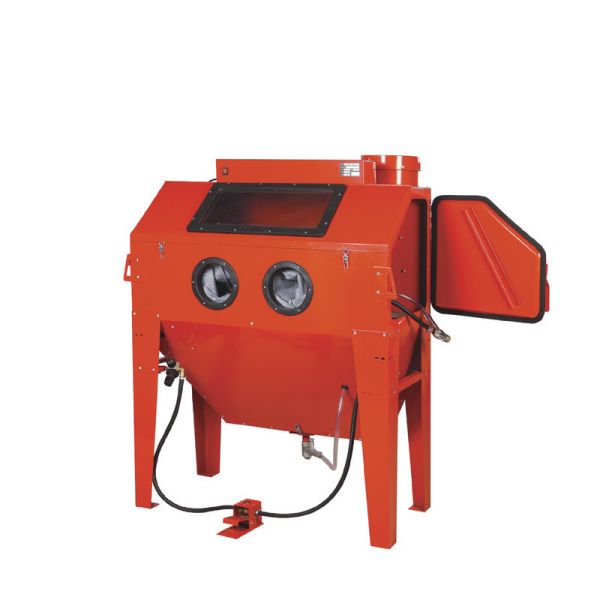
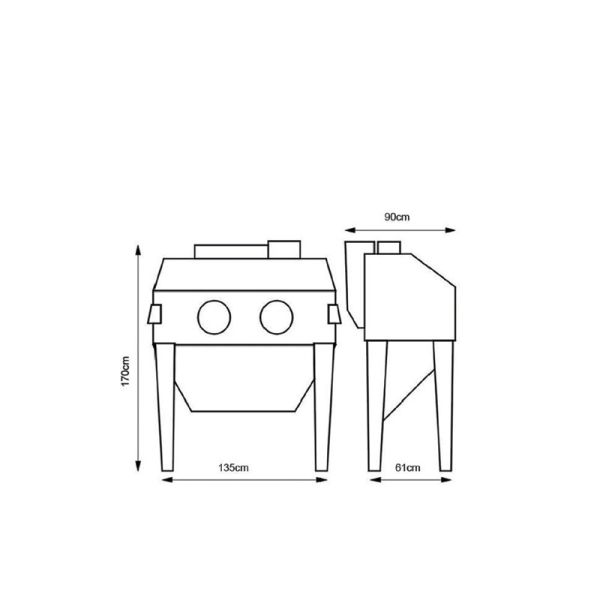
YD45-002 420L Capacity Industrial Cabinet Sandblaster addresses the limitations of small sandblasters: "inability to handle large workpieces, low media efficiency, and fragile structures". With "420L large capacity + heavy-duty industrial build + hands-free operation" as core strengths, it excels in large-scale and batch surface treatment, offering the following key advantages:
- Large Workpiece Compatibility: The 135×90×170cm cabinet (420L internal volume) accommodates large items like industrial machine parts, truck transmission casings, or heavy-duty gearboxes – workpieces that small sandblasters (≤200L) cannot handle. This eliminates the need for splitting workpieces into sections, reducing processing time by 40%.
- Batch Processing Ability: The spacious chamber allows loading 2-3 medium-sized workpieces (e.g., 2× automotive engine blocks) at once. For batch production (e.g., 50 metal brackets), this cuts total operation time by 30% compared to single-workpiece sandblasters, ideal for manufacturing plants with high throughput demands.
- Reinforced Frame & Panels: 14-gauge steel legs (thicker than industry-standard 16-gauge) provide strong load-bearing capacity, supporting up to 250kg workpieces without bending. The 16-gauge steel panels (powder-coated inside and out) resist corrosion from abrasive media and workshop moisture, ensuring a service life of 12+ years – 1.5x longer than uncoated or thin-steel cabinets.
- Functional Flooring System: Perforated steel flooring is designed to withstand heavy impacts (e.g., workpiece placement) without deformation. The integrated separating screen efficiently sorts usable media from debris, while the clean-out door enables quick waste removal – minimizing downtime for maintenance.
- Foot-Pedal + Pistol-Grip Design: The foot-pedal activates the blasting process, freeing both hands to maneuver the pistol-grip gun or adjust large workpieces. This design improves blasting precision (e.g., targeting hard-to-reach areas on complex parts) and reduces operator fatigue during long tasks (e.g., 2-hour machine part stripping).
- Efficient Media Metering: By eliminating traditional suction tubes/hoses, the integrated metering valve delivers uniform media flow to the gun. This prevents clogs and ensures consistent surface treatment, while reducing media waste by 25% – a significant cost-saving for high-volume operations. The brass flow valve in the foot pedal further enhances airflow control, ensuring stable blasting performance.
- Full Safety Protection: Natural rubber/vinyl blast gloves shield operators from abrasive media and dust, while the enclosed cabinet contains debris (no workplace contamination), meeting global industrial safety standards (e.g., OSHA). The powder-coated interior also prevents media from sticking to cabinet walls, reducing cleanup time.
- Bright Lighting for Precision: The external fluorescent lighting system illuminates the cabinet’s interior, allowing operators to detect fine defects (e.g., small paint residues) during blasting. This reduces rework rates by 20% and ensures consistent, high-quality surface finishes for critical parts.
Scenario Requirement: A machinery repair workshop needs to remove rust from 5 industrial gearboxes (each 80×50×40cm, rust thickness 1.2mm) for overhaul. The gearboxes are heavy (180kg each); the workshop requires efficient, safe blasting.
Operation Process:
- Prep & Setup: Use a hoist to place one gearbox into the 420L cabinet (fits easily), connect the sandblaster to a 125 PSI air compressor, put on blast gloves, and turn on the fluorescent light;
2. Blasting: Activate the foot pedal, use the pistol-grip gun to blast the gearbox – rust is fully removed in 20 minutes per unit;
3. Media Recycling: After each gearbox, open the clean-out door to remove debris; 96% of steel grit is recycled;
4. Completion: 5 gearboxes processed in 1.8 hours; all surfaces meet overhaul standards.
Effect: Large capacity fits heavy gearboxes; foot-pedal operation saves labor; media recycling cuts costs.
Scenario Requirement: An auto plant needs to finish 100 truck axle housings (each 70×40×30cm) with glass bead blasting (matte finish). The plant requires high throughput and consistent quality.
Operation Process:
- Batch Loading: Load 2 axle housings into the cabinet at once (420L capacity allows side-by-side placement);
2. Blasting Setup: Set pressure to 95 PSI (gentle for glass beads), activate foot pedal – each batch takes 8 minutes;
3. Efficiency: Operators alternate loading/unloading while blasting, completing 100 housings in 7 hours (vs. 10 hours with small sandblasters);
4. Quality Control: Bright lighting ensures uniform finish; no rework needed.
Effect: Batch processing boosts throughput; precise pressure ensures quality; spacious chamber reduces loading time.
Scenario Requirement: A fabrication shop needs to strip old paint from 3 steel structural beams (each 100×30×20cm, paint thickness 0.5mm) before welding. The beams are long and require full-surface stripping.
Operation Process:
- Workpiece Placement: Slide the beam into the cabinet (135cm length fits perfectly);
2. Blasting Operation: Set pressure to 110 PSI, use aluminum oxide media – the beam’s paint is stripped in 12 minutes per unit;
3. Cleanup: After stripping, open the clean-out door to remove paint chips; the beam is ready for welding immediately.
Effect: Long cabinet length fits structural beams; efficient stripping avoids manual sanding; enclosed design keeps the shop clean.
A1: Clogging is usually due to media size or moisture. Solutions: 1) Check Media Size: Ensure steel grit is within 0.5-2mm (oversized particles block the valve); sieve media before use to remove large debris; 2) Dry Media: Moisture causes media clumping – store steel grit in a dry container and add a desiccant pack if workshop humidity is high; 3) Clean the Valve: Turn off air supply, disassemble the metering valve, and flush with compressed air (100 PSI) to clear clogs. Clean the valve weekly for daily use to prevent buildup.
A2: No. The cabinet’s 14-gauge steel legs and perforated flooring are rated for max 250kg. Exceeding this weight will bend the legs or damage the flooring, affecting blasting precision and safety. For heavier workpieces (e.g., 300kg+), use a specialized heavy-duty sandblaster with reinforced 12-gauge steel framing. If you must blast a 250-300kg workpiece, place a steel support plate under it to distribute weight evenly – but this is not recommended for long-term use.
A3: Air leakage typically comes from worn valve seals or loose connections. Fixes: 1) Inspect Seals: Disassemble the foot pedal, check the rubber seals inside the brass valve – replace them with original manufacturer seals (generic seals may not fit); 2) Tighten Connections: Ensure the air hose is tightly connected to the valve (use a wrench to secure fittings); 3) Test Pressure: After repair, check for leaks by applying 125 PSI pressure – no bubbles should form around the valve. Replace the entire brass valve if seals are irreparably worn.
A4: Preserve the powder coating with these steps: 1) Avoid Abrasive Impact: Use soft slings when loading/unloading workpieces to prevent scratches; do not hit the cabinet with tools; 2) Clean Regularly: Wipe the exterior with a damp cloth (no abrasive cleaners) to remove dust and media residue; vacuum the interior monthly to clear loose media; 3) Touch Up Chips: If coating chips occur, use matching powder-coat touch-up paint (provided by the manufacturer) to cover exposed steel – this stops rust from spreading. Following these steps maintains the coating for 8+ years.