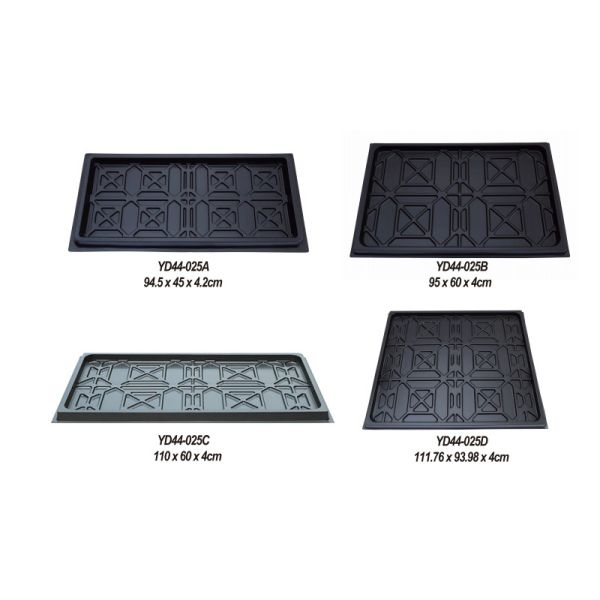
YD44-025 Series Oil Drip Trays solve the core pain point of "oil stains on workshop/garage floors" in vehicle maintenance, with "HDPE durability + multi-size coverage + leak-proof design" as the core. Each model targets specific vehicle types, delivering tailored value:
- All-Weather Durability: High-Density Polyethylene resists oil corrosion, chemical damage, and extreme temperatures (-25℃-75℃). Unlike metal trays that rust or thin plastic trays that crack, these HDPE trays maintain functionality for 8+ years, even with daily use in garages or outdoor maintenance yards.
- Easy Cleaning: The smooth, non-porous HDPE surface allows oil to be wiped off with a rag or rinsed with water. No stubborn oil residue builds up, reducing maintenance time by 70% compared to porous metal trays.
- Impact Resistance: The trays can withstand accidental impacts (e.g., tool drops, vehicle minor bumps) without cracking – a critical advantage for busy repair shops where equipment collisions are common.
- Compact YD44-025A: 94.5×45×4.2cm size fits under sedans (e.g., Honda Civic, Toyota Corolla) with low ground clearance (≥5cm). Its 18L capacity catches drips during oil changes or brake maintenance, ideal for home garages or small repair shops focusing on passenger cars.
- Medium YD44-025B: 95×60×4cm width covers SUV undercarriages (e.g., Toyota RAV4), where oil drip areas are wider than sedans. The 23L capacity handles longer maintenance sessions (e.g., 4-hour transmission repairs) without overflow.
- Large YD44-025C: 110×60×4cm length is designed for double-parking scenarios (two sedans parked closely). It eliminates the need for two separate trays, saving space and reducing costs for shops with limited floor area.
- Extra-Large YD44-025D: 111.76×93.98×4cm extra-large area covers heavy-duty truck undercarriages (e.g., Dongfeng Tianlong). The 42L capacity catches drips from large engines or hydraulic systems, making it a must-have for truck repair yards.
- Seamless Leak-Proof Construction: Each tray is molded in one piece with no seams or joints, ensuring zero oil seepage. Even if the tray is filled to 80% capacity, no oil leaks onto the floor – a key feature for complying with environmental regulations in commercial workshops.
- Easy Portability: Lightweight HDPE design allows 1 person to carry smaller models (025A/025B), while two people can move the extra-large 025D. This flexibility lets technicians place the tray exactly under drip points, instead of relying on fixed floor mats.
Scenario Requirement: A homeowner maintains a Honda Civic (sedan) in a 2×3m garage. The garage floor is concrete; no oil stains are allowed. The Civic has 14cm ground clearance.
Operation Process:
- Prep: Carry YD44-025A (3.2kg) to the garage, slide it under the Civic (94.5×45cm size fits perfectly);
2. Maintenance: Perform an oil change – the tray catches all 4.5L oil drips and residual coolant;
3. Cleanup: After maintenance, pull the tray out, wipe oil with a rag, and store it against the wall (occupies ≤0.5㎡ space).
Effect: Zero stains on the garage floor; compact size fits small spaces; easy for 1 person to handle.
Scenario Requirement: A repair shop services 10 SUVs (e.g., Toyota RAV4) daily. Each SUV needs 2-hour brake maintenance, with oil/coolant drips expected. The shop has 5 technicians.
Operation Process:
- Assignment: Each technician uses 1 YD44-025B – slide it under the SUV (95×60cm coverage catches all drips);
2. Maintenance: Conduct brake repairs; the 23L capacity holds all drips without overflow;
3. Cleaning: After service, rinse the tray with a hose, dry, and stack (up to 6 trays) in a storage cabinet.
Effect: Reduces floor cleanup time by 60%; durable design withstands daily use; stacking saves storage space.
Scenario Requirement: A busy workshop uses double parking (two sedans parked side-by-side in a 1.8×4m space) to save room. Each sedan needs 1-hour oil change; oil drips must be contained.
Operation Process:
- Placement: Roll YD44-025C (4.8kg) between the two parked sedans; its 110×60cm length covers both vehicles’ drip areas;
2. Maintenance: Service both sedans simultaneously – the tray catches drips from both without mixing fluids;
3. Efficiency: 1 tray replaces 2 smaller ones, freeing up 0.3㎡ of floor space per parking spot.
Effect: Optimizes double-parking space; reduces tray inventory; no cross-contamination of drips.
Scenario Requirement: A truck yard maintains 5 Sinotruk heavy-duty trucks (each with large undercarriage drip areas) weekly. The yard has gravel ground; environmental rules prohibit oil seepage.
Operation Process:
- Deployment: Two workers carry YD44-025D to each truck; slide it under the chassis (111.76×93.98cm area covers the entire drip zone);
2. Maintenance: Perform engine repairs – the 42L capacity holds drips from large oil pans or hydraulic lines;
3. Disposal: After service, pour collected oil into a waste tank; rinse the tray and store it outdoors (HDPE resists rain).
Effect: Prevents oil seepage into gravel (avoids fines); extra-large area eliminates missed drips; durable for outdoor use.
A1: Yes, all models can be stacked (up to 8 layers for 025A/025B, 6 layers for 025C, 4 layers for 025D). To avoid damage: 1) Only stack clean, dry trays – oil residue causes slipping; 2) Place a thin cardboard sheet between layers to prevent scratches; 3) Do not stack heavier models (025D) on top of lighter ones (025A). Stacking saves 80% of storage space, ideal for shops with limited inventory room.
A2: The textured surface of the trays reduces slipperiness, but extra precautions help: 1) Wipe excess oil with a rag immediately after use – do not let oil pool for hours; 2) For shops with frequent heavy use, apply a non-slip spray (compatible with HDPE) to the tray surface every 3 months; 3) When moving a full tray, hold it by the edges (not the center) to maintain grip. These steps eliminate slipping risks.
A3: No. The tray is designed to catch drips, not support vehicle weight. A heavy-duty truck (10+ tons) will crack the HDPE tray if it rolls onto it. To avoid this: 1) Place the tray only in areas where the truck’s wheels will not roll over it (e.g., under the engine, not near tires); 2) Use wheel chocks to secure the truck during maintenance, preventing accidental movement onto the tray.
A4: Dried oil can be cleaned with these steps: 1) Fill the tray with 5L warm water + 100ml dish soap (neutral detergent); 2) Let it soak for 30 minutes to soften the oil; 3) Scrub the surface with a soft-bristle brush (avoid steel wool that scratches HDPE); 4) Rinse thoroughly with high-pressure water. For stubborn stains, add 100ml white vinegar to the soapy water – vinegar dissolves dried oil without damaging the tray.