High-Temperature Mica Cable – Engineered for Extreme Heat
When standard PVC or silicone wires fail under extreme temperatures, our high-temperature mica cable delivers reliable performance where others cannot survive. Designed with a mica tape insulation layer combined with a fiberglass braid, this cable is built for applications that demand exceptional heat resistance, fire safety, and long-term durability.
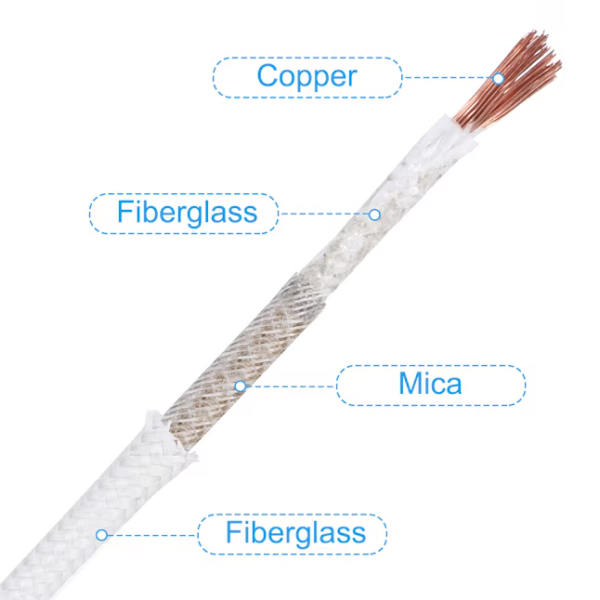
The conductor is available in bare copper, nickel-plated copper, or pure nickel stranded wire. Nickel-plated and pure nickel conductors offer superior oxidation and corrosion resistance at elevated temperatures, making them the preferred choice for extreme heat environments. The insulation system consists of two layers: mica tape wrapped directly over the conductor, followed by a braided fiberglass outer sleeve. Some grades also feature a high-temperature silicone or PTFE coating on the fiberglass braid for added protection.
Mica is a natural mineral material that is chemically neutral, non-toxic, and completely halogen-free. It provides excellent dielectric strength and acts as a unique barrier against fire propagation.
| Parameter | Value |
| Temperature Rating | 450°C – 550°C (continuous); up to 1000°C instantaneous |
| Voltage Rating | 300V – 600V |
| Conductor | Bare copper, nickel-plated copper, or pure nickel stranded wire |
| Insulation | Mica tape + fiberglass braid |
| Standards | UL758, UL1581, RoHS compliant |
| Flame Test | VW-1 rated |
| Available AWG | 26 AWG to 4 AWG (and larger) |
| Colors | White, black, red, blue, yellow, green, brown, and custom options |

Performance Features
Superior heat resistance: Withstands continuous operating temperatures from -60°C up to 550°C, far exceeding the capabilities of standard PVC (105°C) or silicone (150-200°C) wires.
Fire safety: Mica is non-combustible and does not propagate flames. It also reduces the volume of toxic gases and smoke released during a fire.
Chemical resistance: Resistant to acids, alkalis, moisture, and most industrial chemicals.
Mechanical durability: The fiberglass braid provides excellent abrasion resistance and mechanical protection.
Flexibility: Despite its rugged construction, the cable remains flexible enough for installation in tight spaces.
Dielectric strength: Mica insulation offers outstanding electrical insulation properties even at extreme temperatures
Common Applications

Our high-temperature mica cable is widely used in industries where heat is a constant challenge:
Household appliances: Internal wiring for ovens, toasters, electric kettles, rice cookers, and induction cooktops
Lighting: High-temperature lamp fixtures, headlamps, and LED drivers
Industrial equipment: Metallurgical furnaces, heat treatment systems, and extrusion machinery
Aerospace & automotive: Engine compartments, aircraft wiring, and electric vehicle battery systems
Power generation: Thermal power plants, boilers, and generator sets
Petrochemical: Refineries, chemical processing plants, and high-temperature sensor wiring
Emergency systems: Fire alarm cables, emergency lighting, smoke extractors, and control units
1. What is the maximum continuous operating temperature of this mica cable?
It depends on the specific UL style. Our UL5128 grade is rated for 450°C continuous, while UL5561 can handle 550°C continuous. For short-term exposure (e.g., fault conditions), the cable can withstand up to 1000°C for a few minutes without losing insulation integrity.
2. Is this cable flexible enough for tight installations?
Yes. Despite the mica tape and fiberglass braid, the stranded conductor design keeps the cable reasonably flexible. Bending radius is typically 6–8 times the outer diameter, which is comparable to silicone rubber cables. We recommend avoiding sharp kinks during installation to prevent cracking the mica layer.
3. What conductor material should I choose – bare copper, nickel‑plated, or pure nickel?
Bare copper works for applications up to 250°C and in dry, non‑corrosive environments.
Nickel‑plated copper is the most common choice for 450–550°C – it resists oxidation much better than bare copper.
Pure nickel is recommended when temperatures exceed 550°C or when the cable is exposed to aggressive chemicals or high‑humidity conditions over a long service life.
4. Can I use this cable outdoors or in wet locations?
The basic fiberglass braid is not waterproof. For outdoor or damp environments, we offer versions with an additional silicone‑varnish coating or a PTFE‑impregnated braid that provides moisture resistance. Please check the product code – if you need waterproofing, choose the “‑W” suffix option.
5. How does this mica cable compare to silicone or PTFE (Teflon) wires?
Silicone is flexible and cheap but limited to ~200°C – it degrades quickly above that.
PTFE can handle up to 260°C continuously, but it emits toxic fumes when overheated and is more expensive.
Mica cable outperforms both in extreme heat (up to 550°C), is halogen‑free, non‑toxic, and does not propagate flames. The trade‑off is slightly less flexibility and a larger bending radius.