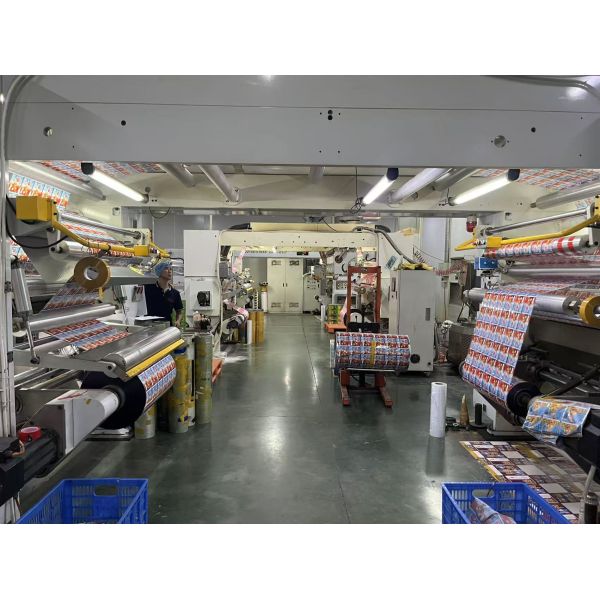
Beneath the vibrant branding and convenient shapes of modern packaging lies a foundational industrial product: the flexible packaging film roll. This is not the final package you see on the shelf, but its essential precursor—the high-performance, multi-layered raw material supplied on massive spools to packaging converters.
Think of it as the "operating system" for product preservation and distribution. Just as an OS manages a device's core functions, these engineered films manage the critical variables—moisture, oxygen, light, and durability—that determine a product's shelf life, safety, and integrity.
Manufacturers don't just choose "plastic"; they select from a portfolio of materials, each contributing a specific performance attribute to the final structure:
The Structural Agents (PET, BOPP): Provide the package's backbone, ensuring it can be printed on, handled, and shipped without failure.
The Barrier Sentinels (AL, VMPET, EVOH): Act as the primary defense. They are the gatekeepers that selectively block oxygen, moisture, aromas, or light from reaching the product.
The Fusion Agents (PE, CPP, RCPP): Function as the inner "welding" layer. They create a secure, hermetic seal during the packaging process, with specialized grades like RCPP capable of withstanding extreme conditions.
The true innovation is in the lamination sequence—the specific order in which these materials are combined. This sequence is the functional "code" written to solve a specific product's vulnerability.
Code for "Crispness": BOPP > VMPET > PE
Logic: A glossy exterior for branding, a metallic core to block degrading elements, and a reliable inner layer to seal it all in. The result is a potato chip that stays fresh.
Code for "Sterility": PET > AL > RCPP
Logic: A tough outer layer, an absolute aluminum barrier, and a heat-proof sealant. This creates a package that can be sterilized and stored for years, like a ready-to-eat meal.
Code for "Freshness": PA > EVOH > PE
Logic: A puncture-resistant nylon, an exceptional oxygen barrier, and a sealable interior. This is the recipe for preserving fresh meats and cheeses in a controlled atmosphere.
This technology is the silent workhorse enabling:
Globalized Food Supply: Allowing food to travel vast distances without spoiling.
Pharmaceutical Integrity: Ensuring medicines and medical devices remain sterile and potent.
Consumer Convenience: Making products lighter, easier to store, and simpler to use.
Brand Expression: Providing a high-quality, printable surface that serves as a mobile billboard.
The shift to this packaging format is a story of superior performance and efficiency:
Radical Source Reduction: It achieves more protection with less material than any rigid alternative, minimizing resource use from the outset.
Logistical Superiority: Its lightweight and space-saving nature drastically reduces fuel consumption and emissions across the entire supply chain.
Precision Engineering: Protection is no longer one-size-fits-all. It can be microscopically tailored to a product's specific needs.
Enhanced User Experience: It enables features that rigid packaging cannot, such as resealability, easy pouring, and lightweight portability.
In summary, a flexible packaging film roll is the sophisticated, pre-fabricated "source code" for the modern package. It is a composite material system, engineered at a molecular level to deliver unparalleled protection, efficiency, and functionality, making it one of the most impactful and ubiquitous technologies in global manufacturing and commerce.
| Material | Full Name & Common Name | Key Properties & Primary Use |
|---|---|---|
| PET | Polyethylene Terephthalate (Polyester) | Strong, stiff, glossy with excellent gas/aroma barrier. Used as outer layer for durability and printability. |
| BOPP | Biaxially Oriented Polypropylene | Stiff with excellent clarity, high gloss, moisture barrier. Common outer layer for snacks and labels. |
| CPP | Cast Polypropylene | Good clarity with excellent heat resistance. Used as inner sealant layer for standard applications. |
| PA | Polyamide (Nylon) | Extremely tough, puncture-resistant with good gas barrier. Middle layer for heavy-duty products. |
| PE | Polyethylene | Excellent moisture barrier, flexible with good low-temperature resistance. LDPE often serves as sealant layer. |
| RCPP | Retort Cast Polypropylene | Special CPP grade with very high heat resistance. Inner sealant layer for retort sterilization packages. |
| VMPET | Vacuum Metallized PET | Provides excellent gas and light barrier at lower cost than foil. Middle barrier layer. |
| AL | Aluminum (Foil) | Ultimate barrier impermeable to gases, moisture, light and odors. Middle layer for sensitive products. |
| EVOH | Ethylene Vinyl Alcohol | Exceptional oxygen barrier. Always sandwiched between moisture-resistant layers as middle barrier. |
| End-Use Product | Typical Material Structure | Layer Functions |
|---|---|---|
| Potato Chips | BOPP / VMPET / PE | Print/Gloss / Oxygen & Light Barrier / Seal |
| Retort Meal | PET / AL / RCPP | Strength / Ultimate Barrier / Retortable Seal |
| Frozen Vegetables | PET / PE | Strength / Low-Temp Seal |
| Coffee Bag | PET / AL / PE | Strength / Aroma & Oxygen Barrier / Seal |
| Shampoo Sachet | PET / AL / PE | Strength / Leak & Moisture Barrier / Seal |
| Fresh Meat (MAP) | PA / EVOH / PE | Puncture Resistance / Oxygen Barrier / Seal |
These material combinations create lightweight, cost-effective, and highly protective packaging solutions tailored to preserve and present products across industries.