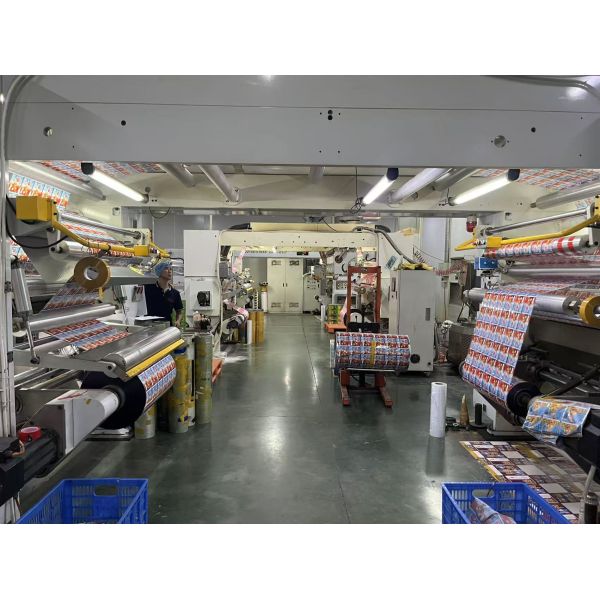
Think of a product—from a gourmet coffee to a life-saving vaccine. It needs a protective layer that is precisely engineered for its unique vulnerabilities: oxygen, moisture, light, or physical impact. Flexible packaging film rolls are that custom-built "second skin," manufactured as massive, continuous sheets before being tailored into the final package.
No single material can do everything, so they are combined in layers to achieve specific properties. Here are the most common materials:
| Material | Full Name & Common Name | Key Properties & Primary Role |
|---|---|---|
| PET | Polyethylene Terephthalate (Polyester) | Strong, stiff, glossy, excellent print surface. Used as the outer layer. |
| BOPP | Biaxially Oriented Polypropylene | Stiff, crystal clear, high gloss, moisture barrier, cost-effective. Common outer layer. |
| PE | Polyethylene | Excellent moisture barrier, flexible, sealable. LDPE is a common sealant layer. HDPE is stiffer. |
| CPP | Cast Polypropylene | Good clarity, excellent heat resistance. Used as the inner sealant layer. |
| RCPP | Retort Cast Polypropylene | A special heat-resistant CPP. Used as the sealant for packages sterilized in an autoclave (retort pouches). |
| PA | Polyamide (Nylon) | Extremely tough, puncture and abrasion-resistant. Used as a middle layer for heavy-duty products. |
| EVOH | Ethylene Vinyl Alcohol | Exceptional Oxygen Barrier. Its weakness is moisture, so it's always sandwiched between other layers as a middle barrier layer. |
| AL | Aluminum (Foil) | The ultimate barrier. Impermeable to gases, moisture, and light. Used as a middle layer. |
| VMPET | Vacuum Metallized PET | PET with a thin layer of aluminum. Provides a good gas & light barrier at lower cost and more flexibility than foil. A middle barrier layer. |
| Metalized BOPP/CPP | - | Provides a decorative metallic finish and enhanced barrier properties. |
Instead of a simple list, imagine these materials as a designer's palette, where each "color" represents a specific functional property.
| Material "Element" | Its Functional "Color" | Core Personality |
|---|---|---|
| PET & BOPP | The Armor | Provides the structural integrity and the brilliant, printable "face" of the package. |
| AL & VMPET | The Fortress | Creates an impenetrable (or nearly so) shield against gases, light, and moisture. |
| EVOH | The Bouncer | A specialist that excels at one job: blocking oxygen from spoiling the product. |
| PE & CPP | The Embrace | Forms the gentle, reliable inner layer that seals the package shut with a secure bond. |
| PA (Nylon) | The Chainmail | Adds incredible toughness and puncture resistance against sharp or heavy contents. |
The true innovation lies in the architecture. These elemental layers are laminated into a multi-strata structure, a microscopic high-rise where each floor has a dedicated job.
For the Snack Shelf (The Crisp-Preserver):
Architecture: Armor (BOPP) / Fortress (VMPET) / Embrace (PE)
Design Logic: A tough, attractive exterior wraps a light-blocking core, all sealed by a reliable inner layer to lock in freshness.
For the Ready-Meal (The Autoclave-Survivor):
Architecture: Armor (PET) / Fortress (AL) / Super-Embrace (RCPP)
Design Logic: Maximum durability, an absolute barrier, and a sealant engineered to withstand the brutal heat and pressure of sterilization.
For the Fresh Cut Meat (The Oxygen-Blocker):
Architecture: Chainmail (PA) / Bouncer (EVOH) / Embrace (PE)
Design Logic: A tough shell protects from punctures, a specialized core scavenges oxygen, and a sealant keeps the protective atmosphere intact.
This engineered skin is ubiquitous, serving critical roles across modern life:
The Daily Convenience: Your morning coffee bag, your child's juice pouch, the salad bag from the supermarket.
The Preserved Pantry: The bag of rice, the frozen vegetable pack, the refill pouch for hand soap.
The Critical Guardian: The sterile barrier for a syringe, the moisture-proof bag for electronics, the chemical-resistant sack for fertilizer.
This approach to packaging has fundamentally changed the industry because it is:
Radically Efficient: It achieves maximum protection with minimal material, slashing weight, waste, and shipping costs.
Precision-Engineered: Unlike one-size-fits-all rigid packaging, its protection can be custom-designed at a molecular level for the product inside.
A Conduit of Experience: It transforms utility into experience with easy-open spouts, resealable zippers, and tactile, visually stunning surfaces.
Inherently Sustainable: Its light weight means a dramatically lower carbon footprint in transit. While end-of-life recycling is a challenge, its source reduction is a major environmental win.
In summary, flexible packaging film rolls are not merely plastic sheeting. They are highly sophisticated, laminated structures—a "performance material" engineered from the atom up to be the lightest, smartest, and most effective protective skin for the goods we use every day.
The shift from rigid packaging (like glass and metal cans) to flexible formats is driven by significant advantages:
In summary, flexible packaging film rolls are the engineered, multi-layered "raw material" that form the basis of modern, high-performance, and efficient packaging for a massive range of consumer and industrial products.