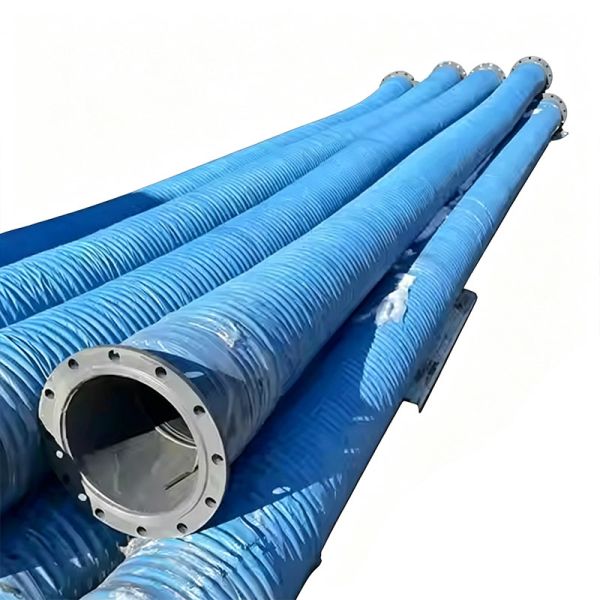
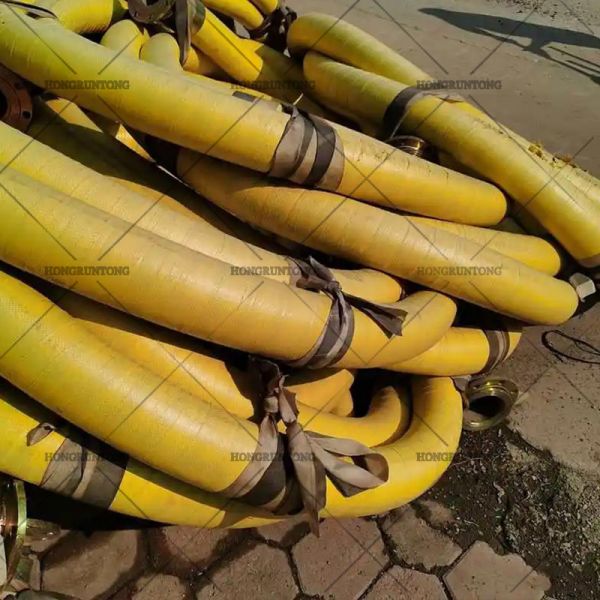
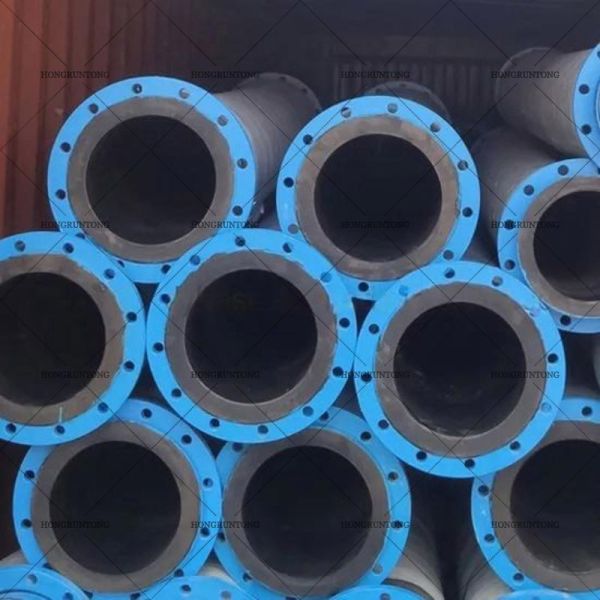
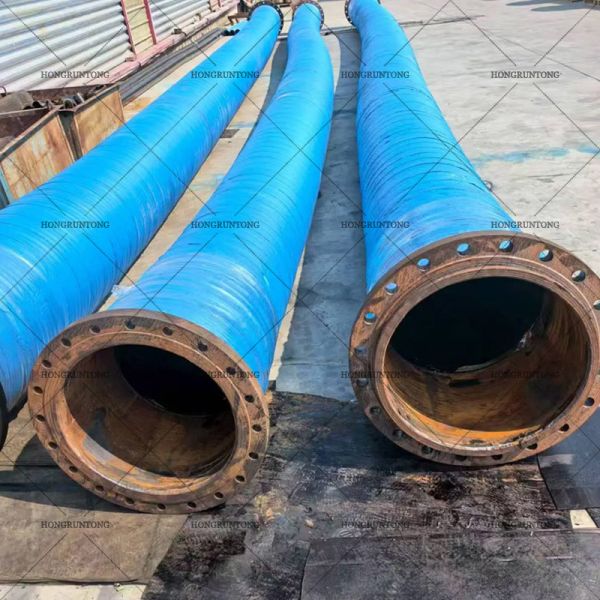
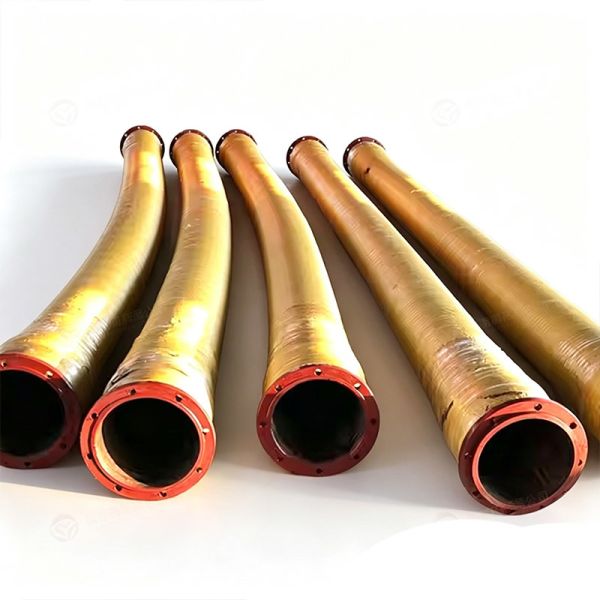
Hongruntong Marine Dredging Rubber Hose is designed for high-intensity slurry transfer and solid material conveying systems in offshore energy projects, deep-sea engineering, mining operations, and large-scale hydraulic infrastructure. It is manufactured using high-tensile synthetic rubber, multi-layer fabric reinforcement, and steel wire helix structure to ensure stable performance under extreme pressure, continuous abrasion, and dynamic marine conditions.
The hose is specifically developed to transport abrasive and high-density media such as sand, gravel, sludge, tailings, and sediment mixtures. The inner tube uses advanced wear-resistant rubber compounds that significantly reduce erosion caused by continuous high-velocity particle flow. The outer cover is engineered with marine-grade protective materials that resist seawater corrosion, UV radiation, ozone exposure, and mechanical damage.
Compared with standard industrial hoses, it provides higher structural stability, longer operational lifespan, and improved safety under fluctuating pressure conditions. It is suitable for continuous operation in demanding dredging systems, floating pipelines, and offshore pumping networks where reliability is critical.
Subsea pipeline support project for offshore wind farm foundation dredging: A large offshore wind farm construction project in Northern Europe required seabed dredging and foundation preparation for turbine installation across deep-water zones with complex seabed geology. The operation involved continuous removal and transportation of sand, clay, and rock fragments under strong tidal currents and low-temperature marine conditions.
The original pipeline system experienced severe wear issues, pressure instability, and frequent maintenance interruptions due to abrasive seabed materials and harsh offshore exposure. These problems affected dredging efficiency and delayed foundation installation schedules.
Hongruntong Marine supplied reinforced Dredging Rubber Hoses with enhanced low-temperature flexibility, high abrasion resistance inner lining, and multi-layer pressure reinforcement structures designed for offshore energy engineering applications. After implementation, the dredging system achieved more stable material flow and improved pressure consistency across long-distance subsea transfer lines.
The hose system demonstrated strong resistance to abrasion and maintained flexibility under low-temperature marine conditions. Maintenance frequency was significantly reduced, and overall dredging efficiency improved, enabling faster completion of foundation preparation work for wind turbine installation.


| Parameter | Value |
|---|---|
| Name | Dredging Rubber Hose |
| Nominal Bores | From 150mm (6") to 1200mm (47") |
| Length | Up to 11.8 Metres (38ft) |
| Working Pressure | Up to 20 bar |
| Safety Factor | 4:1 |
| Flange Options | Fixed, Swivel, Double-Flange and Built-in-Nipple Designs |
| Features | Heavy-Duty Robust Construction Designed to Handle Large Dredged Particles Hoop-Ring or Spring-Wire-Helix Construction for Flexibility or Full Vacuum During Service Tailor-Made Designs, Including Self-Floater, Suction Dredge Hose and Flexible Discharge Hoses Suitable for Slurries Containing Rock, Shell and Coral |
| Model | I.D. (inch) | I.D. (mm) | W.P. (bar) | B.P. (bar) | Min Bending Radius(mm) | Wear Layer Thickness (mm) | Length (m) |
|---|---|---|---|---|---|---|---|
| HM-DHP150 | 6 | 150 | 5-10 | 15-30 | 8D | 10-20 | 11.8 |
| HM-DHP200 | 8 | 200 | 5-10 | 15-30 | 8D | 10-20 | 11.8 |
| HM-DHP250 | 10 | 250 | 5-10 | 15-30 | 8D | 10-20 | 11.8 |
| HM-DHP300 | 12 | 300 | 10-20 | 30-60 | 12D | 12-25 | 11.8 |
| HM-DHP350 | 14 | 350 | 10-20 | 30-60 | 12D | 12-25 | 11.8 |
| HM-DHP400 | 16 | 400 | 10-20 | 30-60 | 12D | 12-25 | 11.8 |
| HM-DHP450 | 18 | 450 | 10-20 | 30-60 | 12D | 12-25 | 11.8 |
| HM-DHP500 | 20 | 500 | 10-20 | 30-60 | 12D | 12-25 | 11.8 |
| HM-DHP600 | 24 | 600 | 15-20 | 45-60 | 15D | 20-30 | 11.8 |
| HM-DHP650 | 26 | 650 | 15-20 | 45-60 | 15D | 20-30 | 11.8 |
| HM-DHP700 | 28 | 700 | 20-25 | 60-75 | 15D | 30-50 | 11.8 |
| HM-DHP750 | 30 | 750 | 20-25 | 60-75 | 15D | 30-50 | 11.8 |
| HM-DHP800 | 32 | 800 | 20-25 | 60-75 | 15D | 30-50 | 11.8 |
| HM-DHP850 | 34 | 850 | 20-25 | 60-75 | 15D | 30-50 | 11.8 |
| HM-DHP900 | 36 | 900 | 25-30 | 75-90 | 15D | 30-50 | 11.8 |
| HM-DHP1000 | 40 | 1000 | 25-30 | 75-90 | 15D | 50-75 | 11.8 |
| HM-DHP1100 | 44 | 1100 | 25-30 | 75-90 | 15D | 50-75 | 11.8 |
The inner layer is engineered using high-performance rubber compounds designed for extreme seabed dredging conditions involving sand, rock fragments, clay, and dense sediment mixtures. It provides strong resistance against continuous particle impact and internal erosion in high-speed slurry flow environments. The smooth internal structure reduces turbulence and improves hydraulic efficiency, making it suitable for long-distance offshore pumping systems where abrasion levels are extremely high.
The hose uses multi-layer reinforcement consisting of high-strength textile cords and steel wire spirals to ensure structural integrity under fluctuating deep-sea pressure conditions. It maintains dimensional stability during continuous pumping operations and prevents deformation caused by external hydrostatic pressure and internal flow variations. This structure enhances safety performance in offshore engineering environments where system failure risk must be minimized.
The outer cover is formulated for harsh marine climates, including low-temperature seawater, high salinity exposure, UV radiation, and strong mechanical abrasion. It maintains elasticity and structural performance in cold offshore regions, ensuring reliable operation in deep-sea environments where temperature fluctuations can affect material stability.
The hose maintains controlled flexibility while preserving high structural strength, allowing it to adapt to floating systems, subsea pipelines, and moving dredging platforms. It performs reliably under wave impact, tidal movement, and continuous vibration, ensuring stable slurry transport in complex offshore construction environments.
Yes, it is designed for offshore and deep-sea dredging operations with high pressure and harsh marine conditions.
Yes, it maintains flexibility and structural stability in low-temperature offshore environments.
Yes, it is widely used in seabed preparation and foundation dredging for offshore wind projects.
It offers higher deep-sea pressure resistance, better abrasion performance, and improved environmental durability.
Yes, it is commonly used in trenching, backfilling, and slurry transport for subsea pipeline installation.