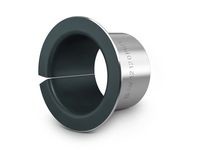
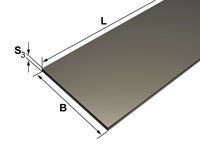
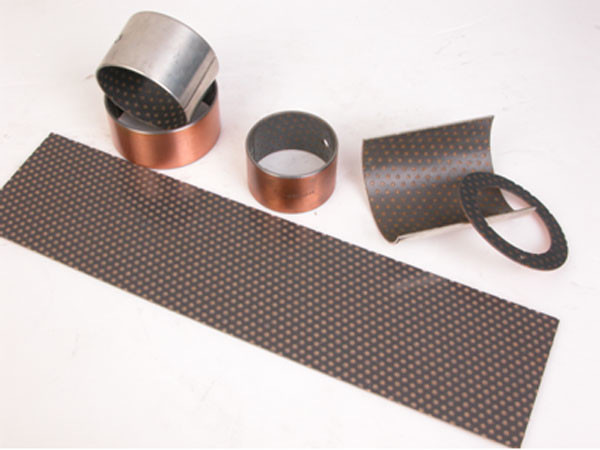
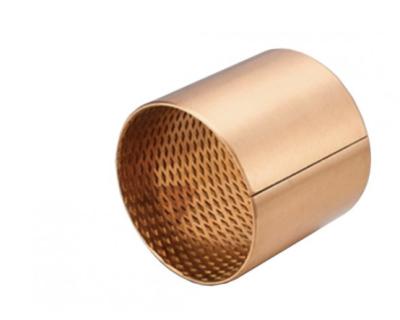
It is not possible to find the desired solution for plain bearing applications with products made of maintenance-free materials for all duties and applications. For such duties and applications, low-maintenance materials are available. In this case, the sliding surfacetaking up the wear load is formulated from a PVDF (Polyvinylidene Fluoride) matrix.

It is designed for maintenance-free, dry-running applications, but can also be employed in systems with liquid lubrication.
The unique features:
| Characteristics | Unit | P10, P11 | P14 | P147* |
| Unleaded | – | No | Yes | Yes |
| pvmax | MPa · m/s | 1.8 | 1.6 | 1.4 |
| pmax.stat. | MPa | 250 | 250 | 250 |
| pmax.dyn. | MPa | 56 at v ≤ 0.032 m/s | 56 at v ≤ 0.029 m/s | 56 at v = 0.025 m/s |
| vmax | m/s | 2 at p ≤ 0.90 MPa | 1 at p ≤ 1.60 MPa | 0.8 at p ≤ 1.75 MPa |
| T | °C | -200 to +280 | -200 to +280 | -200 to +280 |
The solid lubricant mass is produced in a specially adapted mixing process. In a parallel, continuous sintering operation, bronze powder is sintered onto the steel or bronze back as a sliding layer. This produces a sliding layer with a thickness from 0.2 mm to 0.35 mm and a pore volume of approx. 30 %. Next, the cavities are filled with solid lubricant by means of impregnating rollers.
This process step is controlled in such a way that a running-in layer of solid lubricant up to max. 0.03 mm thick is produced above the sliding layer. In further thermal treatments, the characteristic properties of the material system are adjusted, and the required thickness tolerances of the composite material are produced using controlled roller pairs.
1.Maintenance-free operation under dry-running conditions
2.Rotating or oscillating movements
3.Up to a velocity of 2 m/s
4.Linear movements
5.Temperature range -200 °C to 280 °C
The unique features:
| Characteristics | Unit | P20, P22*, P23* | P200, P202*, P203* |
| Unleaded | – | No | Yes |
| pvmax | MPa · m/s | 3 | 3.3 |
| pmax.stat. | MPa | 250 | 250 |
| pmax.dyn. | MPa | 70 at v ≤ 0.042 m/s | 70 at v ≤ 0.047 m/s |
| vmax | m/s | 3 at p ≤ 1.00 MPa | 3.3 at p ≤ 1.00 MPa |
| T | °C | -40 to +110 | -40 to +110 |
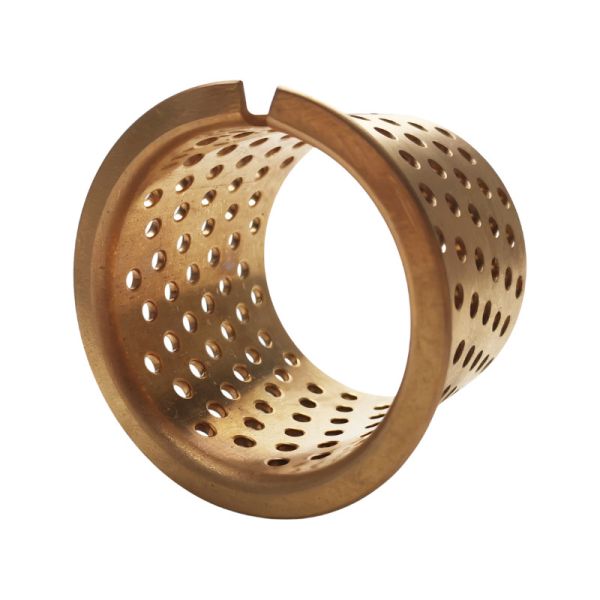
To reduce the coefficient of friction and improve thermal conductivity, special additives are mixed into the matrix. In addition, the surface of the sliding layer may optionally be equipped with lube bore relieves to accommodate grease or oil.