strial machine esafety fencing system
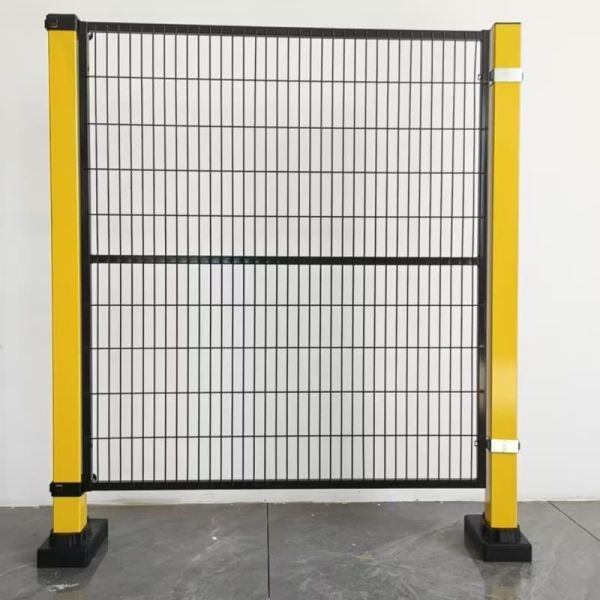
BDINDUSTRIAL company For Industrial Machine Safety Fencing Systems, the core purpose is to create a reliable physical barrier for isolation, protecting personnel, preventing accidental intrusion, and ensuring compliance with stringent safety regulations. Its features and selection logic share similarities with logistics robot fencing, but protection for industrial machinery typically demands higher and more professional standards.
BDINDUSTRIAL General Characteristics of Industrial Machine Safety Fencing
| Feature Dimension | Specific Description |
|---|---|
| Core Design Objective | Mandatory physical isolation to prevent personnel from entering hazardous zones (e.g., robotic arm working envelope, rotating parts, pinch points). |
| Structural Strength | Must withstand potential impact or crushing forces (e.g., from flying workpieces or equipment malfunction), often using heavier-duty profiles and more robust connections. |
| Safety Standards | Must strictly comply with national/international machinery safety standards, such as China's GB/T 15706, Europe's ISO 13857, America's ANSI/RIA R15.06, etc. These standards specify safety distances, height (typically ≥1.8m), opening sizes (to prevent limb access), etc. |
| Common Materials | Heavy-duty steel frame, industrial aluminum profiles (for cleanrooms or adjustable layouts), metal wire mesh or solid panels (for splash, dust protection). |
| Safety Integration | Fencing access gates must be equipped with safety interlocking devices (safety door switches, solenoid locks, etc.) to ensure hazardous equipment stops immediately or enters a safe state when the door is open. |
| Visibility & Ventilation | Metal mesh allows observation and airflow while providing protection; special scenarios (e.g., welding) may require splash-resistant viewing windows. |
BDINDUSTRIAL Detailed Explanation of Core Selection Points:
Performance Level (PL) & Risk Assessment
This is the first and most critical step. A risk assessment must be conducted following standards like EN ISO 12100 to determine the risk level.
Based on EN ISO 13849-1, determine the required Performance Level (PL) that the safety control system (including fencing and its interlocks) must achieve. High-risk machinery (e.g., power presses) typically requires PL d or PL e.
Defining Physical Specifications
Height & Safety Distance: According to ISO 13857, fence height must maintain a certain horizontal distance from the hazard, ensuring a person cannot reach the danger zone even by reaching through.
Aperture Size: The size of mesh or gaps in the fence must prevent fingers, hands, or limbs from passing through (refer to specific values in ISO 13857).
Detailed Material & Structure Selection
Heavy-Duty Steel Fencing: The most common choice. Advantages: Extremely high strength, cost-effective, very durable. Disadvantages: Heavyweight, potential for rust (requires surface treatment), less flexible for layout changes. Typical Applications: Automotive manufacturing, metalworking, injection molding machines.
Industrial Aluminum Profile Fencing: Advantages: Modern appearance, lightweight, inherently corrosion-resistant, requires no painting, modular design for easy reconfiguration and expansion. Disadvantages: Higher initial cost, absolute impact strength is lower than heavy steel. Typical Applications: Robotic work cells, assembly lines, clean rooms, laboratories.
Metal Mesh/Solid Panel Fencing: Advantages: Effectively blocks flying debris, sparks, liquids, or noise, providing more complete enclosure. Disadvantages: Reduces visibility and ventilation, can make space feel enclosed. Typical Applications: Welding stations, spray booths, machining centers generating chips.
Mandatory Integration of Safety Systems
Safety Interlocks: Every access gate on the fencing must be equipped with a safety interlock switch (e.g., tongue-operated, hinge-operated). When the door is opened, the switch immediately cuts power to the equipment or triggers the safety controller to initiate a stop.
Auxiliary Devices: In higher-risk areas, it may be necessary to add safety light curtains, safety laser scanners, or pressure-sensitive safety mats inside the fencing to create multiple layers of protection.
Signage & Compliance
Clear safety signs conforming to standards like ISO 7010 must be displayed on the fencing, such as "Danger," "Unauthorized Entry Prohibited," "Lock Out Before Maintenance."
The final installed system must pass a safety inspection and have accompanying safety documentation.

If your equipment is heavy-duty, high-risk machinery (e.g., large stamping presses, foundry equipment), prioritize Heavy-Duty Steel Fencing and ensure the interlock system achieves PL e.
If your environment is an automated production line, collaborative robot area, or has cleanliness requirements (e.g., food, electronics), Industrial Aluminum Profile Fencing is a more flexible and aesthetic choice.
If your process generates significant splash or debris (welding, cutting), opt for fencing with solid panels or fine mesh panels, and consider explosion-proof or fire-resistant requirements.
Always consult a professional industrial safety supplier or integrator. They can provide compliant safety distance calculations, correct interlock product selection, and assist with final risk assessment and compliance certification.