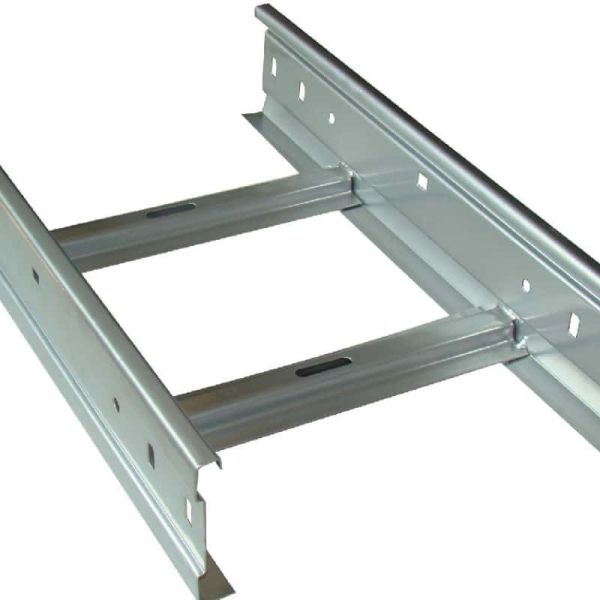
The Straight Cable Ladder is the fundamental, linear backbone of any cable management system. It serves as the primary runway for routing and supporting cables over long, uninterrupted distances. Manufactured to precise industry standards from hot-dip galvanized steel, aluminum, or stainless steel, these straight sections provide a rigid, ventilated, and reliable pathway that forms the core of the entire tray network. As the essential building block, they are designed for effortless interconnection with a full suite of fittings (bends, tees, crosses) to create a complete and customized cable routing solution for power, data, and communication infrastructure across all sectors.
The Straight Cable Ladder segment is the workhorse component in cable tray installations. Its purpose is to create the main, linear trunk lines from which all other fittings branch or divert. Characterized by its open-ladder design—featuring two parallel side rails connected by solid, evenly spaced rungs—it prioritizes cable accessibility, superior heat dissipation, and straightforward installation.
These sections are engineered for structural continuity and load-bearing integrity over specified spans. Their standardized design ensures seamless compatibility with matching connectors and accessories from the same manufacturing system, guaranteeing a secure, mechanically sound, and professional installation. Available in a comprehensive range of widths, depths, and load ratings, straight ladders can be specified to meet the exact capacity and strength requirements of any project, from a simple office conduit to the heavy-duty backbone of an industrial plant.
Core Advantages:
Forms the System Backbone: Provides the primary, continuous pathway for cable runs, onto which all other fittings connect.
Engineered for Strength & Span: Designed to carry specified uniform and concentrated loads over defined support intervals (e.g., 3m, 6m) without sagging.
Maximum Ventilation & Accessibility: The open rung design allows optimal airflow to prevent cable overheating and enables easy cable placement or retrieval from above at any point.
Standardized & Interconnectable: Manufactured to consistent dimensional standards (width, depth, side rail profile) for perfect compatibility with system fittings, ensuring a unified and strong assembly.
Easy to Handle & Install: Straight lengths are typically lightweight, easy to measure, cut (if needed), and align during installation, speeding up project timelines.
Key Configurations:
By Width: Ranging from narrow (50mm, 100mm) for light cables to wide (600mm, 900mm+) for high-density bundles.
By Load Class: Light, Medium, Heavy, and Extra-Heavy Duty variants, differing in material gauge and rung spacing.
By Material: Hot-Dip Galvanized Steel (standard corrosion resistance), Aluminum (lightweight, good corrosion resistance), Stainless Steel (maximum corrosion resistance for harsh environments).
Typical Applications (As the Main Trunk):
Horizontal Runs: Along ceilings and walls in factories, data centers, and commercial buildings.
Vertical Risers: In shafts and mezzanine transitions (when used with vertical bends).
Overhead Trunking: As the main distribution artery in power plants, substations, and utility corridors.
| Item | Specification Details |
|---|---|
| Type | Standard Straight Section / Straight Length. |
| Standard Materials | Hot-Dip Galvanized Steel (HDG), Aluminum Alloy (e.g., 6063), Stainless Steel (304/316). |
| Common Standard Widths (W) | 50mm, 100mm, 150mm, 200mm, 300mm, 450mm, 600mm, 750mm, 900mm, 1200mm. |
| Common Side Rail Heights (H) | 50mm, 75mm, 100mm, 150mm, 200mm. |
| Standard Lengths | 3.0 meters (most common for handling), 6.0 meters (for reduced joints in long runs). Custom cut lengths are available. |
| Load Class & Design | Light (A), Medium (B), Heavy (C), Extra-Heavy (D) per NEMA VE 1 / IEC 61537. Load-span tables define performance. |
| Rung Spacing (Center-to-Center) | Varies by duty: Light/Medium: 225-300mm; Heavy: 150-225mm; EHD: 100-150mm. |
| Connection Ends | Ends are square-cut and pre-punched with bolt holes for connection via splice plates. Some systems feature slotted ends for length adjustment during installation. |
| Finish/Coating | HDG: Zinc coating per ISO 1461/ASTM A123. Aluminum: Mill, anodized, or powder-coated. SS: Mill, brushed, or polished. |
| Compliance Standards | Manufactured to comply with IEC 61537, NEMA VE 1, BS EN 61537, AS/NZS 2053. |
| Identification & Marking | Often labeled with width, depth, material, and load class for easy identification on site. |
| Packaging | Bundled in stacks by identical size, securely strapped to prevent damage. Typically shipped on pallets for easy handling with forklifts. |