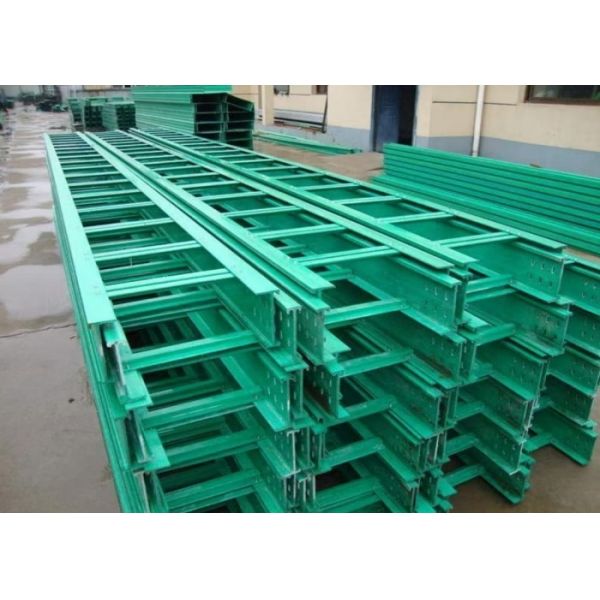
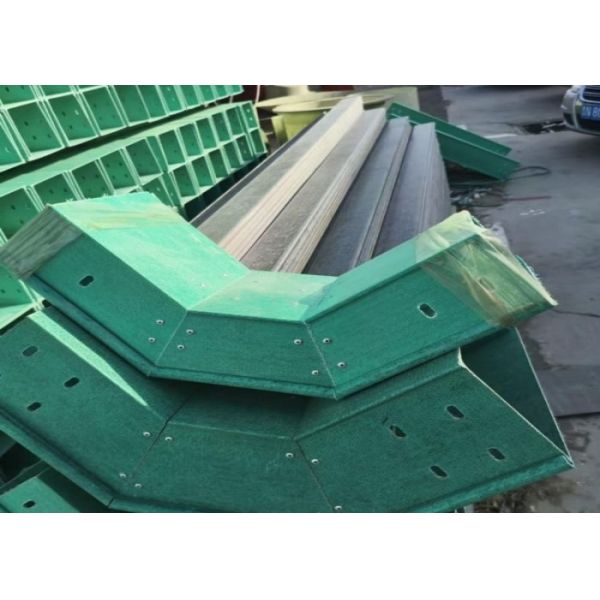
fibreglass cable ladder
The most prominent features of fiberglass ladder trays are their exceptional corrosion resistance and lightweight nature.
| Characteristic Dimension | Specific Description & Advantages |
|---|---|
| 1. Superior Corrosion Resistance | Key Advantage. Made from unsaturated polyester resin and fiberglass, it offers excellent resistance to acids, alkalis, salts, oils, and most organic solvents. Its lifespan far exceeds metal trays and it is maintenance-free. |
| 2. Lightweight & High Strength | Density is about 1/4 that of steel and 2/3 that of aluminum, yet it offers high mechanical strength, facilitating handling and installation and reducing load on support structures. |
| 3. Excellent Electrical Insulation | The material itself is non-conductive, making it an ideal choice for applications requiring electrical isolation, avoidance of stray currents, or lightning protection, ensuring safety. |
| 4. Flame Retardancy & Low Smoke Halogen-Free (LSZH) | High-quality products achieve flame retardant ratings (e.g., UL94 V-0), producing low smoke and no toxic gases when burned, suitable for crowded places like subways and shopping malls. |
| 5. Design Flexibility & Aesthetics | Can be molded into complex shapes, colors are customizable (common: grey, yellow), with a smooth, aesthetically pleasing surface that is UV resistant, ideal for exposed outdoor installations. |
The table below clearly shows its differences from mainstream metal ladders:
| Feature | FRP Ladder Tray | Hot-Dip Galv. Steel Ladder | Aluminum Ladder |
|---|---|---|---|
| Corrosion Resistance | Excellent (for strong acids/bases) | Good (for humid atmosphere) | Good (natural oxide film) |
| Weight | Very Light | Very Heavy | Light |
| Strength/Stiffness | High (but lower than steel) | Highest | Medium |
| Electrical Conductivity | Insulator | Conductor | Conductor |
| Flame Retardancy | Excellent (customizable) | Non-combustible, but conductive | Non-combustible, but conductive |
| Cost | Relatively High | Medium | High |
| Typical Scenario | Chemical, Marine, Water Treatment | General Industry, Outdoors | Data Centers, Weight-sensitive |
When selecting a fiberglass ladder tray, you must focus on its material composition and structural design:
| Selection Dimension | Key Parameters & Basis for Choice |
|---|---|
| Resin System & Reinforcement | Core. Confirm resin type (Ortho/Isophthalic/Vinyl Ester); Isophthalic and Vinyl Ester resins offer superior corrosion resistance. Glass fiber content (typically ≥25%) and layup process determine strength. |
| Mechanical Properties | Must request data: Flexural Strength (≥150MPa), Flexural Modulus, Barcol Hardness (≥40). These directly indicate load-bearing capacity and stiffness. |
| Load Rating & Span | Select based on load-span curves. Its elastic modulus is lower than metals, so support spans often need to be shorter, or reinforcing ribs may be required. |
| Fire Safety & Environmental Certs | Verify Flame Retardant Rating (e.g., GB 8624 B1, UL94), Smoke Density Rating, Toxicity Index to ensure compliance with project safety codes. |
| Installation & Environment | Coefficient of thermal expansion is 2-3 times that of steel; long runs require expansion joints. For outdoor use, it must contain UV stabilizers. |

Core Value: It is the ultimate solution for projects in highly corrosive environments, with high insulation requirements, or sensitive to weight.
Preferred (Often Essential) Applications:
Strongly Corrosive Industries: Chemical plants, electroplating facilities, pickling lines, pharmaceutical plants, coastal power stations.
Marine & Water Treatment: Ships, offshore platforms, docks, wastewater treatment plants.
Special Safety Requirements: Flammable/explosive areas (requires anti-static type), substations/rail transit requiring strict insulation.
Outdoor with Aesthetic/Weathering Needs: Cable routing in parks, scenic areas.
Not Recommended or Requiring Careful Evaluation:
Extreme High Temperatures: Continuous service temperature is typically not recommended to exceed 70-100°C (depends on resin), much lower than metals.
Continuous Heavy Load or Long Spans: Its creep characteristic is more pronounced than metal's, making it unsuitable for very long spans (e.g., >4m) or sustained loads at its limit.
Extremely Cost-Sensitive, General Environments: In ordinary dry indoor settings, galvanized steel trays are a more economical choice.