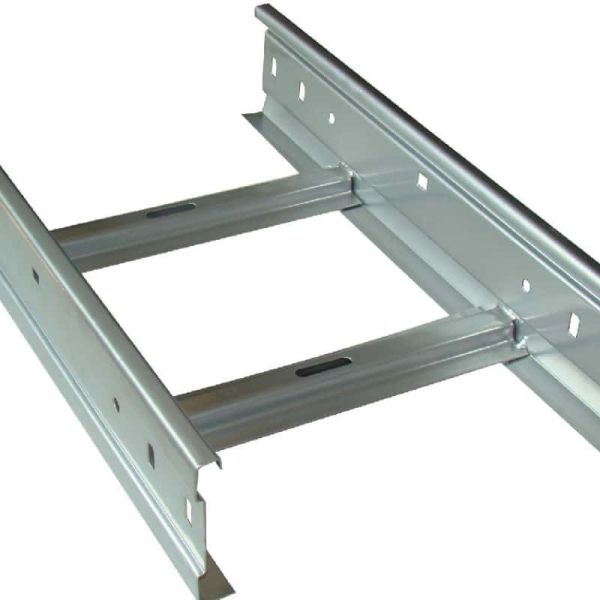
The Electrical Cable Ladder is the primary and purpose-engineered support system for the safe, organized, and efficient routing of power cables and heavy electrical conductors. Designed to meet the rigorous demands of electrical installations, it provides a high-strength, ventilated, and fully accessible pathway that ensures cable integrity, facilitates heat dissipation, and simplifies maintenance. Fabricated from robust, non-combustible materials like hot-dip galvanized steel or aluminum, and engineered to comply with stringent electrical and safety standards, it is the indispensable infrastructure for power distribution in commercial buildings, industrial plants, data centers, and utility projects worldwide.
The Electrical Cable Ladder is a specialized subset of cable management systems, explicitly designed to address the unique requirements of power cable installations. Its defining ladder-type construction—featuring solid side rails and transverse rungs—creates an optimal balance of mechanical strength and open ventilation.
This design is critical for electrical applications: it allows heat generated by current-carrying conductors to dissipate freely, preventing overheating that can lead to insulation degradation, energy loss, and fire risk. The open structure also provides unparalleled access for installation, inspection, and future circuit modifications, supporting the evolving needs of electrical infrastructure over its lifespan.
Engineered with safety and reliability as paramount concerns, these ladders are rated to carry significant loads over long spans, ensuring cables are securely supported and protected from sagging or undue stress. As a code-compliant and engineered solution, it replaces ad-hoc methods of cable support, providing a safer, more organized, and professionally recognized installation.
Core Advantages:
Optimized for Power Cables: Designed to support the weight and manage the heat of heavy, large-diameter power cables, busbars, and conduits.
Enhanced Safety & Compliance: Provides a secure, grounded, and code-compliant support method, reducing risks associated with improper cable hanging and facilitating compliance with NEC, IEC, and local electrical codes.
Superior Heat Management: The open-ladder design promotes maximum air circulation around cables, a critical factor for maintaining ampacity ratings and prolonging cable life.
Future-Proof Flexibility: Enables easy addition, removal, or re-routing of circuits without system overhaul, accommodating facility expansions and upgrades.
High Structural Integrity: Offers excellent load-bearing capacity and impact resistance, protecting critical power distribution pathways from physical damage.
Main Product Styles:
Heavy & Extra-Heavy Duty Ladder: The standard for main power distribution trunks and high-capacity feeds, with close rung spacing for dense cable support.
Ventilated Tray with Ladder Frame: Combines a perforated base for added cable support with the strength of side rails, suitable for mixed power and control cable runs.
Wire Mesh Ladder (for specific applications): Offers lightweight support and extreme flexibility in routing, often used for lower-voltage power or in complex layouts.
Typical Applications:
Main and Sub-Distribution Electrical Rooms
Industrial Plant Power Distribution (Motor Control Centers, Switchgear Feeds)
Data Center Power Busway and PDU Connections
Generator and Transformer Bay Cable Routing
Commercial Building Rising Mains and Feeder Lines
| Item | Specification Details |
|---|---|
| Primary Function | Structural support and management of power cables, busbars, and heavy electrical conductors. |
| Standard Materials | Hot-Dip Galvanized Steel (HDG) – Most common, offering strength and corrosion resistance. Aluminum Alloy – Lightweight, non-magnetic, and corrosion-resistant. Stainless Steel – For highly corrosive or cleanroom environments. |
| Load Classification | Primarily Heavy (C) and Extra-Heavy (D) Duty per NEMA VE 1 / IEC 61537, to support substantial cable weights. Certified load-span tables are mandatory. |
| Standard Widths (W) | 150mm, 300mm, 450mm, 600mm, 900mm (to accommodate large cable bundles and maintain bend radius). |
| Standard Depths (H) | 75mm, 100mm, 150mm, 200mm (deeper sides provide greater rigidity and sidewall protection). |
| Rung Specifications | Material: Solid steel bar (Ø8mm-10mm common). Spacing: 150mm (EHD), 225mm (HD) for optimal cable support and safety. Secured by continuous welding. |
| Finish / Corrosion Protection | HDG: Minimum zinc coating of 610 g/m² (85µm) per ASTM A123/ISO 1461. Paint or Powder Coat over HDG is available for color-coding (e.g., safety red for fire circuits, yellow for caution). |
| Electrical Safety Features | Designed to provide a continuous, low-impedance grounding path. Non-combustible material. Edges are smooth to prevent cable sheath damage. |
| Compliance & Standards | Engineered to meet IEC 61537, NEMA VE 1, NEC (National Electrical Code) Article 392, and relevant local safety standards. Third-party certification (e.g., UL, CE) is often available. |
| Accessories | Full system of matching bends, tees, crossovers, support clamps, and cable cleats designed for electrical applications. |
| Installation Hardware | Hot-dip galvanized or stainless steel splice plates, bolts, nuts, and spring washers to maintain corrosion protection and ensure a solid electrical connection between sections. |
| Fire Performance | Material is inherently non-combustible. Systems can be specified with fire-rated coatings or barriers to meet specific circuit integrity (CI) requirements. |