| Parameters | P860 | |||
|---|---|---|---|---|
| Min | Typical | Max | Unit | |
| Output current[PK] | 0.5 | - | 7.2(6.0 RMS) | A |
| Supply voltage | 24 | 36 | 75 | Vac |
| Pulse Voltage | 4 | 5 | 28 | Vdc |
| Logic signal current | 7 | 10 | 16 | mA |
| Pulse input frequency | 0 | - | 200 | KHz |
| Isolation resistance | 500 | - | - | MΩ |
| Cooling | Natural Cooling or Forced cooling | |
|---|---|---|
| Operating Environment | Environment | Avoid dust, oil fog and corrosive gases |
| Ambient Temperature | 0℃ -50℃ (32℉ -122℉) | |
| Humidity | 40%RH -90%RH | |
| Operating Temperature | 70℃ (158℉) Max | |
| Storage Temperature | -20 ℃ - 65℃ (-4℉ - 149℉) | |
| Weight | Approx. 280g (10 oz) | |
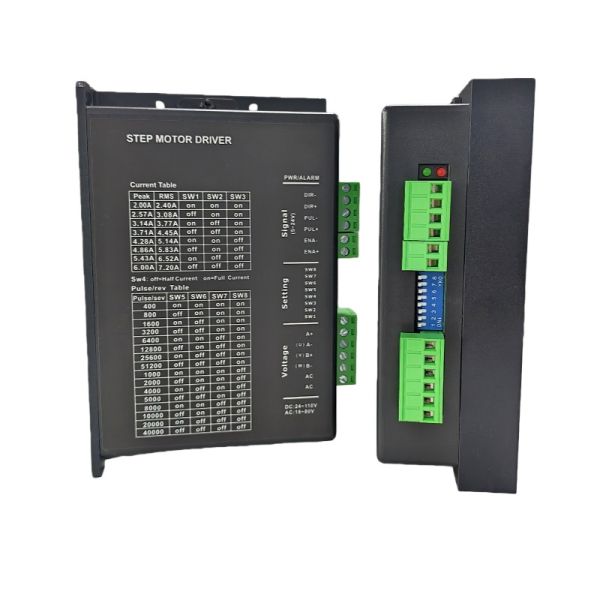
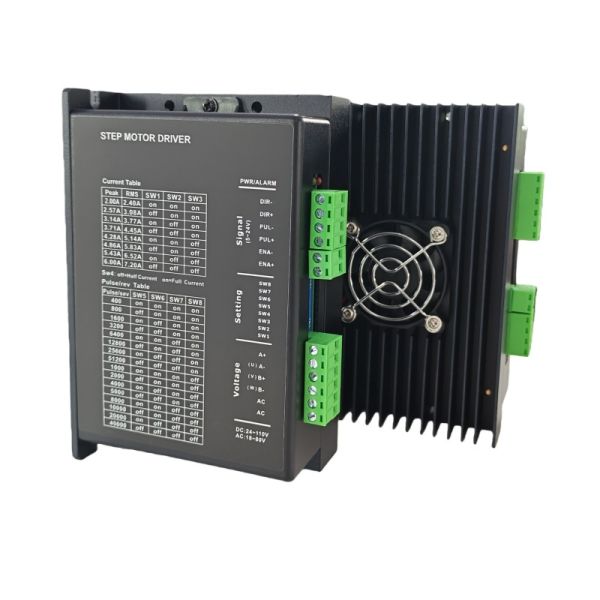
The P860 has two connectors, connector P1 for control signals connections, and connector P2 for power and motor connections. The following tables are brief descriptions of the two connectors. More detailed descriptions of the pins and related issues are presented in section 4, 5, 9.
| Pin Function | Details |
|---|---|
| PUL+ | Pulse signal: In single pulse (pulse/direction) mode, this input represents pulse signal,active at each rising or falling edge (software configurable). In double pulse mode (software configurable), this input represents clockwise (CW) pulse, active both at each high level and low level. 4-28V for PUL-HIGH, 0-0.5V for PUL-LOW. For reliable response,pulse width should be longer than 2.5μs for 200K MAX input frequency or 1μs for 500K MAX input frequency. |
| PUL- | |
| DIR+ | Dir signal: In single-pulse mode, this signal has low/high voltage levels,representing two directions of motor rotation; in double-pulse mode (software configurable), this signal is counter-clock (CCW) pulse,active both at high level and low level (software configurable). For reliable motion response, DIR signal should be ahead of PUL signal by 2.5μs at least. 4-28V when DIR-HIGH,0-0.5V when DIR-LOW. Please note that rotation direction is also related to motor-Drive wiring match. Exchanging the connection of two wires for a coil to the Drive will reverse motion direction. |
| DIR- | |
| ENA+ | Enable signal: This signal is used for enabling/disabling the Drive. High level (NPN control signal, PNP and Differential control signals are on the contrary,namely Low level for enabling.) for enabling the Drive and low level for disabling the Drive. Usually left UNCONNECTED (ENABLED). |
| ENA- |
The P860 supports PUL/DIR and CW/CCW modes and pulse actives at rising or falling edge. See more information about these settings in Section 13. Default setting is PUL/DIR mode and rising edge active (NPN, and PNP control signal is on the contrary).
| Pin Function | Details |
|---|---|
| GND | Power Ground. |
| +Vdc | Power supply, 20~80 Vdc, Including voltage fluctuation and EMF voltage. |
| A+,A- | Motor Phase A |
| B+,B- | Motor Phase B |
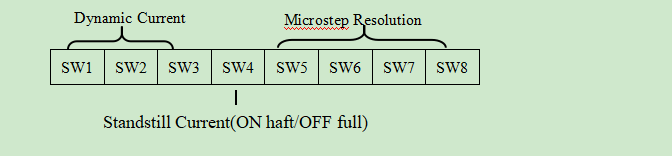
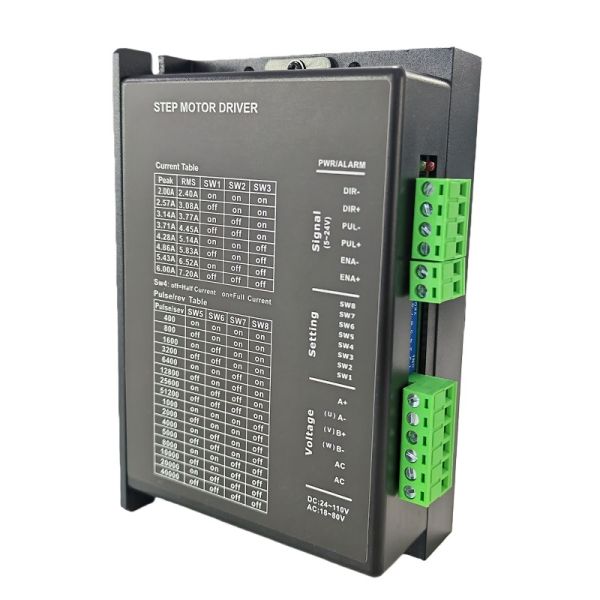
Microstep resolutions and output current are programmable, the former can be set from full-step to 102,400 steps/rev and the latter can be set from 0.5A to 5.6A. See more information about Microstep and Output Current Setting in Section 13. However, when it’s not in software configured mode, this Drive uses an 8-bit DIP switch to set microstep resolution, and motor operating current, as shown below:
When it’s not in software configured mode, microstep resolution is set by SW5, 6, 7, 8 of the DIP switch as shown in the following table:
| Microstep | Steps/rev.(for 1.8°motor) | SW5 | SW6 | SW7 | SW8 |
|---|---|---|---|---|---|
| 2 | 400 | ON | ON | ON | ON |
| 4 | 800 | OFF | ON | ON | ON |
| 8 | 1600 | ON | OFF | ON | ON |
| 16 | 3200 | OFF | OFF | ON | ON |
| 32 | 6400 | ON | ON | OFF | ON |
| 64 | 12800 | OFF | ON | OFF | ON |
| 128 | 25600 | ON | OFF | OFF | ON |
| 256 | 51200 | OFF | OFF | OFF | ON |
| 5 | 1000 | ON | ON | ON | OFF |
| 10 | 2000 | OFF | ON | ON | OFF |
| 20 | 4000 | ON | OFF | ON | OFF |
| 25 | 5000 | OFF | OFF | ON | OFF |
| 40 | 8000 | ON | ON | OFF | OFF |
| 50 | 10000 | OFF | ON | OFF | OFF |
| 100 | 20000 | ON | OFF | OFF | OFF |
| 200 | 40000 | OFF | OFF | OFF | OFF |
For a given motor, higher Drive current will make the motor to output more torque, but at the same time causes more heating in the motor and Drive. Therefore, output current is generally set to be such that the motor will not overheat for long time operation. Since parallel and serial connections of motor coils will significantly change resulting inductance and resistance, it is therefore important to set Drive output current depending on motor phase current, motor leads and connection methods.Phase current rating supplied by motor manufacturer is important in selecting Drive current, however the selection also depends on leads and connections.
When it’s not in software configured mode, the first three bits (SW1, 2, 3) of the DIP switch are used to set the dynamic current. Select a setting closest to your motor’s required current.
| Peak Current | RMS Current | SW1 | SW2 | SW3 |
|---|---|---|---|---|
| Default/Software configured | ON | ON | ON | |
| 3.08A | 2.57A | OFF | ON | ON |
| 3.77A | 3.14A | ON | OFF | ON |
| 4.45A | 3.71A | OFF | OFF | ON |
| 5.14A | 4.28A | ON | ON | OFF |
| 5.83A | 4.86A | OFF | ON | OFF |
| 6.52A | 5.43A | ON | OFF | OFF |
| 7.20A | 6.00A | OFF | OFF | OFF |
Notes: Due to motor inductance, the actual current in the coil may be smaller than the dynamic current setting, particularly under high speed condition.