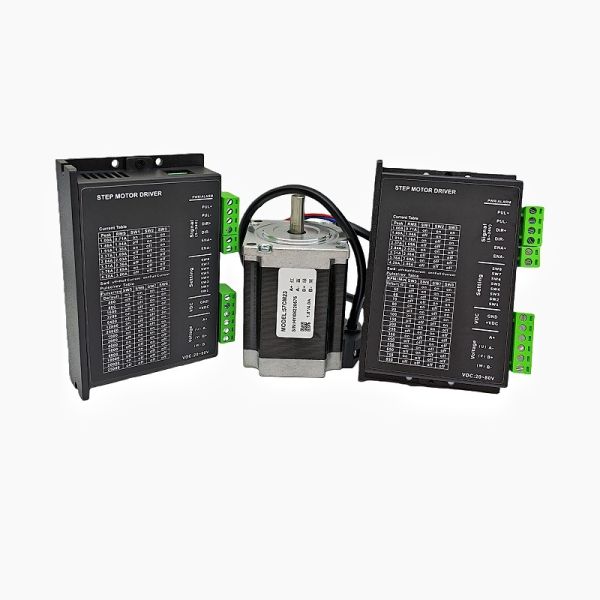
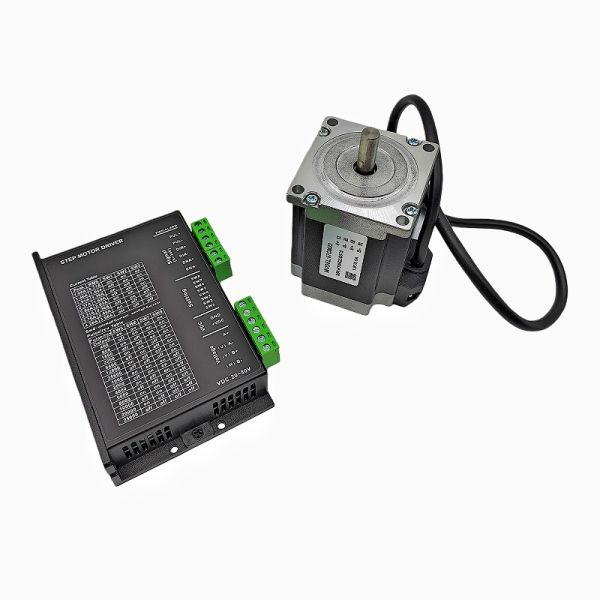
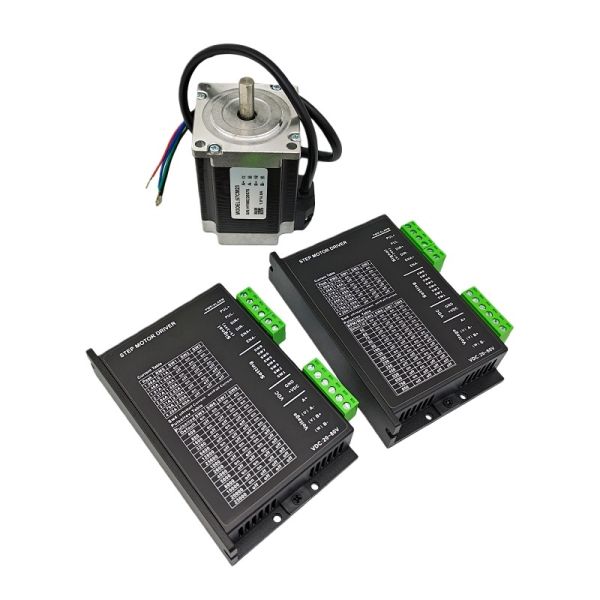
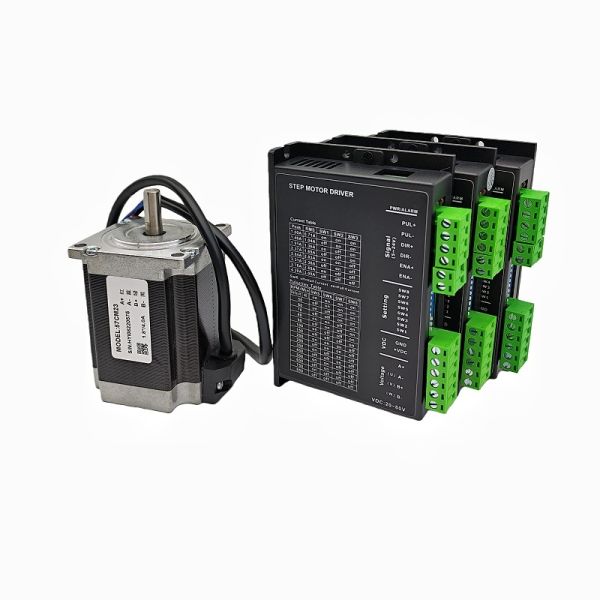
57CM23-5A Stepper Motor & DM542 Driver Combination Introduction
The combination of 57CM23-5A (NEMA23 two-phase stepper motor) and DM542 (digital two-phase stepper driver) is a commonly used open-loop precision motion assembly in industrial automation, suitable for small and medium-sized load applications requiring high-precision positioning.
I. Core Parameters Overview
57CM23-5A Stepper Motor
- Model: 57CM23-5A
- Specification: NEMA23 (57mm), two-phase hybrid type, motor length 76mm, shaft diameter 8mm
- Holding Torque: 2.3N·m
- Rated Current: 5.0A per phase
- Step Angle: 1.8° (200 steps per revolution without subdivision)
- Lead Wires: 4 wires (Bipolar)
- Features: High precision, low heat generation, low vibration, compatible with open-loop driving
DM542 Stepper Driver
- Power Supply: DC 18-50V (24-48V recommended)
- Output Current: 1.0-4.2A (8 adjustable gears, peak current 4.2A)
- Subdivision: 15 gears (maximum 25600 steps per revolution)
- Control Interface: PUL/DIR/EN (opto-isolated, pulse response 200kHz)
- Protection Functions: Overvoltage/undervoltage/overcurrent/inter-phase short-circuit protection
- Dimensions: 118×75.5×34mm
II. Key Matching Points of the Combination
- Current Matching: The motor’s rated current is 5.0A, while the DM542’s peak output current is 4.2A. The driver’s current DIP switch must be set to 4.2A for safe and stable operation (derated use).
- Power Supply Recommendation: DC 36-48V is recommended to balance high-speed torque and heat control.
- Subdivision Setting: 16-64 subdivision is suggested to improve smoothness and reduce vibration noise, suitable for engraving machines, small CNC machines, automatic sliding tables, etc.
- Wiring Specifications: Connect the 4 motor wires to the driver’s A+, A-, B+, B- terminals; connect the control terminals (PUL/DIR/EN) to PLC or single-chip microcomputer, adopting common cathode or common anode to match the system level.
- Heat Dissipation & Protection: The driver requires good ventilation; enable automatic half-current mode when the motor runs at low speed for a long time to reduce heat generation.
III. Performance & Application Scenarios
- Advantages: Simple and easy-to-use open-loop control with low cost; high positioning precision of subdivision driving (up to ±0.01mm level); stable low-speed operation and excellent high-speed torque performance; complete protection functions and high reliability.
- Application Scenarios: Suitable for small and medium-sized load precision positioning occasions such as 3D printers, laser cutting machines, small CNC machines, dispensing machines, automatic assembly lines, and testing equipment.
- Note: The load torque shall not exceed 2.0N·m (85% derating) to avoid step loss. For loads beyond this range, a stepper motor with higher torque or a closed-loop solution is recommended.
IV. Wiring & Debugging Steps
1. Power Supply: Connect DC 24-48V to the driver’s V+ and V- terminals, and connect the protective ground.
2. Motor: Connect A+ and A- to motor winding A; connect B+ and B- to motor winding B (confirm phase sequence).
3. Control: Connect PUL to pulse signal, DIR to direction signal, and EN to enable signal (can be left floating to activate).
4. DIP Switch Setting: Set the current to 4.2A, subdivision to 16/32/64, and enable half-current mode.
5. Debugging: First run at low speed to observe the rotation direction and smoothness; gradually increase the speed to confirm there is no step loss, overheating or abnormal noise.
V. Common Problems & Solutions
- Motor Step Loss: Check if the load is overloaded; increase the power supply voltage; enhance subdivision; reduce acceleration.
- Excessive Noise/Vibration: Increase subdivision to above 16; optimize mechanical installation (add buffer/fasten components); check wiring phase sequence.
- Driver Alarm: Check the power supply voltage; confirm the current setting; troubleshoot motor winding short circuit or open circuit.