Interior WPC Wall Panel Waterproof Anti Warp
Product Name
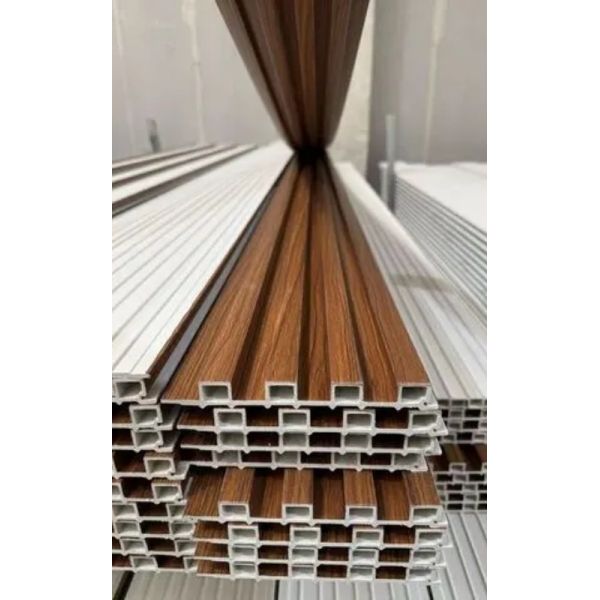
Exclusively engineered for high-humidity indoor hospitality lounges, premium spa wall claddings, and commercial basements demanding dual perfection in hydrological biosecurity and geometric alignment, this premium Interior WPC Wall Panel Waterproof Anti Warp sets a global technical standard. Leveraging an advanced molecular formulation, the homogeneous profile features a micro-cellular closed-cell lattice that seals out airborne vapor and water condensation to block localized mold growth. Fortified with structural crystalline anti-creep stabilizers and a high-strength interlocking seam design, this matrix successfully neutralizes linear expansion forces and ambient heat movements, delivering permanent, warp-free linear aesthetics for enterprise procurement.
Product Features
Closed-Cell Hydrophobic Lattice Stops Liquid Infiltration
Non-Porous Inert Surface Prevents Black Mold Colonization
Anti-Creep Structural Matrix Eradicates Deep-Span Bowing
How to Install
Timber Batten / Substrate Board Method
Applicable Surfaces:
Bare concrete walls, lightweight partition walls, or old walls with poor flatness.
Core Tools:
Timber battens or 9mm/12mm OSB boards as substrate, expansion anchors, brad nails.
Step-by-Step Installation:
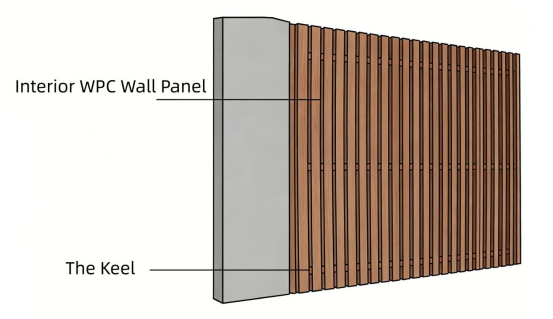
Leveling & Substrate Installation: Install timber battens at intervals of ≤ 40cm, or fix an OSB sheet to the wall using expansion anchors. Use a laser level to ensure perfect vertical alignment.
Fixing the Panels: Position the panel and shoot nails at a 45-degree angle through the inner edge of the tongue.
Seamless Interlocking: Interlock subsequent panels via the tongue-and-groove joint to flawlessly hide all nail holes.

Technical Specifications
| No. | Property | Test Method | Technical Data |
| 1 | Dimensions | Caliper | 170mm x 16mm |
| 2 | Surface Gloss | Gloss Meter | 5 - 8 GU (Ultra-Matte) |
| 3 | Termite Resistance | Laboratory Test | Level 1 (Highly Resistant) |
| 4 | Water Absorption | ASTM D1037 | ≤ 0.5% (24h Immersion) |
| 5 | Fire Resistance | EN 13501-1 / GB 8624 | Class B1-s1, d0 |
| 6 | Formaldehyde | EN 717-1 | E0 Grade (≤ 0.05 mg/m³) |
| 7 | Shore Hardness | ASTM D2240 | Shore D 70 |
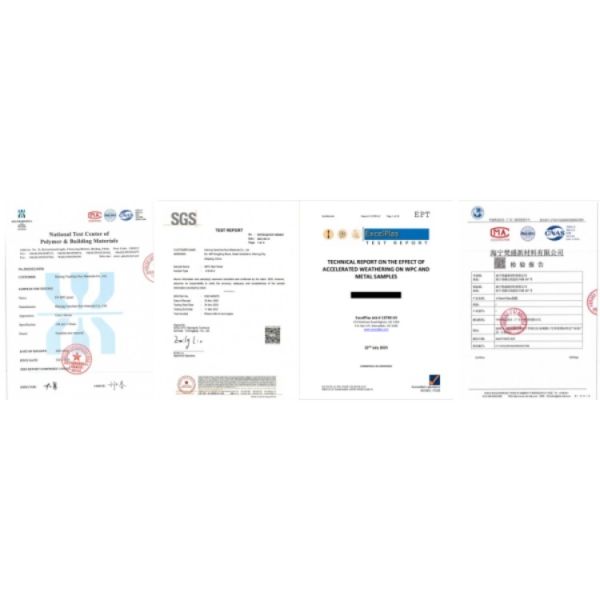
Certification

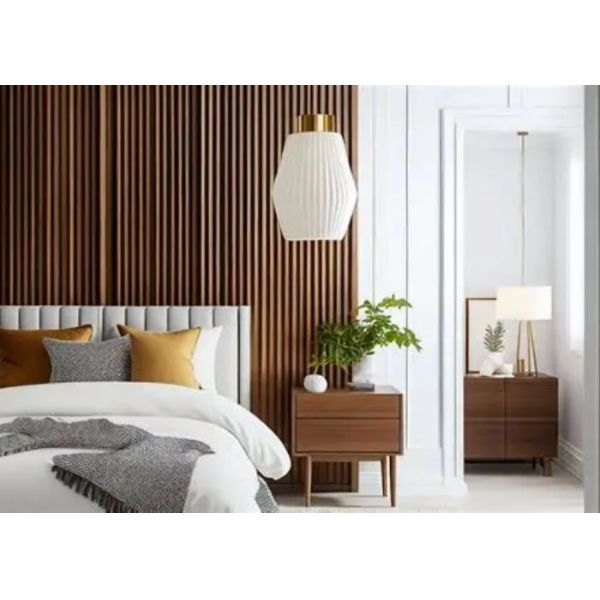
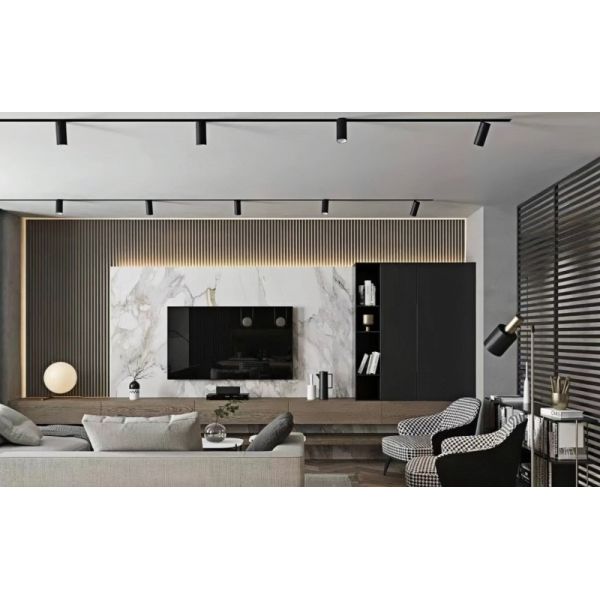
Application Gallery


Colors
,
FAQ
A: Standard natural wood and low-grade alternative fibers have highly porous structures that continuously absorb airborne water vapor, which causes the inner matrix to expand, split, and grow black mold colonies. Our Interior WPC Wall Panel Waterproof Anti Warp completely solves this structural and biological hazard through advanced material engineering. Featuring a micro-cellular closed-cell wall network throughout the profile cross-section, our panels limit 24-hour liquid absorption to $le 0.5%$. Since water cannot penetrate the inert compound, the core remains entirely immune to moisture expansion, swelling, and core rot, keeping your commercial interior completely mold-free and clean.
A: Interior thermal fluctuations from constant HVAC cooling and heating shifts frequently trigger severe expansion stresses in low-end wall tiles, forcing flat joints into buckled, warped seams. We eradicate this structural deflection directly through core passivation. Our pure virgin matrix is deeply infused with specialized multi-axial crystalline stabilizers that significantly minimize the coefficient of thermal expansion and contraction. Combined with an engineered tight interlocking tongue-and-groove track system, the panels lock flat against the wall carrier, ensuring laser-straight vertical linear grids that never warp or buckle across massive commercial spaces.
A: Typical budget tiles use shallow joint clips that break easily under structural room vibrations or standard wall shifts, causing ugly, uneven gaps to form across the wall. We resolve this installation weakness through physical engineering. Our structural joint profile features a high-precision interlocking tongue-and-groove layout with exceptional clip shear retention. This deep-locking geometric design distributes horizontal and vertical loads evenly across the wall facade, keeping the individual panels perfectly joined together, remaining immune to mechanical movement and HVAC ventilation resonance.