HCL536 Drone Wireless Video Transmitter
Compact, lightweight wireless video transmitter designed for long-distance video transmission ranging from 10KM to 150KM. Ideal for FPV and UAV flight applications.
Key Features
- TDD OFDM technology-based wireless video data link
- Maximum throughput of 30Mbps @20MHz bandwidth
- Point-to-point and point-to-multipoint networking capabilities
- Web UI or Serial UART management interfaces
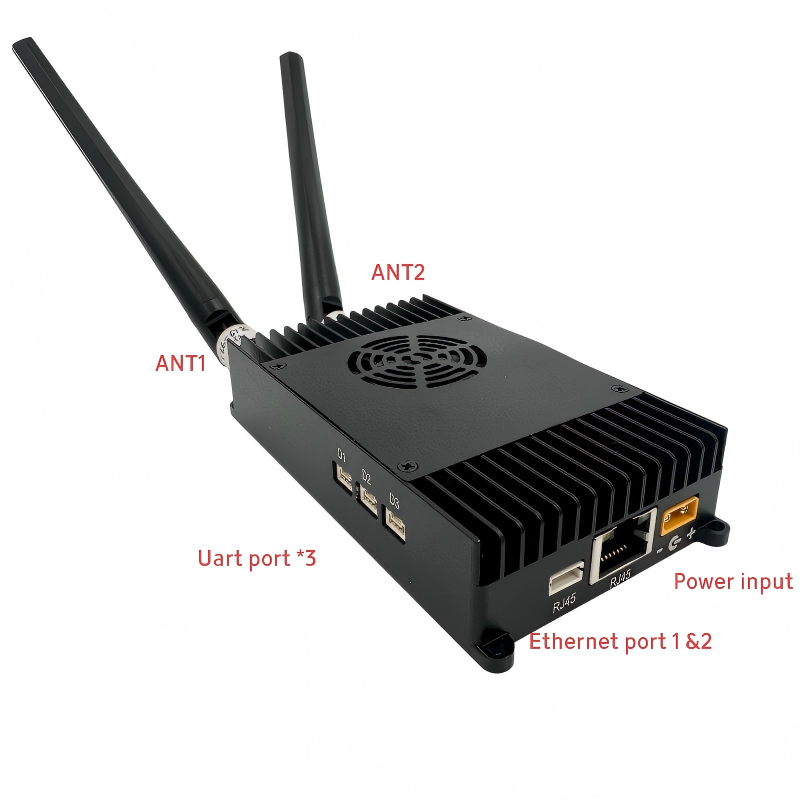
- Dual Ethernet ports with 3-channel serial data transmission
- Uplink and downlink data stream control
Technical Specifications
| Model Number |
HCL536 |
| Modulation |
TDD OFDM |
| Frequency Bands |
806~826MHz, 1428~1468MHz, 1420~1530MHz |
| FHSS |
Supported |
| Bandwidths |
1.4/3/5/10/20MHz |
| Throughput |
Maximum 30Mbps@20MHz |
| RF Transmission Power |
300mW, 2W, 5W |
| Constellation |
QPSK, 16QAM, 64QAM self-adaption |
| Sensitivity |
-108dBm(1Mbps) |
| Ethernet Ports |
2 * Ethernet ports |
| Serial Ports |
3 channels, 3*RS232, 3*TTL or 2*RS232/TTL + 1*Sbus |
| Transmission Range |
10km~150km (UAV to Ground) |
| Management |
Web UI and Control Uart |
| Encryption |
AES128 |
| Networking Mode |
Point to Point, Point to Multipoint, Relay |
| Movement Speed |
Support no less than 300km/h |
| Power Input |
12~18V(2W), 24~28V(5W) |
| Power Consumption |
<22W(RF Power 5W) |
| Dimensions |
103.4*61.4*22mm |
| Weight |
142g |
Input/Output Connections
| Port |
Description |
| Ethernet 1 |
4Pin ZH1.5mm connector, bridged with Ethernet2 |
| Ethernet 2 |
RJ45 connector, bridged with Ethernet1 |
| Uart * 3 |
3Pin GH1.25mm lockable connector*3, 3 channel uart, RS232/TTL/Sbus optional |
| Power in |
XT30PW-M connector |
| ANT 1 |
Tx/Rx Antenna port, SMA female |
| ANT 2 |
Rx Antenna port, SMA female |
Frequently Asked Questions
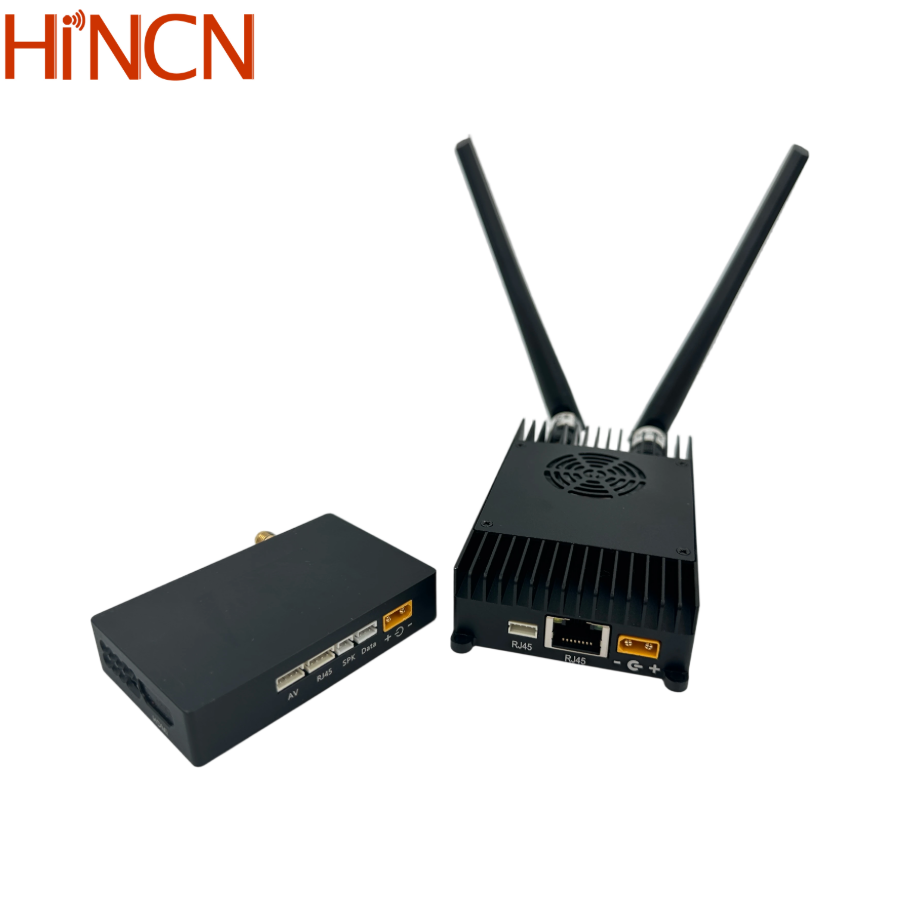
Q1. This Ethernet aircraft transmitter receiver supports IP cameras. What if I want HDMI or SDI video input?
The default video input is IP RJ45 Ethernet port. For cameras with HDMI, SDI, AHD or AV output, we recommend using our mini encoder device to encode the video/audio signal into digital data for transmission. At the receiver end, you can connect directly to your computer or NVR. For HDMI monitor output, our decoder device can convert the digital data back into HDMI video and audio signals.
Q2. For the 800MHz and 1.4G bands, which one would be better?
If your local area has DVB-T or DVB-T2 digital television signal in the 170-860Mhz range, the 1.4G band would be better. Additionally, since GPS antennas on drones point upward and transmitter antennas point downward, the 1.4G frequency has negligible effect on GPS signals.