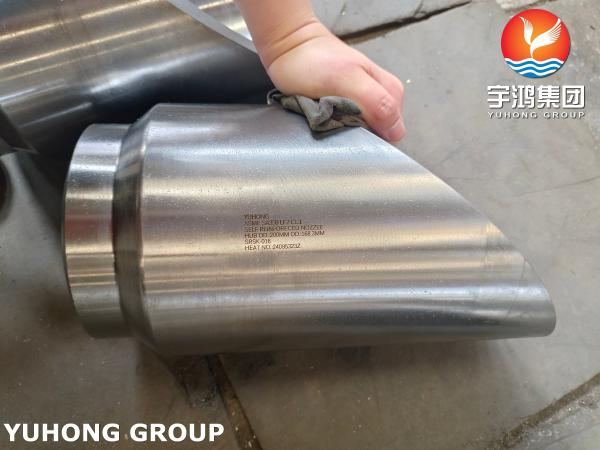
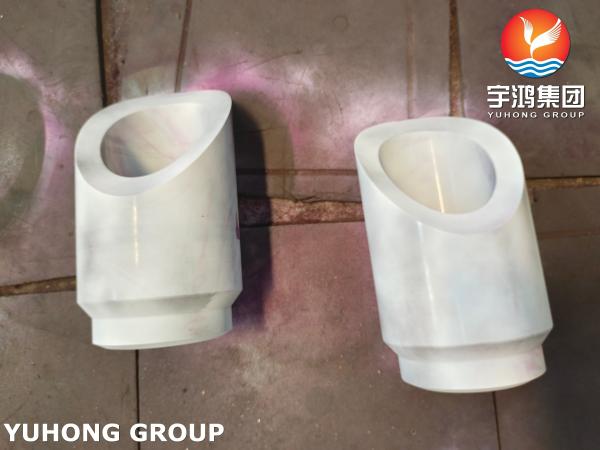
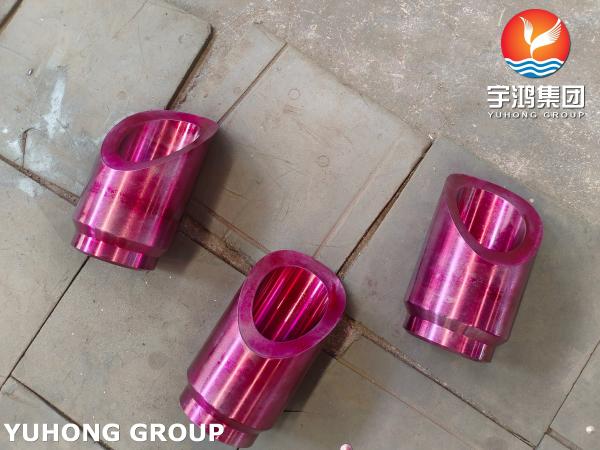
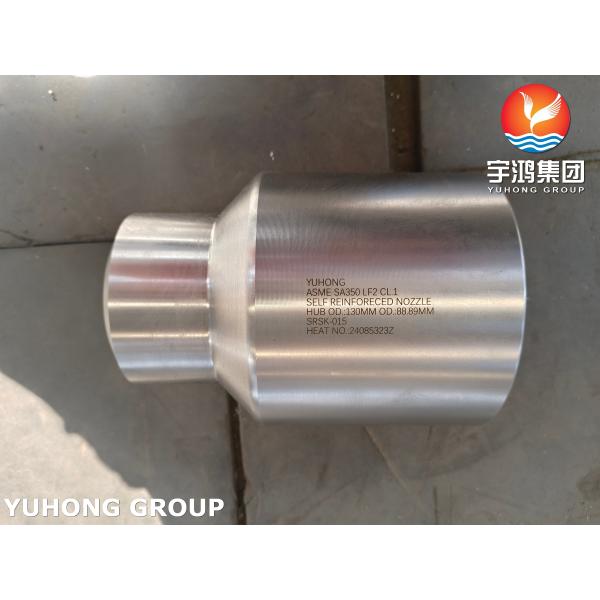
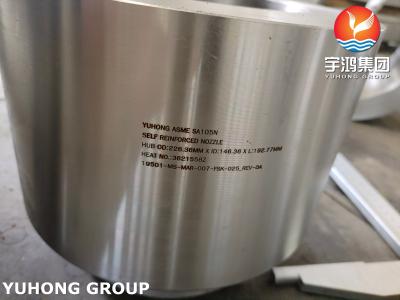
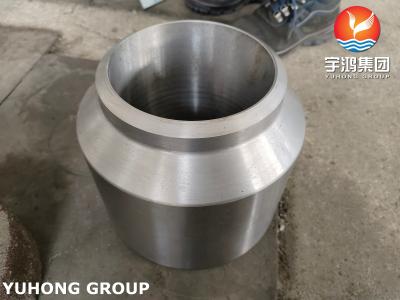
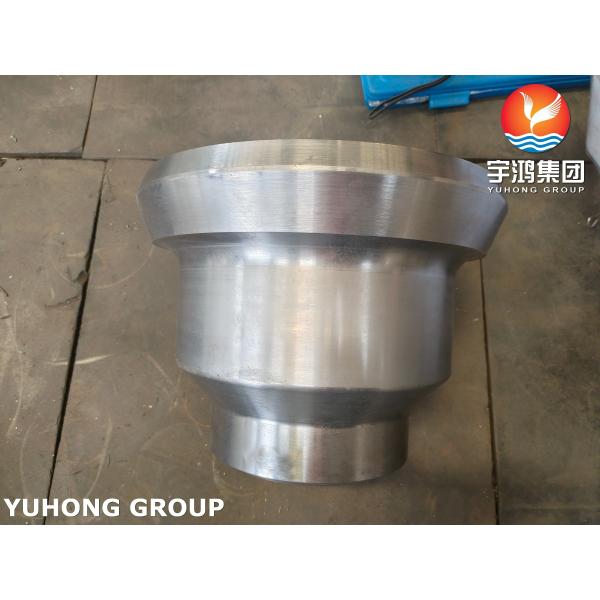
SA350 GR.LF2 CL1 Self-Reinforced Nozzle: Low-Temp Pressure Vessel Part
1. Introduction
The ASME SA350 GR.LF2 CL.1 Self-Reinforced Nozzle is a high-integrity forged steel component used in pressure vessels and piping systems operating at cryogenic temperatures (down to -46°C/-50°F). Its integral reinforcement eliminates the need for separate weld-on pads, enhancing structural reliability and reducing failure risks in services like LNG, petrochemical, and refrigeration.
2. Technical Specifications
Material Standard
Designation: ASME SA350 (Equivalent to ASTM A350)
Grade: LF2 (Carbon steel optimized for low-temperature toughness)
Class: CL.1 (Stringent impact testing requirements)
Chemical Composition (Typical)
| Element | Content (%) |
|---|---|
| Carbon (C) | ≤ 0.30 |
| Manganese (Mn) | 0.60–1.35 |
| Silicon (Si) | 0.15–0.30 |
| Nickel (Ni)* | ≤ 0.40 |
| Phosphorus (P) | ≤ 0.035 |
| Sulfur (S) | ≤ 0.040 |
*Nickel enhances low-temperature toughness.
Mechanical Properties
| Property | Requirement |
|---|---|
| Tensile Strength | ≥ 485 MPa (70 ksi) |
| Yield Strength | ≥ 250 MPa (36 ksi) |
| Elongation | ≥ 22% |
| Charpy V-Notch Impact | @ -46°C (-50°F) |
| Avg. of 3 Specimens | ≥ 18 J (13 ft-lbf) |
| Single Specimen | ≥ 13 J (10 ft-lbf) |
3. Self-Reinforced Design
Integral Hub: Forged as a monolithic thickening around the branch opening.
Purpose:
Compensates for material removed during penetration (per ASME BPVC Section VIII Area Replacement Method).
Reduces stress concentration at nozzle-vessel junctions.
Advantages vs. Weld-On Pads:
Eliminates pad-to-shell crevices (reduces corrosion/fatigue risks).
Simplified NDE inspection (no weld fusion zone).
Improved pressure cycle fatigue resistance.
4. Manufacturing & Quality Control
Production Process
Forging: Hot-forged to shape (press/hammer/ring rolling).
Heat Treatment:
Normalizing + Tempering (mandatory for grain refinement and toughness).
Machining: Precision CNC to final dimensions (weld bevels, bore, reinforcement contour).
Mandatory Testing
NDE:
100% UT (ASTM A388) for internal defects.
100% MT/PT for surface flaws.
Impact Testing: CL.1 requires triple specimens @ -46°C.
Hardness Survey: Post-PWHT to ensure ≤ 200 HB (typical).
5. Welding & Fabrication
Preheat: 95–200°C (prevents hydrogen cracking).
PWHT (Post-Weld Heat Treatment):
Mandatory per ASME BPVC Sec. VIII (UCS-56) to relieve stresses.
Typical cycle: 595–650°C for 1 hr/inch thickness.
Welding Standards: Qualified per ASME Sec. IX.
6. Applications
Industries: LNG storage, cryogenic plants, ethylene units, ammonia refrigeration.
Typical Services: Liquid nitrogen (-196°C), propane (-42°C), CO₂ (-78°C).
7. Compliance & Standards
| Area | Standard |
|---|---|
| Material | ASME SA350 |
| Design | ASME BPVC Sec. VIII, Div. 1 (App. 1-7/9) |
| Dimensions | MSS-SP-97 (Butt-weld) / ASME B16.5 (Flanged) |
| NDE | ASME Sec. V |
8. Key Advantages
Low-Temperature Toughness: CL.1 impact certification for -46°C service.
Reduced Weld Joints: Monolithic design minimizes leak paths.
Lifecycle Cost Savings: Lower inspection/maintenance vs. pad-reinforced nozzles.
9. Limitations
Cost: Higher initial cost than carbon steel nozzles without reinforcement.
Lead Time: Complex forging/heat treatment extends manufacturing.
For fabrication, always reference ASME BPVC Section VIII and MSS-SP-97 for dimensional tolerances. Testing must include triplicate impact tests at the design temperature to validate CL.1 compliance.