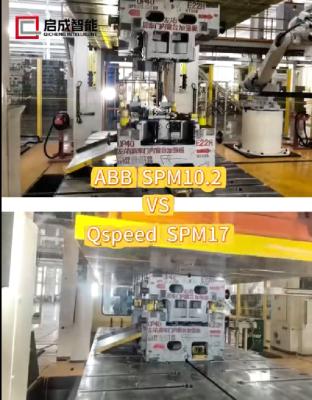
Heavy-duty Stamping Press For Truck Parts Manufacturing
Structural Integrity in Heavy-Duty Metal Forming
Manufacturing truck chassis and structural components requires a robust stamping infrastructure capable of managing extreme "Snap-Through" energy. Unlike passenger vehicle stamping, truck part production often involves material thicknesses exceeding 6.0mm and lengths up to 12 meters for frame rails. Our heavy-duty stamping solutions utilize high-torque drive systems and reinforced tie-rod constructions to maintain geometric precision under massive eccentric loads. By integrating automated heavy-payload transfer systems, we ensure that structural integrity is maintained across high-volume runs of safety-critical components.
Technical Performance Matrix
Core benchmarks for heavy-duty truck part stamping systems.
| Feature |
Technical Specification |
Operational Advantage |
| Nominal Force |
25,000kN - 50,000kN+ |
Necessary for cold-forming thick-gauge structural steel |
| Bed Dimensions |
Up to 15,000mm (Length) |
Accommodates full-length truck chassis frame rails |
| Slide Stroke |
600mm - 1,000mm+ |
Provides clearance for deep-draw oil pans and housings |
| Shock Damping |
Active Hydraulic Dampers |
Absorbs energy release from thick-gauge material shearing |
| Bolster Type |
Heavy-Duty Moving Bolsters |
Enables rapid changeover of 50-ton+ die sets |
| Automation Link |
Heavy-Payload Tandem Robots |
Handles parts weighing 250kg+ with millimetric accuracy |
Engineering Advantages
Critical Innovations for Structural Truck Component Production
- Reinforced Link-Drive Kinematics: To manage the forming of thick-gauge steel, our presses utilize a link-drive motion that slows the slide speed during the "Work Zone." This reduces material heating and prevents fractures in high-stress areas of the chassis.
- High-Energy Snap-Through Suppression: Heavy-duty stamping creates massive vibration. Integrated hydraulic shock absorbers protect the press crown and floor foundation from the kinetic energy released when a 10mm steel plate is sheared.
- Precision Eccentric Load Compensation: Truck parts are often asymmetrical, causing uneven pressure on the press slide. Our 4-point suspension systems utilize independent tonnage monitoring to automatically adjust for off-center loading.
- Integrated Multi-Process Automation: Our lines support In-Die Piercing and Nut Insertion, allowing heavy structural parts to exit the press ready for assembly, significantly reducing secondary labor costs.
Technical FAQ
Addressing core engineering and procurement concerns.
How does the press handle the high-strength materials used in modern "Lightweight" truck frames?
Modern truck frames utilize Ultra-High-Strength Steel (UHSS). We calibrate our press lines with increased holding pressures and specialized lubrication systems. The servo-controlled slide motion allows for a "dwell" phase at the bottom of the stroke, which is essential for neutralizing springback in thick-gauge UHSS.
What is the benefit of a Tandem Line vs. a Large Transfer Press for truck parts?
For extremely long components like Frame Rails, a Tandem Line (multiple independent presses) is preferred because it provides more space for part reorientation. For smaller, high-volume chassis brackets, a Large Transfer Press offers higher Strokes Per Minute (SPM) and a more compact factory footprint.
How do you ensure the longevity of the press under 24/7 heavy-duty operation?
We implement Predictive Maintenance (PdM) Sensors that monitor oil temperature, motor torque, and vibration signatures. By analyzing the "Tonnage Signature" of every stroke, the system can identify tool wear or mechanical fatigue long before a failure occurs, ensuring 95%+ Uptime.