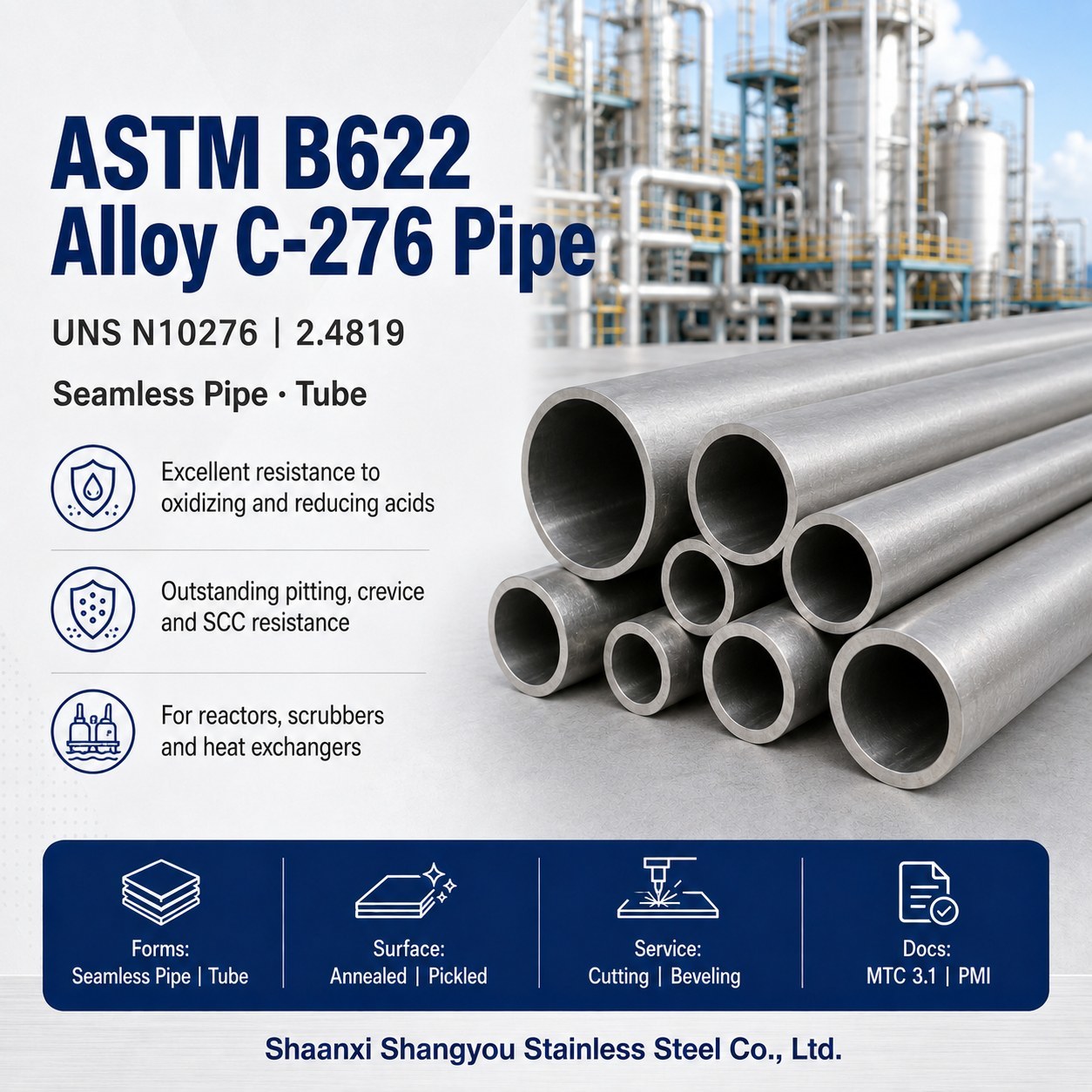
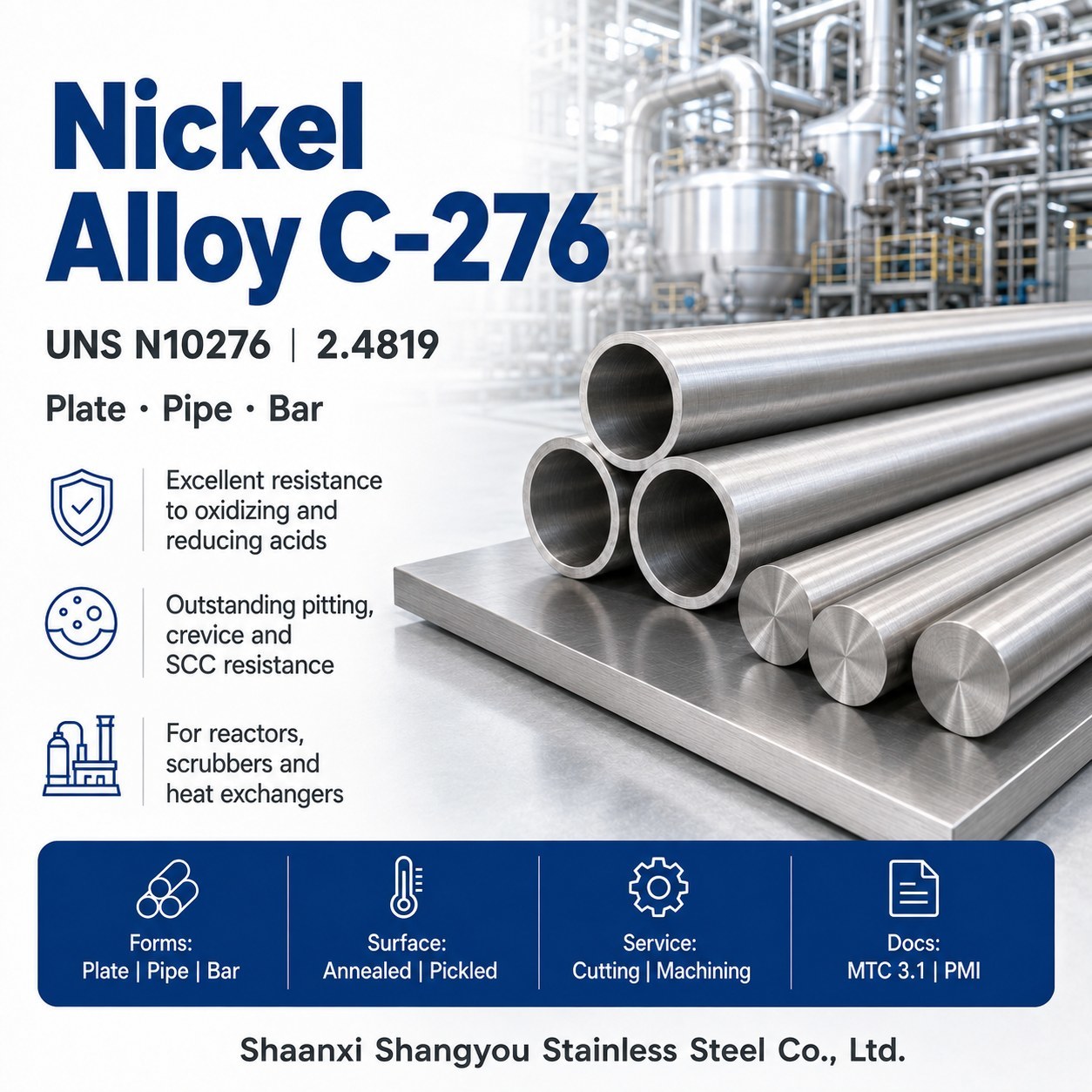
ASTM B622 Alloy C-276 Pipe | UNS N10276 | Hastelloy C-276
Shaanxi Shangyou Stainless Steel Co., Ltd. supplies Nickel Alloy C-276, also known as Hastelloy C-276, identified as UNS N10276 and Werkstoff 2.4819, in seamless pipe and tube form according to ASTM B622 / ASME SB-622.
Nickel Alloy C-276 is a low-carbon nickel-molybdenum-chromium-tungsten alloy developed for outstanding corrosion resistance in a wide range of severe environments. The high nickel content (balance) provides immunity to chloride-induced stress corrosion cracking, while the high molybdenum (15-17%) and chromium (14.5-16.5%) contents enable resistance to both reducing and oxidizing media. The low carbon content minimizes carbide precipitation during welding, making the alloy suitable for most chemical process applications in the as-welded condition. Alloy C-276 is widely regarded as one of the most versatile corrosion-resistant alloys available, with a proven track record in chemical processing, pollution control, pulp and paper, and sour gas recovery.
Procurement Summary
| Item |
Supply Information |
| Alloy Grade |
Nickel Alloy C-276 / Hastelloy C-276 |
| UNS Number |
N10276 |
| EN / Werkstoff Number |
2.4819 |
| EN Material Symbol |
NiMo16Cr15W |
| Seamless Pipe / Tube Standard |
ASTM B622 / ASME SB-622 |
| Product Forms |
Seamless pipe, tube |
| OD Range |
1/2" – 40" ; stock sizes 1/2" to 24" |
| Wall Thickness |
Schedule 10S – XXS |
| Supply Condition |
Solution annealed; cold drawn, bright annealed |
| Surface |
Pickled, ground or polished |
| Testing |
Chemical analysis, tensile, hardness, hydrostatic, nondestructive electric, PMI |
| Inspection Documents |
EN 10204 3.1 MTC; third-party inspection optional |
Chemical Composition
| Element |
Weight % (min) |
Weight % (max) |
| Nickel (Ni) |
Balance |
— |
| Molybdenum (Mo) |
15.0 |
17.0 |
| Chromium (Cr) |
14.5 |
16.5 |
| Iron (Fe) |
4.0 |
7.0 |
| Tungsten (W) |
3.0 |
4.5 |
| Cobalt (Co) |
— |
2.5 |
| Carbon (C) |
— |
0.010 |
| Silicon (Si) |
— |
0.08 |
| Manganese (Mn) |
— |
1.0 |
| Vanadium (V) |
— |
0.35 |
| Phosphorus (P) |
— |
0.040 |
| Sulfur (S) |
— |
0.030 |
Composition per ASTM B622 requirements.
Technical Data
| Property |
Typical Reference |
| Density |
8.89 g/cm3 |
| Melting Range |
1,325 – 1,370°C |
| Modulus of Elasticity |
205 – 221 GPa at 20°C |
| Thermal Conductivity |
9.4 – 9.8 W/m-K |
| Electrical Resistivity |
1.30 µΩ·cm |
| Coefficient of Expansion (20-300°C) |
~11.2 µm/m-°C |
| Tensile Strength, Annealed |
690 MPa (100 ksi) minimum |
| Yield Strength (0.2%), Annealed |
283 – 290 MPa (41 ksi) minimum |
| Elongation, Annealed |
40% minimum |
| Hardness, Annealed |
≤ 100 HRB |
| Operating Temperature Range |
Cryogenic to 400°C (750°F) |
| Heat Treatment |
Solution annealed at ~1,120°C; not age-hardenable |
| Product Standards |
ASTM B622, ASME SB-622 |
Actual properties depend on product form, dimensions, and the specified standard.
Heat Treatment Conditions
Solution Annealed
Alloy C-276 pipe is normally supplied in the solution-annealed condition. The standard solution annealing treatment is performed at approximately 2,050°F (1,120°C) followed by rapid cooling. The low carbon content (0.010% max) minimizes carbide precipitation during welding, making the alloy suitable for most chemical process applications in the as-welded condition without the need for post-weld heat treatment.
Cold Working
Alloy C-276 is not age-hardenable – strength increases only through cold working. Annealed material typically exhibits tensile strength of 120 – 160 ksi (830 – 1,100 MPa).
Corrosion Resistance and Selection Limits
Alloy C-276 is considered one of the most versatile corrosion-resistant alloys available, offering outstanding resistance to a wide range of aggressive media.
Key Corrosion Characteristics:
- Excellent resistance to pitting and crevice corrosion due to high molybdenum (15-17%) and tungsten (3-4.5%) content
- Resists stress-corrosion cracking in chloride environments
- Resists both oxidizing and reducing media: chromium provides oxidizing resistance; molybdenum and tungsten provide reducing resistance
- Resistant to wet chlorine gas, hypochlorite, and chlorine dioxide solutions – one of few materials that withstand these environments
- Exceptional resistance to ferric and cupric chlorides
- Excellent resistance to sulfuric acid (all concentrations), hydrochloric acid (up to 50°C), phosphoric acid, formic and acetic acids
- Low carbon content minimizes grain boundary precipitation in the weld heat-affected zone
- Approved for sour service per NACE MR0175 / ISO 15156
Selection Considerations:
- One of the few alloys suitable for wet chlorine gas service
- Recommended when no single corrosion mechanism dominates and the process fluid combines multiple aggressive species
- For applications requiring even higher resistance to oxidizing conditions, Alloy C-22 may be preferred
- For pure reducing acid service, Alloy B-3 offers superior performance
- Final selection must consider the specific medium, concentration, temperature, and exposure conditions
Typical Applications
- Chemical Processing: Reactor vessels, heat exchangers, evaporators, distillation columns, transfer piping for mixed-acid and chloride-containing environments
- Flue Gas Desulfurization: Scrubber internals, outlet ducts, dampers, reheaters, fans and fan housings
- Pulp and Paper: Digesters, bleach plants, equipment in high-chemical-stress processes
- Waste Treatment: Incinerator off-gas scrubbing systems, hazardous waste handling
- Oil and Gas: Sour gas wellhead components, pipeline cladding, offshore production systems
- Pollution Control: Stack liners, ducting, scrubber systems
- Marine Engineering: Seawater handling equipment
Testing and Inspection
Available quality-control services include:
- Heat-number traceability
- Chemical composition verification
- Tensile, yield and elongation testing
- Hardness inspection
- Dimensional and surface inspection
- Hydrostatic testing
- Nondestructive electric testing
- Positive Material Identification (PMI)
- Heat-treatment records
- EN 10204 3.1 material certificate
Request a Quote
For an accurate quotation, please provide:
Alloy Grade · Standard · Product Form · OD · Wall Thickness / Schedule · Length · Quantity · Inspection Requirement · Application · Working Temperature · Destination Port
For corrosive environments, also provide:
Chemical Medium · Concentration · Temperature · Oxidizing or Reducing Conditions
Procurement Actions
- Request ASTM B622 Alloy C-276 Pipe Quote
- Upload Drawing or MTO
- Check Available Stock
- Ask for Alloy Selection Support
Frequently Asked Questions
1. What is ASTM B622 Alloy C-276 pipe?
ASTM B622 Alloy C-276 pipe (UNS N10276) is a low-carbon nickel-molybdenum-chromium-tungsten seamless pipe with outstanding resistance to pitting, crevice corrosion, and stress corrosion cracking in severe environments.
2. What are the UNS and EN numbers for Alloy C-276?
The UNS designation is N10276; the European Werkstoff number is 2.4819; the EN material symbol is NiMo16Cr15W.
3. Which standard applies to Alloy C-276 seamless pipe?
ASTM B622 / ASME SB-622 applies to seamless pipe and tube of Alloy C-276. For welded pipe, ASTM B619 applies.
4. What size range is available for ASTM B622 pipe?
Stock sizes range from 1/2" to 24" OD with wall thicknesses from Schedule 10S through XXS, with custom sizes up to 40" available.
5. Does Alloy C-276 pipe require heat treatment?
No. Alloy C-276 is not age-hardenable. It is supplied in the solution-annealed condition and is strengthened only through cold working.
6. What environments does Alloy C-276 pipe resist?
It resists wet chlorine gas, ferric and cupric chlorides, sulfuric acid (all concentrations), hydrochloric acid (up to 50°C), phosphoric acid, formic/acetic acids, seawater, brine, hypochlorite solutions, and many mixed acid environments.
7. Is Alloy C-276 resistant to chloride stress-corrosion cracking?
Yes. Alloy C-276 has excellent resistance to chloride stress-corrosion cracking and is considered highly resistant in most chloride environments.
8. What is the difference between Alloy C-276 and Alloy 22?
Alloy C-276 has higher molybdenum (15-17%) and tungsten (3-4.5%), making it more suited for reducing acid environments. Alloy 22 has higher chromium (20-22.5%) and is preferred when oxidizing conditions dominate.
9. Can Alloy C-276 pipe be welded?
Yes. Alloy C-276 exhibits excellent weldability with minimal risk of sensitization or intergranular attack. The low carbon content allows service in the as-welded condition without post-weld heat treatment.
10. What information is required for a quotation?
Please provide the standard (ASTM B622), product form (seamless pipe), OD, wall thickness or schedule, quantity, inspection requirements, application, working temperature and destination port. For corrosive environments, also specify the chemical medium and concentration.