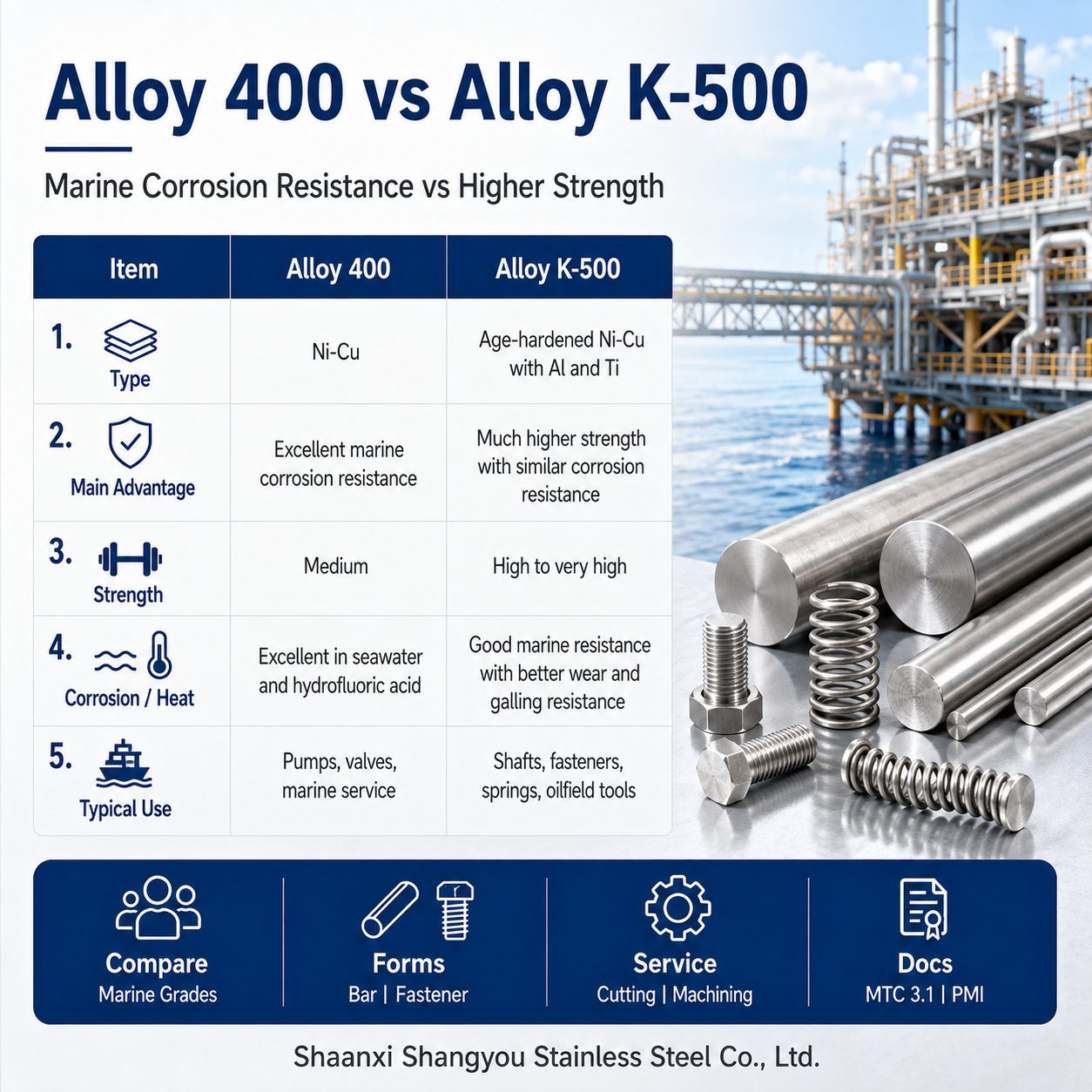
Shaanxi Shangyou Stainless Steel Co., Ltd. supplies both Nickel Alloy 400 (UNS N04400) and Nickel Alloy K-500 (UNS N05500) in plate, sheet, round bar, wire, and forging forms. These nickel-copper alloys are among the earliest nickel-based alloys developed commercially and remain widely used in marine engineering, chemical processing, and oil and gas applications.
Alloy 400 is a single-phase solid-solution alloy containing approximately 63% nickel and 28-34% copper. It cannot be hardened by heat treatment and relies on cold working for moderate strength increases. It is the workhorse grade for valves, pumps, and piping in marine and chemical services.
Alloy K-500 has the same base nickel-copper composition as Alloy 400 but adds approximately 2.3-3.15% aluminum and 0.35-0.85% titanium. These elements form gamma-prime (Ni3Al/Ti) precipitates during age hardening at 480-620°C, doubling the yield strength and tripling the hardness compared to the annealed condition. Both alloys are available with EN 10204 3.1 MTC, PMI testing, and full traceability.
| Property | Alloy 400 (UNS N04400) | Alloy K-500 (UNS N05500) |
|---|---|---|
| Strengthening Mechanism | Solid solution strengthening | Precipitation hardening (γ' phase) |
| Aluminum (Al) | — | 2.30 – 3.15% |
| Titanium (Ti) | — | 0.35 – 0.85% |
| Density | 8.83 – 8.89 g/cm3 | 8.44 g/cm3 |
| Tensile Strength, Annealed | 483 MPa (70 ksi) min | 550 – 760 MPa (80-110 ksi) |
| Tensile Strength, Aged | N/A | 1,000 MPa (145 ksi) typical |
| Yield Strength (0.2%), Annealed | 172 MPa (25 ksi) min | ~300 – 400 MPa |
| Yield Strength, Aged | N/A | 690 MPa (100 ksi) typical |
| Elongation, Annealed | 35 – 55% | 30 – 40% |
| Hardness | ~70 HRB | ~30 HRC (aged) |
| Maximum Service Temperature | ~480°C (900°F) | ~480°C (900°F) |
| Magnetic Properties | Slightly magnetic at room temperature | Virtually non-magnetic |
| Element | Alloy 400 (UNS N04400) | Alloy K-500 (UNS N05500) |
|---|---|---|
| Nickel (Ni) | 63.0 – 70.0% | 63.0 – 70.0% |
| Copper (Cu) | 28.0 – 34.0% | 27.0 – 33.0% |
| Aluminum (Al) | — | 2.30 – 3.15% |
| Titanium (Ti) | — | 0.35 – 0.85% |
| Iron (Fe) | 2.5% max | 2.0% max |
| Manganese (Mn) | 2.0% max | 1.5% max |
| Silicon (Si) | 0.5% max | 0.5% max |
| Carbon (C) | 0.30% max | 0.25% max |
| Sulfur (S) | 0.024% max | 0.010% max |
Alloy 400 is a single-phase solid-solution alloy that cannot be hardened by heat treatment. It derives its strength from solid solution strengthening—copper atoms dissolved in the nickel matrix distort the crystal lattice, impeding dislocation movement. Strength increases only through cold working, with moderate gains at the expense of ductility. This simplicity is an operational advantage: the alloy is easy to form and fabricate with no requirements for additional heat treatments to re-balance the alloy.
Alloy K-500 is precipitation-hardenable through additions of aluminum (2.3-3.15%) and titanium (0.35-0.85%). During age hardening at 480-620°C, these elements form gamma-prime (γ') precipitates (Ni3Al/Ti) that act as powerful barriers to dislocation motion. This aging response enables K-500 to achieve tensile strengths above 1,000 MPa—roughly double that of Alloy 400—and yield strengths above 690 MPa. However, this strength comes at a cost: the alloy requires careful heat treatment, and overaging occurs above 480°C.
Both alloys have comparable maximum service temperatures of approximately 480°C (900°F). Above this temperature, Alloy K-500 experiences overaging and strength loss, while Alloy 400 maintains its properties. Alloy 400 retains excellent mechanical properties at sub-zero temperatures.
Both alloys have essentially identical corrosion resistance because the base nickel-copper matrix is the same. The age-hardening precipitates in K-500 do not significantly alter the alloy's electrochemical behavior.
Key Corrosion Characteristics (Both Alloys):
Selection Considerations:
| Product Form | Alloy 400 | Alloy K-500 |
|---|---|---|
| Plate / Sheet | ASTM B127 / ASME SB-127 | ASTM B865 |
| Bar / Rod | ASTM B164 / ASME SB-164 | ASTM B865 / AMS 4676 |
| Seamless Pipe / Tube | ASTM B165 / ASME SB-165 | Not commonly supplied as pipe |
| Welded Pipe | ASTM B725 / ASME SB-725 | — |
| Forgings | ASTM B564 / ASME SB-564 | ASTM B564 |
| Fittings | ASTM B366 / ASME SB-366 | ASTM B366 |
| Wire | AMS 4675 / QQ-N-281 | AMS 4676 |
| Application Area | Specific Use Cases |
|---|---|
| Chemical Processing | HF alkylation unit piping and equipment, sulfuric acid and hydrochloric acid processes |
| Marine Engineering | Propeller shafts, seawater cooling systems, pumps, valves, fittings, fasteners |
| Oil and Gas | Crude petroleum stills, process vessels, valves, heat exchangers |
| General Corrosion Service | Piping systems (standard choice), heat exchanger tubes and shells |
| Salt Production | Brine handling equipment |
| Application Area | Specific Use Cases |
|---|---|
| Marine Engineering | Pump shafts, impellers, propeller shafts requiring high fatigue strength |
| Oil and Gas | Drill collars, oil well tools, wellhead components, sour-gas service equipment |
| Pulp and Paper | Doctor blades and scrapers |
| High-Strength Fasteners | Marine and industrial bolting requiring high strength and corrosion resistance |
| Springs | Springs and rotating components requiring high strength and non-magnetic properties |
| Electronic Components | Sensors, gyroscopes, and other non-magnetic instrumentation |
| Aspect | Alloy 400 | Alloy K-500 |
|---|---|---|
| Weldability | Very good | Good; requires careful procedure |
| Post-Weld Heat Treatment | Not required | Recommended to restore optimal properties |
| Annealing Temperature | 870-980°C | 870°C |
| Age Hardening | Not applicable | ~540°C for 8-10 hours |
| Fabricability | Easy to form and fabricate | More difficult due to higher strength |
Choose Alloy 400 when:
Choose Alloy K-500 when:
For a detailed quotation or material selection assistance, please provide:
Alloy Grade Under Consideration · Required Standard · Product Form · Dimensions · Quantity · Service Conditions (Temperature, Medium, Pressure) · Application · Destination Port
For corrosive service, also provide:
Chemical Medium · Concentration · Temperature · Oxidizing or Reducing Conditions
Alloy 400 is a solid-solution nickel-copper alloy that cannot be heat-treated for higher strength. Alloy K-500 adds aluminum and titanium for precipitation hardening, achieving approximately double the strength while maintaining similar corrosion resistance.
Alloy 400 is UNS N04400 and Werkstoff 2.4360/2.4361. Alloy K-500 is UNS N05500 and Werkstoff 2.4375.
Alloy 400: ASTM B127 (plate), ASTM B164 (bar), ASTM B165 (pipe). Alloy K-500: ASTM B865 (bar/plate), AMS 4676.
Yes. Alloy K-500 requires age hardening at approximately 540°C for 8-10 hours to achieve its high strength. Overaging occurs above 480°C service temperature.
Both alloys have essentially identical corrosion resistance because the base nickel-copper matrix is the same. The age-hardening precipitates in K-500 do not significantly alter the alloy's electrochemical behavior.
Both are excellent. Alloy 400 is the standard choice for general seawater piping and valves. Alloy K-500 is preferred for high-strength components like pump shafts and impellers requiring superior fatigue resistance.
Both are highly resistant. However, Alloy 400 exhibits slightly better stress-corrosion cracking resistance in HF vapors compared to Alloy K-500. Alloy K-500 may be more susceptible to SCC in moist HF vapors, especially when age-hardened.
No. Alloy K-500 is rarely used for pipe; it is primarily a bar, forging, and wire product. Alloy 400 is the standard choice for piping systems.
Alloy 400 can be slightly magnetic as its Curie temperature is close to room temperature (21-49°C). Alloy K-500 is virtually non-magnetic.
Please provide the application, operating temperature, chemical medium (if corrosive), required strength, and product form needed. Our team can provide expert guidance based on your specific service conditions.