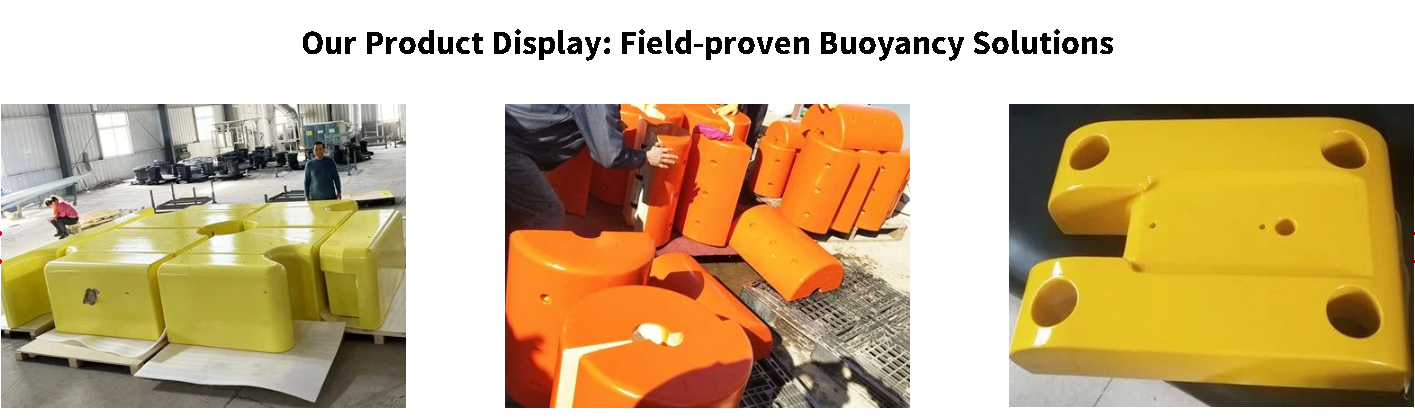
Customized Low Water Absorption Marine Sea Buoy Syntactic Foam Subsea Buoyancy
Product Attributes
| Attribute | Value |
|---|
| Product name | Subsea Buoyancy floats |
| Advantages | Aging resistance, abrasion resistance |
| Design Using Life | 7-10 Years |
| Size | As per customer request |
| Skin | Elester polyurethane Coating |
| Color | Orange, Yellow, or customized |
| Warranty | 2 years |
| Customized | Available |
| High-strength | 1-100MPa |
| Low-density | 0.35-0.7g/cm³ |
| Water absorption | <2% |
Product Description
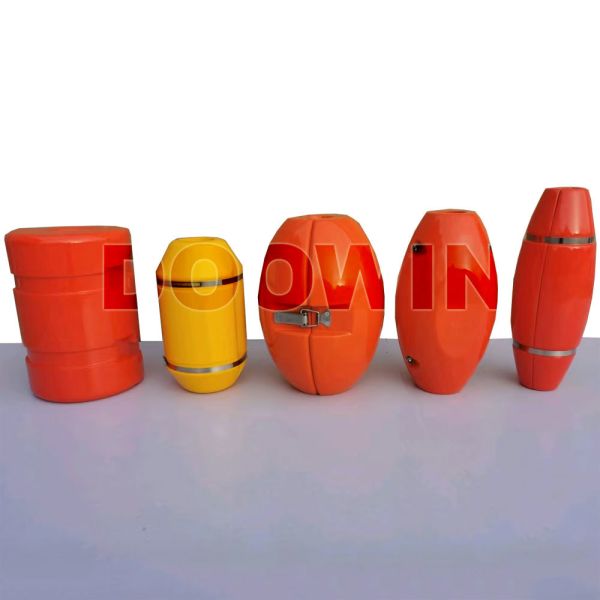
The subsea buoyancy material is mainly used underwater. Based on its characteristics of low density and high pressure resistance, it mainly provides the required buoyancy for underwater operation equipment. Spray coating or protective layer treatment can be applied to the surface as required. Often manufactured and processed into floats, buoys and other counterweight products. It can also be directly machined into product parts.
It can not only meet the mechanical requirements of the product structure, but also greatly reduce the product weight and other functions. The application of this material realizes the functions that are difficult for metal structural parts to realize. At present, it has been used in underwater deep submersibles, underwater robots, etc., and can be used safely at depths of several thousand meters underwater.

Subsea Buoyancy Syntactic Foam
Subsea solid buoyancy material (syntactic foam) is a lightweight composite formed by embedding hollow microspheres in polymer matrices. These low-density (0.35-0.7g/cm³), high-strength (1-100MPa) materials feature minimal water absorption (<2%) and corrosion resistance, serving as essential counterweights for underwater equipment. Their applications enable deeper dives, increased payload capacity, and stable operation in deep-sea environments, making them crucial for 21st-century subsea technology.
Chemical Foaming Solid Buoyancy Material
The chemical foaming method buoyancy material is a kind of polyurethane-epoxy resin rigid foam composite material made by the chemical foaming method.
| Model | Density (g/cm3) | Compression Strength (MPA) | Water Absorption (24H) | Submersible Depth (m) |
|---|
| CSBM-08 | 0.08 | / | ≤2% | 50 |
| CSBM-15 | 0.15 | 2.6 | ≤2% | 100 |
| CSBM-20 | 0.20 | 5.19 | ≤2% | 200 |
Syntactic Foam
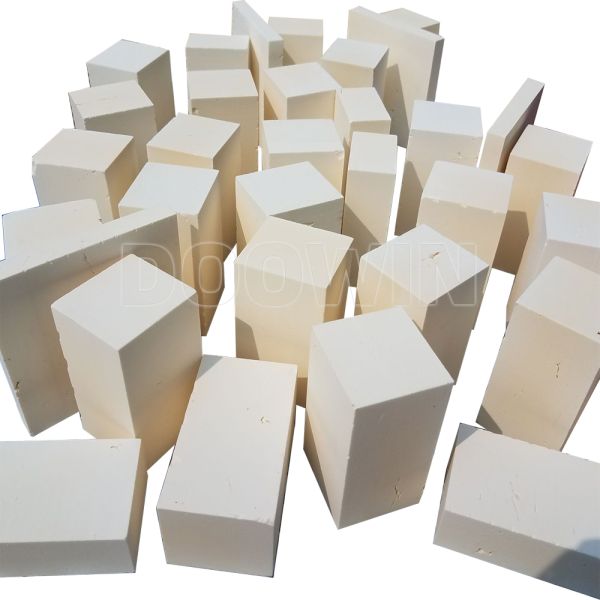
Syntactic foams are composite materials synthesized by filling a metal, polymer, or ceramic matrix with hollow spheres called micro balloons or cenospheres or non-hollow spheres.
| Model | Density (g/cm3) | Compression Strength (MPA) | Water Absorption (24H) | Submersible Depth (m) |
|---|
| SBM-35 | 0.35±0.02 | ≥8 | ≤2% | 200 |
| SBM-37H | 0.37±0.02 | ≥12 | ≤1% | 500 |
| SBM-38 | 0.38±0.02 | ≥10 | ≤1% | 300 |
| SBM-40 | 0.40±0.02 | ≥12 | ≤1% | 500 |
| SBM-40H | 0.40±0.02 | ≥18 | ≤1% | 1000 |
| SBM-45 | 0.45±0.02 | ≥20 | ≤1% | 1000 |
| SBM-48 | 0.48±0.02 | ≥25 | ≤1% | 2000 |
| SBM-51 | 0.51±0.02 | ≥35 | ≤1% | 3000 |
| SBM-54 | 0.54±0.02 | ≥45 | ≤1% | 4500 |
| SBM-57H | 0.57±0.02 | ≥55 | ≤1% | 6000 |
| SBM-63 | 0.63±0.02 | ≥55 | ≤1% | 6000 |
| SBM-70 | <0.7 | ≥90 | ≤1% | 11000 |
Syntactic Foam CNC Production

Subsea Buoyancy Modules