Four-Roller Marine Fairlead for Engineering Vessels | Steel Wire Rope Guide CB 3015-83 Type B
Product Overview
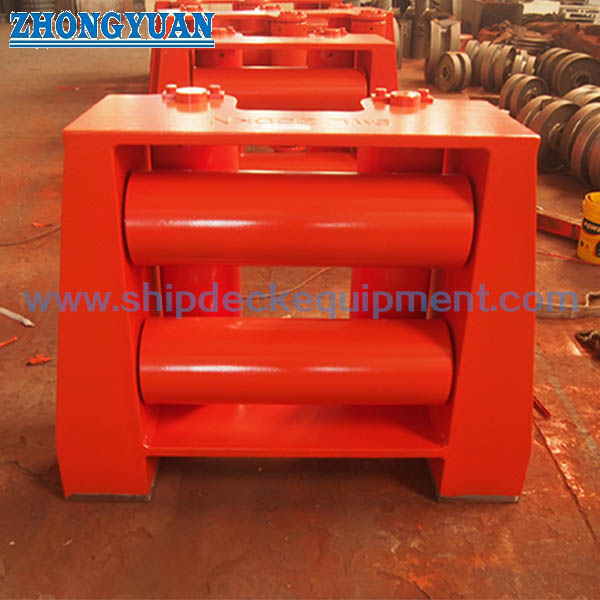
The CB* 3015-83 Type B marine fairlead is a four-roller steel wire rope guide developed for engineering-vessel deck arrangements. Its two vertical rollers and upper and lower horizontal rollers form an enclosed rope passage that guides a running wire rope from different lead directions, helps reduce direct sliding against fixed steel edges, and keeps the rope within the fairlead opening during winch, towing, positioning, or deck-working operations.
Typical vessel applications include dredgers, crane ships, piling vessels, engineering barges, salvage and work vessels, and other ships using steel-wire-rope deck machinery. The fairlead is a passive guiding component and does not generate pulling force. Final selection must therefore consider the actual wire rope, winch line pull, rope lead and change-of-direction angle, duty cycle, roller reactions, mounting structure, and project inspection requirement—not roller diameter alone.
Quick Specifications
Main Technical Parameters
| Roller Dia. D |
Horizontal Roller Dia. D1 |
Applicable Steel Wire Rope Dia. Φ |
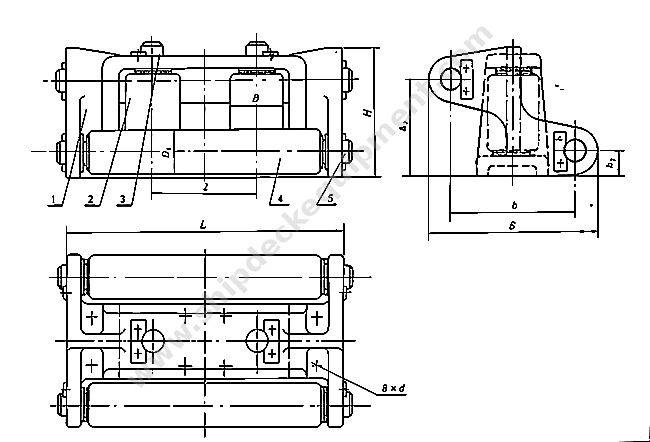
L | B | H | b | h1 | h2 | l | d |
| 100 | 85 | 19.5 | 540 | 340 | 240 | 250 | 220 | 50 | 200 | 22 |
| 150 | 120 | 26 | 760 | 460 | 340 | 340 | 320 | 65 | 290 | 26 |
| 200 | 150 | 37.5 | 980 | 580 | 440 | 430 | 410 | 80 | 380 | 32 |
| 250 | 200 | 176 | 1220 | 740 | 550 | 540 | 500 | 110 | 480 | 39 |
| 300 | 250 | 370 | 1460 | 900 | 675 | 650 | 590 | 135 | 580 | 39 |
Selection & Inquiry Guide
Step 1: Confirm CB* 3015-83 Type B, the required roller diameter D, and whether the four-roller enclosed arrangement matches the vessel rope-routing drawing.
Step 2: Provide steel wire rope data: nominal diameter, construction, core, lay, grade, minimum breaking load, operating condition, and rope manufacturer’s allowable bending or contact requirements.
Step 3: Confirm the machinery and load case: towing winch, positioning winch, anchor-handling or deck-working winch, maximum line pull, brake holding load, operating speed, dynamic factor, duty cycle, and change-of-direction angle.
Step 4: Provide the incoming and outgoing rope directions, expected side lead and vertical lead, fairlead location, available deck or bulwark space, and adjacent equipment arrangement.
Step 5: Confirm material grades, roller construction, shaft and bearing or bushing arrangement, lubrication method, surface treatment, mounting type, weld or bolt details, and supporting-structure reinforcement.
Step 6: Confirm quantity, certificate and inspection scope, NDT or load-test requirement, vessel type, classification society requirement, delivery destination, required delivery time, and approved drawing or reference photo.
Structure
Two vertical steel rollers | Upper horizontal roller | Lower horizontal roller | Roller shafts | Bearings or bushings | Side frames and cross members | Mounting base or welded support | Lubrication and retention arrangement as specified
Wire Rope Guidance, Installation & Quality Advantages
Custom Attributes
How It Works
Steel wire rope approaches the fairlead → Rope contacts one or more freely rotating rollers according to its lead angle → Vertical and horizontal rollers redirect and contain the rope path → Roller shafts and frame transfer the resulting reactions to the vessel support structure → Rope continues to the winch, towing point, or deck-working system
Applications
Dredgers | Crane ships | Piling vessels | Engineering barges | Salvage and work vessels | Towing-wire routes | Positioning and deck-working winches | Marine construction equipment | Newbuilding and replacement projects
Certifications & Advantages
Certificates and inspection can be arranged according to project requirement, agreed manufacturing scope, material traceability, test plan, and classification society approval procedure. Availability is subject to order confirmation and class acceptance.
Certification: CCS, NK, BV, ABS, DNV, LR, KR, IRS, RS, RINA, CRS, Makers Test Certificate.
Drawing & Photos


FAQ
Q1: How should the correct CB* 3015-83 Type B fairlead size be selected?
A1: Use the standard model and rope diameter only for preliminary selection. Final selection requires the actual rope construction and MBL, maximum line pull, brake holding load, horizontal and vertical lead angles, change-of-direction angle, duty cycle, roller reactions, deck arrangement, and supporting-structure calculation.
Q2: Why does Type B use four rollers?
A2: The two vertical rollers guide side-to-side movement, while the upper and lower horizontal rollers control upward and downward rope lead. Together they form an enclosed passage for engineering-vessel rope routes that can vary in more than one plane.
Q3: Are class certificates and load testing included with every fairlead?
A3: No. Maker documentation, material certificates, NDT, roller-rotation inspection, proof or load testing, and class certification depend on the agreed project scope. The required class society, load basis, test method, witnessing, and acceptance criteria must be confirmed before quotation.