JIS F 2030 Type A Single Point Mooring Chock | Oval Bow Bulwark Rope Guide
Product Overview
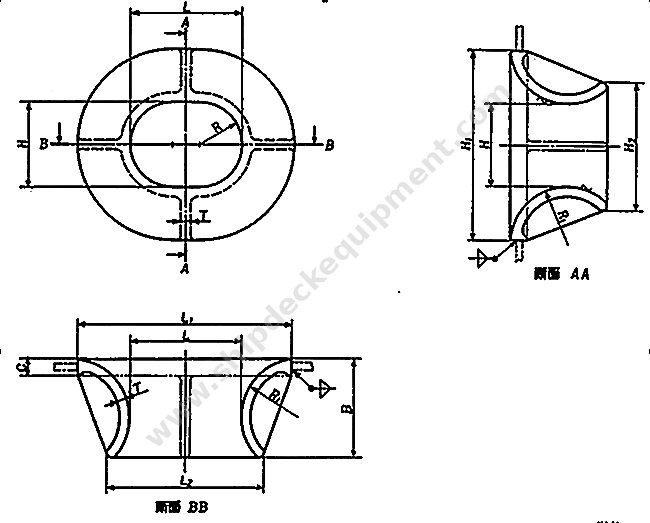
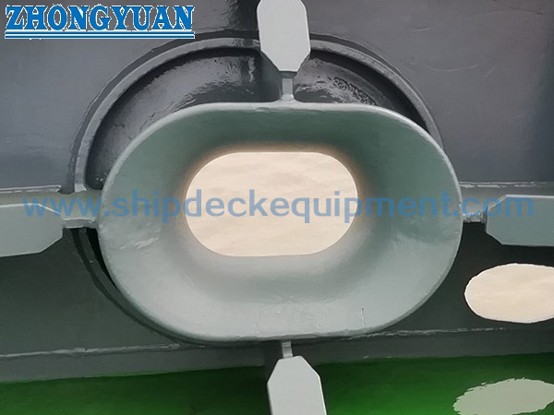
The JIS F 2030 Type A single point mooring chock, also described in the standard terminology as a single point mooring pipe, is a large cast rope-guiding fitting installed in the vessel bow bulwark. Its oval opening provides a smooth passage for a mooring hawser or rope as the line is led between the outboard single point mooring arrangement and the shipboard securing equipment.
Type A is the non-inclined oval configuration in the supplied product description, while Type B is the inclined oval configuration. The Type A series covers nominal sizes 400 to 800 mm and reference calculated masses from 210 to 880 kg. Selection must be based on the approved vessel mooring arrangement, rope construction and diameter, line lead direction, local bulwark reinforcement, and project classification requirements. This is a shipboard chock/rope guide; it is not the offshore single point mooring buoy system itself.
Quick Specifications
Main Technical Parameters
| Nominal size | L | L1 | L2 | H | H1 | H2 | B | R | R1 | T | C | Reference Calculated mass kg | Nominal dia. of applicable rope (Reference) | ||
| Wire rope(6×24) | Mani-la rope |
Nylon rope |
|||||||||||||
| 400 | 400 | 780 | 570 | 300 | 680 | 460 | 350 | 150 | 210 | 35 | 65 | 210 | 50-60 | 30 | 80 |
| 500 | 500 | 940 | 690 | 400 | 840 | 580 | 400 | 200 | 240 | 40 | 70 | 340 | 62-73 | 40 | 90 |
| 600 | 600 | 1100 | 910 | 450 | 950 | 655 | 450 | 225 | 270 | 45 | 75 | 490 | 76-92 | 50 | 100 |
| 700 | 700 | 1260 | 930 | 500 | 1060 | 730 | 500 | 250 | 300 | 50 | 80 | 660 | 95-114 | 60 | 110 |
| 800 | 800 | 1420 | 1050 | 600 | 1220 | 850 | 550 | 300 | 330 | 55 | 85 | 880 | 117-132 | 70 | 120 |
Selection & Inquiry Guide
Step 1: Confirm JIS F 2030 Type A and nominal size 400, 500, 600, 700, or 800 according to the approved vessel arrangement and required rope passage.
Step 2: Provide rope type, construction, nominal diameter, MBL, chafe-chain or hawser-end arrangement if applicable, and expected horizontal and vertical lead directions.
Step 3: Confirm the bow bulwark opening, installation elevation, available clearances, welding interface, local reinforcement, and relationship to bitts, chain stopper, or mooring equipment.
Step 4: Confirm material: cast C-Mn steel, cast stainless steel, or special low-temperature/ice-service steel. State the exact grade, impact-test temperature, heat treatment, and traceability requirement.
Step 5: Confirm surface treatment, rope-contact finishing, coating system, NDE scope, dimensional inspection, certificate requirement, and any class surveyor witness points.
Step 6: Provide quantity, vessel type, installation drawing, classification society, destination, required delivery time, and reference photos or existing replacement dimensions.
Structure
Oval cast body | Non-inclined Type A rope passage | Smooth rope-contact radii R and R1 | Bulwark-mounted welded interface | Reinforced casting sections | Carbon-steel coating or polished stainless-steel finish
Mooring, Casting and Installation Advantages
Custom Attributes
How It Works
Mooring hawser approaches the bow → Line passes through the oval Type A chock → Smooth radii guide the line and limit sharp local contact → Rope force is transferred through the cast body and welded bulwark structure → Line is secured by the approved shipboard mooring arrangement
Applications
Large commercial vessels | Tankers fitted for single point mooring | Bulk carriers | Bow mooring stations | Temporary offshore mooring operations | Newbuilding projects | Replacement of JIS F 2030 Type A mooring pipes
Certifications & Advantages
Material certificates, dimensional inspection records, NDE reports, and classification inspection can be arranged according to project requirement. Classification approval and survey scope must be confirmed before quotation and are subject to the approved drawing and applicable class rules.
Certification: CCS, NK, BV, ABS, DNV, LR, KR, IRS, RS, RINA, CRS, Makers Test Certificate.
Drawing & Photos


FAQ
Q1: What is the difference between JIS F 2030 Type A and Type B?
A1: According to the supplied product description, Type A is the oval non-inclined configuration and Type B is the oval inclined configuration. The final choice depends on the vessel bow geometry, rope lead, installation position, and the original standard or approved project drawing.
Q2: Can the reference rope table be used as the only selection basis?
A2: No. The reference diameters are an initial dimensional guide. Final selection must also consider rope construction and MBL, chafe-chain or hawser-end arrangement, line lead angles, dynamic loading, contact pressure, local bulwark strength, and class/owner requirements.
Q3: What information is required for a class-approved quotation?
A3: Provide the original JIS or vessel drawing, nominal size, material grade, rope data, installation and reinforcement drawing, coating or polishing specification, NDE and test scope, certificate requirement, quantity, destination, and required delivery schedule.