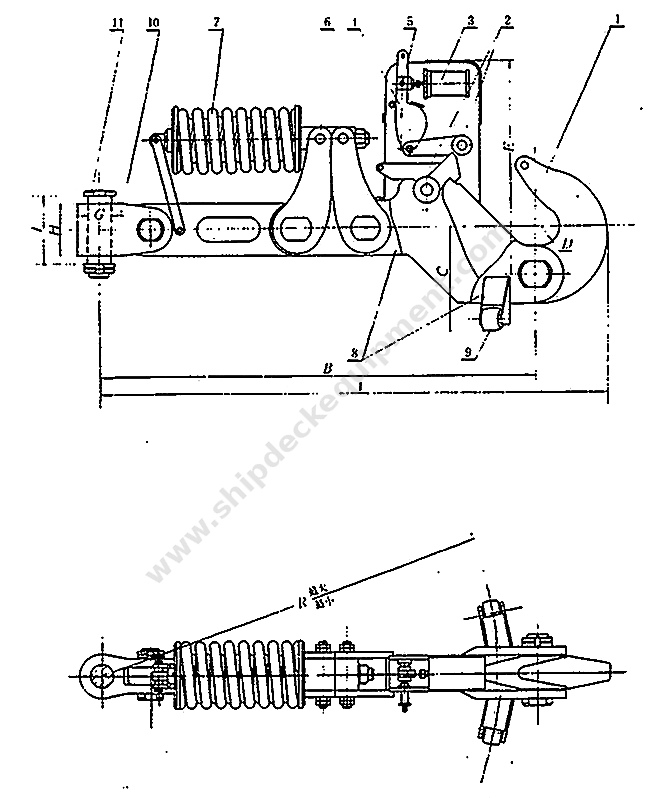
200-600 kN Pneumatic Quick Release Spring Towing Hook for Tugboats
Product Overview
The pneumatic quick release spring towing hook is a deck-mounted towing connection for tugboats, harbor tugs, workboats, and other vessels that require a controlled method of retaining and releasing a towing link or towline eye. The hook is arranged for pneumatic remote release and local manual release, allowing the crew to disconnect the towline from a safer operating position when an approved release command is required.
The series covers stated Safe Working Loads from 200 to 600 kN and follows the spring-type designation of CB*3064-79. Selection must consider the vessel bollard pull, towline MBL, towing geometry, dynamic loading, hook link dimensions, deck foundation, release-system arrangement, and the project-specific test basis. Release under load must be confirmed by the approved design and witnessed test procedure; it should not be assumed from the product name alone.
Quick Specifications
Main Technical Parameters
|
|||||||||||||||||||||||||||||||||||||||||||||||||||||||||||||||||
Selection & Inquiry Guide
Step 1: Confirm the required SWL: 200, 300, 400, or 600 kN. Selection should be based on the approved towing-load analysis and not on vessel bollard pull alone.
Step 2: Provide towline construction, diameter, MBL, towing link or eye dimensions, expected lead angles, tow-point height, and normal towing arrangement.
Step 3: Confirm pneumatic remote release, local manual release, required control station, air supply pressure, piping interface, indication/alarm requirement, and behavior after loss of air supply.
Step 4: Confirm exact steel grades, hook body and pin materials, heat treatment, NDE scope, corrosion protection, lubrication points, and spare parts requirement.
Step 5: Define the test basis: prototype or break-load test, production proof/SWL test, operation test, release-under-load test, hold time, acceptance criteria, and class witness points.
Step 6: Provide vessel type, installation position, deck foundation drawing, quantity, classification society, required certificates, destination, and delivery schedule.
Structure
Spring-type towing hook body | Hook and locking mechanism | Pneumatic release cylinder | Local manual release device | Towline link interface | Mounting foundation | Pins, bushes and lubrication points | Control and indication interfaces
Towing Release, Installation and Quality Advantages
Custom Attributes
How It Works
Towline link or eye is placed on the hook → Locking mechanism is fully engaged and indicated → Towing load is transferred through the hook body and vessel foundation → Pneumatic or local manual release command operates the release mechanism → Retaining condition is disengaged and the towing connection clears the hook along the approved release path
Applications
Harbor tugboats | Coastal towing vessels | Inland towboats | Workboats | Rescue and service vessels | Ship-assist towing | Barge handling | Newbuilding and towing-equipment replacement projects
Certifications & Advantages
Material certificates, NDE records, load-test reports, operation-test records, and class inspection can be arranged according to project requirement. Classification approval and surveyor witnessing are not included by default and must be confirmed before quotation.
Certification: CCS, NK, BV, ABS, DNV, LR, KR, IRS, RS, RINA, CRS, Makers Test Certificate.
Drawing & Photos


FAQ
Q1: Can the towing hook release while carrying its full SWL?
A1: Only when the approved design, pneumatic system, release force, load direction, and witnessed test procedure confirm release at that load. The website should not make an unconditional full-SWL release claim without the applicable test record.
Q2: How should the 200, 300, 400, and 600 kN models be selected?
A2: Select from the required towing load, towline MBL, dynamic and shock factors, vessel bollard pull, towline lead angles, towing-link dimensions, hook geometry, foundation strength, and class requirements. Bollard pull alone is not a complete selection basis.
Q3: Which tests and certificates should be specified?
A3: Confirm whether the order requires a type/prototype or destructive break-load test, a production proof or SWL test, release-under-load testing, no-load operation testing, NDE, material traceability, control-system checks, and class witnessing. The exact load multipliers and acceptance criteria must be agreed before production.