Marine Towing Hook | 400 kN Manual-Release Spring Type for Tugboats
Product Overview
The 400 kN manual-release spring towing hook is a shipboard towing fitting used on tugboats and towing vessels to retain the towing connection during operation and permit deliberate local release through a mechanical operating arrangement. The spring-assisted mechanism supports hook opening after the retaining device is disengaged. This page is for the manually operated spring type and does not represent a hydraulic or pneumatic remote-release system.
CB/T 637-1995 covers product classification, technical requirements, test methods, inspection rules, marking, and packing for spring towing hooks used in ship towing. The supplied series ranges from 16 kN to 400 kN, with this page focused on the 400 kN model. The supplied dimensional table uses the term "Max. Load"; the contractual designation as allowable load, SWL, or safe towing load, together with the required release load and test load, must be confirmed from the approved project drawing and class scope before manufacture.
Quick Specifications
Main Technical Parameters
|
Selection & Inquiry Guide
Step 1: Confirm the 400 kN model and state whether the project load is specified as maximum load, allowable load, SWL, or safe towing load.
Step 2: Provide towing-line type, towing eye or connection dimensions, expected lead direction, operating angle, and the required clear hook opening.
Step 3: Confirm the installation foundation, load path, under-deck reinforcement, fastening / welding interface, and available operating clearance by drawing.
Step 4: Confirm the manual release arrangement, local operating position, lever or release-wire route, required release load, and reset procedure.
Step 5: Confirm material grades, minimum design temperature, corrosion environment, ice-class or low-temperature requirement, and final coating system.
Step 6: State test and certificate scope, class society, witness points, quantity, delivery destination, required delivery date, and provide GA or installation drawings.
Structure
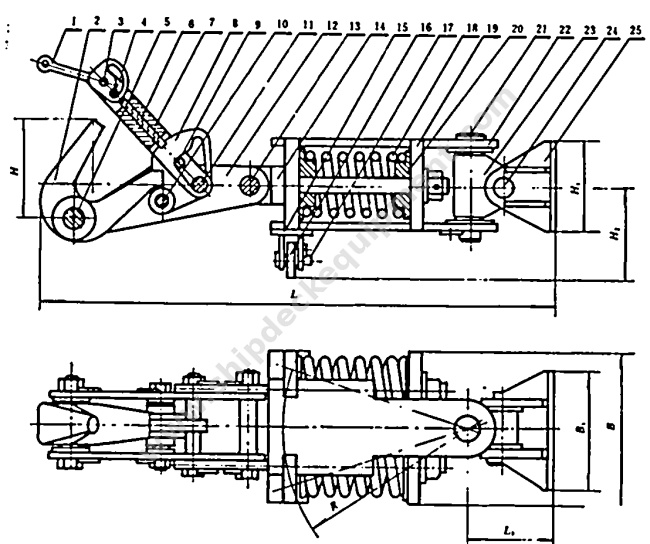
Towing hook body | Retaining and latch assembly | Spring-assisted release mechanism | Manual operating lever / release linkage | Pivot pin and bushes | Base and foundation interface | Reset and locking arrangement | Marine protective coating
Release, Installation & Quality Advantages
Custom Attributes
How It Works
Towing connection is placed on the hook → Retaining mechanism secures the hook in the working position → Towing load is transferred to the base and supporting hull structure → Operator actuates the manual release arrangement → Latch disengages and the spring assists hook opening → Connection is released → Hook is reset, locked, and function-checked before reuse
Applications
Harbour tugboats | Coastal towing vessels | Ship-assist tugs | Workboats with approved towing arrangements | Newbuilding projects | Replacement of compatible spring towing hooks
Certifications & Advantages
Certificates and inspection can be arranged according to project requirement, approved test scope, material traceability, and classification society procedure. Availability is subject to class approval and the agreed order scope.
Certification: CCS, NK, BV, ABS, DNV, LR, KR, IRS, RS, RINA, CRS, Makers Test Certificate.
Drawing & Photos


FAQ
Q1: Can the hook be manually released while carrying the full 400 kN load?
A1: The supplied table identifies 400 kN as the maximum load, but it does not independently confirm the permitted release load. Release under load must be defined in the approved specification and verified by the required release-operation test. It should not be assumed that full-load release is included.
Q2: Does this model include wheelhouse remote release?
A2: No. This page describes a manual-release spring towing hook. A hydraulic or pneumatic remote-release system requires a different approved configuration, control philosophy, fail-safe review, and test scope.
Q3: What information is required before quotation?
A3: Provide the required load designation, towing-line or eye dimensions, pull direction, foundation and installation drawing, manual release arrangement, material and coating requirements, class society, test scope, quantity, destination, and delivery schedule.