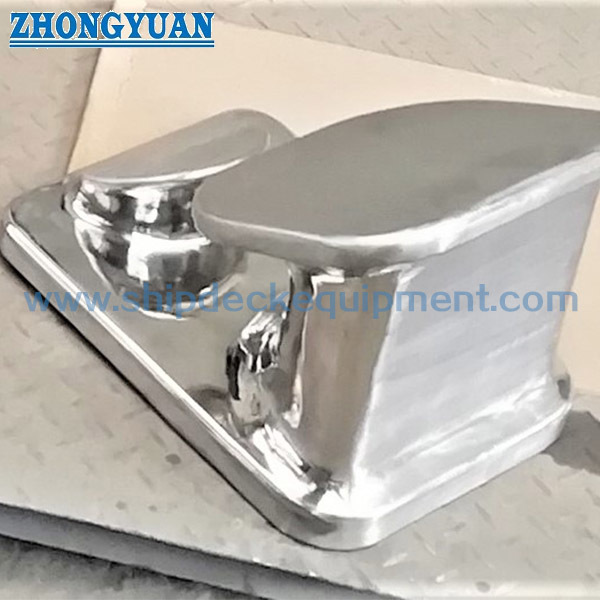
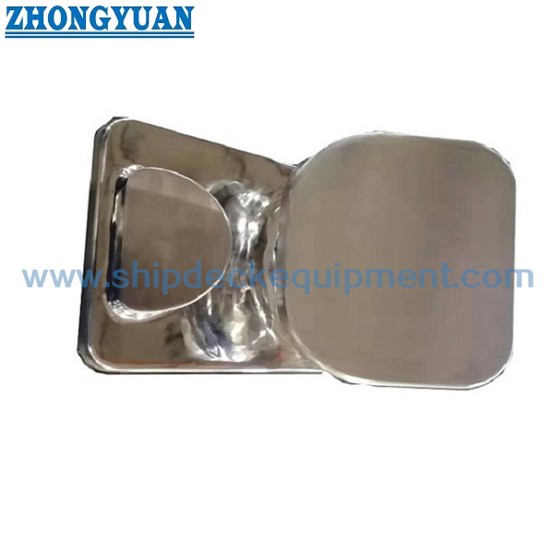
6-Inch Polished Stainless Steel Fixed Towing Chock for Inland Barges and Workboats
Product Overview
The 6-inch polished stainless steel fixed towing chock is a deck-mounted towline guide developed for river barges, tank barges, towboats, and workboats operating on American inland waterways and Gulf-connected service routes. Its fixed cast body provides a controlled rope path, while the curved polished working surfaces help reduce sharp contact, abrasion, and local line damage during towing, fleeting, and barge-handling operations.
This model is supplied as a 6-inch configuration with a stated Safe Working Load of 75 T. Selection must also consider towline construction and diameter, line MBL, expected lead angles, load direction, deck foundation, welding details, and the approved test basis. A 10-inch configuration is also available, but its dimensions and load rating are different and should be treated as a separate model.
Quick Specifications
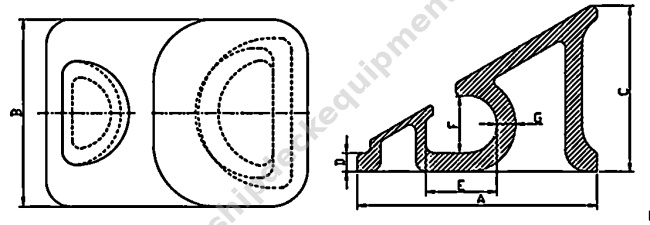
Main Technical Parameters
| Description | Type | Dimensions (MM) | Weight | ||||||
| A | B | C | D | E | F | G | (KGS) | ||
| Stainless Steel Fixed Chock | 6” | 410 | 295 | 280 | 33 | 128 | 98 | 33 | 75 |
Selection & Inquiry Guide
Step 1: Confirm the required version: 6 in or 10 in, together with the reference drawing or existing chock model. Do not select only by the inch designation.
Step 2: Provide towline type, construction, diameter, MBL, expected service tension, and normal lead angles in plan and elevation.
Step 3: Confirm the required SWL unit, principal load direction, maximum side lead, deck location, foundation plate, surrounding reinforcement, and welding arrangement.
Step 4: Confirm the exact cast stainless steel grade and material standard, including whether the project requires SUS, ASTM/UNS, EN, or class-approved material identification.
Step 5: Define the surface finish, RT extent and acceptance level, pull-test or proof-load value, witness inspection, material traceability, and certificate scope.
Step 6: Provide vessel type, quantity, installation drawing or photos, classification society requirement, delivery destination, and required delivery time.
Structure
Integral cast stainless steel body | Fixed deck mounting base | Curved rope-working channel | Forward and aft guide shoulders | High-polished contact surfaces | Reinforced vessel foundation by shipyard
Towing, Casting and Installation Advantages
Custom Attributes
How It Works
Towline approaches the chock → Line enters the polished fixed channel → Curved contact surfaces guide and restrain the line path → Towing force is transferred through the cast body and mounting base → Reinforced deck structure distributes the load into the vessel
Applications
American inland dry bulk barges | Tank barges | Towboats and push boats | Harbor and river workboats | Fleeting operations | Barge towing and handling stations | Newbuilding and replacement projects
Certifications & Advantages
Material certification, NDE records, pull-load test documentation, and class inspection can be arranged according to project requirement and are not included by default.
Certification: CCS, NK, BV, ABS, DNV, LR, KR, IRS, RS, RINA, CRS, Makers Test Certificate.
Drawing & Photos

FAQ
Q1: How should the 6-inch and 10-inch versions be selected?
A1: Select by the approved drawing, towline diameter and construction, line MBL, required SWL, load direction, available deck space, and foundation arrangement. The inch designation alone does not establish the rating.
Q2: Does the 75 T SWL apply in every towing direction?
A2: No. The rating must be linked to the approved principal load direction, allowable side lead, complete deck foundation, welding details, and test basis. A different lead angle or installation can change the structural demand.
Q3: What is normally required for ABS or other class inspection?
A3: The scope should be agreed before production and may include an approved drawing, material certificate, material traceability, NDE procedure and report, load-test procedure and results, welding or foundation details, and surveyor witnessing.