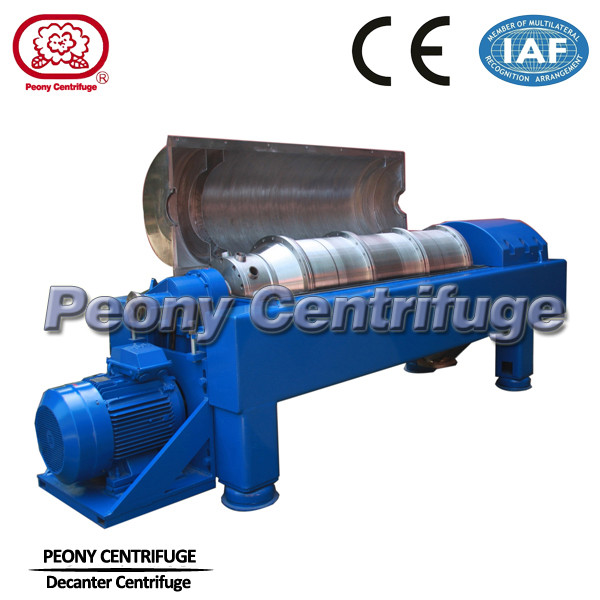
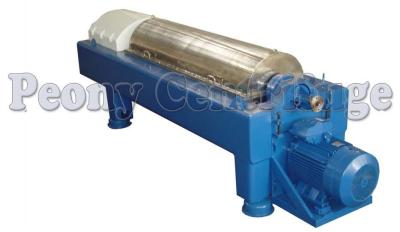
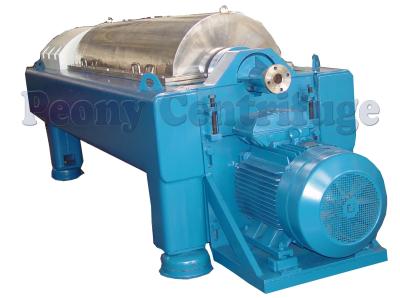
The Decanter Centrifuge for Pharmaceutical Waste Slurry is designed for continuous solid-liquid separation in pharmaceutical manufacturing processes, including fermentation residues, API production waste, chemical slurry, and pharmaceutical wastewater treatment.
It efficiently separates fine suspended solids from complex pharmaceutical slurry, helping reduce liquid content in waste solids, improve recovery efficiency, and provide stable pretreatment before drying, incineration, or further treatment.
Pharmaceutical waste often contains fine particles, biological residues, and compressible solids that are difficult to separate with conventional equipment.
Organic compounds, solvents, salts, and active ingredients may affect separation performance and material selection.
Pharmaceutical residues usually contain a large amount of water, increasing drying energy consumption and disposal costs.
Equipment design needs to consider cleanability, corrosion resistance, and contamination control.
Pharmaceutical plants require reliable operation with stable separation performance.
Pharmaceutical Waste Slurry
→ Feed Conditioning System
→ Decanter Centrifuge
→ Clarified Liquid + Dewatered Pharmaceutical Solids
Clarified Liquid
→ Wastewater Treatment / Solvent Recovery / Recycling
Dewatered Solids
→ Drying / Disposal / Further Processing
Pharmaceutical waste slurry containing suspended solids enters the rotating bowl through a controlled feeding system.
Under centrifugal force, solid particles move toward the bowl wall and form a concentrated solids layer.
Separated liquid remains in the inner liquid zone and moves toward the clarified liquid area.
The scroll continuously transports concentrated pharmaceutical solids toward the discharge end.
Dewatered solids and clarified liquid are continuously separated for further treatment or recovery.

| Model | Diameter (mm) | Length (mm) | Length-to-diameter rate | G force | Max solid discharge (m³/h) | Weight (kg) | Dimension (L*W*H) (mm) |
|---|---|---|---|---|---|---|---|
| PDC-10 | 250 | 1000 | 4 | 4080 | 0.4 | 1000 | 2410*800*1080 |
| PDC-12 | 4200 | 1350 | 4 | 3500 | 0.6 | 1200 | 2610*800*1080 |
| PDC-12 | 4200 | 1350 | 4.5 | 3180 | 1.2 | 1800 | 3495*840*1180 |
| PDC-18 | 4000 | 1600 | 4.5 | 3180 | 1.2 | 3200 | 3497*1020*1385 |
| PDC-18 | 450 | 2150 | 4 | 2500 | 2 | 3800 | 4447*1080*1385 |
| PDC-20 | 400 | 2250 | 4.5 | 2500 | 3.5 | 4000 | 4580*1140*1470 |
| PDC-21 | 530 | 2280 | 4.3 | 2500 | 5 | 5000 | 4924*1170*1540 |
| PDC-26 | 655 | 2800 | 4.3 | 2270 | 8 | 7000 | 4300*1900*1350 |
Removing excess water before drying helps reduce thermal energy demand and operating costs.
The decanter centrifuge enables uninterrupted feeding and automatic solids removal.
Optimized bowl design and differential speed control improve separation of fine particles.
Materials such as SS316L can be selected according to chemical composition.
Sealed configurations help reduce exposure and improve process safety.
Reliable operation supports continuous pharmaceutical production processes.
Please provide:
A decanter centrifuge provides continuous solid-liquid separation, reducing moisture content and improving pharmaceutical waste handling efficiency.
Yes. Differential speed, bowl design, and operating parameters can be adjusted for fine and difficult-to-settle particles.
It can handle fermentation residues, API waste slurry, pharmaceutical wastewater sludge, and chemical process residues.
Yes. SS316L and other corrosion-resistant materials can be selected according to process conditions.
Yes. The decanter centrifuge is designed for automatic continuous operation with stable solid discharge.
Peony provides industrial decanter centrifuge solutions for pharmaceutical plants, chemical manufacturers, EPC contractors, and engineering partners.
We support slurry evaluation, equipment selection, customized configurations, and project cooperation.
Contact us to discuss pharmaceutical waste slurry separation requirements and long-term cooperation opportunities.