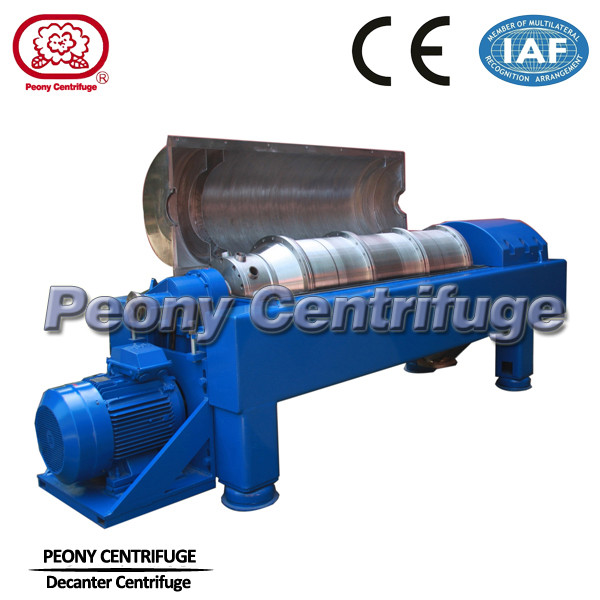
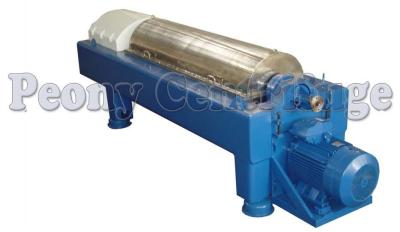
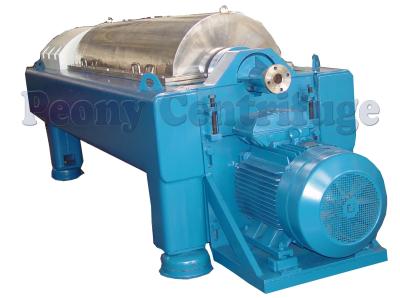
The Decanter Centrifuge for Paper Coating Slurry Recovery is designed for continuous coating-pigment recovery, slurry thickening, wash-water clarification, and filter-press feed preparation.
It is suitable for paper coating colors containing kaolin, calcium carbonate, titanium dioxide, latex binders, starch, dispersants, and other coating additives.
Kaolin, calcium carbonate, and titanium dioxide particles may remain suspended.
Higher centrifugal force and optional coagulation or flocculation can improve solids recovery.
Latex, starch, and synthetic binders may create sticky sludge or deposits inside the machine.
Stable feeding, suitable differential speed, and regular flushing help maintain continuous discharge.
Concentrated coating color may have high viscosity and poor flowability.
An agitated buffer tank and controlled feed pump help stabilize the feed condition.
Different coating formulations should be collected separately when recovered solids will be returned to production.
Dedicated pipelines and flushing systems help reduce cross-contamination.
Paper fibers, dried coating lumps, and foreign particles may block the feed system.
Screening is recommended before the slurry enters the centrifuge.
Peony provides continuous separation solutions for coating-pigment recovery, sludge thickening, water clarification, and downstream filtration preparation.
Paper Coating / Coater Cleaning / Tank Washing
→ Screening
→ Agitated Slurry Tank
→ Optional pH Adjustment / Flocculation
→ Decanter Centrifuge
→ Thickened Coating Solids
→ Rework Evaluation / Filter Press / Dryer / Disposal
Clarified Liquid
→ Water Tank
→ Polishing Filtration / Biological Treatment / Membrane Treatment
→ Reuse or Discharge
Screened paper coating slurry enters the rotating bowl through a controlled feed pipe.
An agitated tank maintains a stable concentration and prevents coating solids from settling.
High-speed rotation separates coating pigments, fiber fines, and binder solids from the liquid phase.
The denser particles move outward and form a solids layer against the bowl wall.
The screw conveyor rotates at a controlled differential speed.
It continuously transports settled coating solids toward the conical discharge end.
The separated liquid leaves through the liquid outlet.
It can be sent to polishing filtration, biological treatment, membrane treatment, or water-recovery systems.
Concentrated coating solids are discharged continuously.
The recovered material can be evaluated for rework or transferred to filtration, drying, recycling, or disposal.

| Model | Diameter (mm) | Length (mm) | Length-to-diameter rate | G force | Max solid discharge (m³/h) | Weight (kg) | Dimension (L*W*H) (mm) |
|---|---|---|---|---|---|---|---|
| PDC-10 | 250 | 1000 | 4 | 4080 | 0.4 | 1000 | 2410*800*1080 |
| PDC-12 | 4200 | 1350 | 4 | 3500 | 0.6 | 1200 | 2610*800*1080 |
| PDC-12 | 4200 | 1350 | 4.5 | 3180 | 1.2 | 1800 | 3495*840*1180 |
| PDC-18 | 4000 | 1600 | 4.5 | 3180 | 1.2 | 3200 | 3497*1020*1385 |
| PDC-18 | 450 | 2150 | 4 | 2500 | 2 | 3800 | 4447*1080*1385 |
| PDC-20 | 400 | 2250 | 4.5 | 2500 | 3.5 | 4000 | 4580*1140*1470 |
| PDC-21 | 530 | 2280 | 4.3 | 2500 | 5 | 5000 | 4924*1170*1540 |
| PDC-26 | 655 | 2800 | 4.3 | 2270 | 8 | 7000 | 4300*1900*1350 |
Recovers suspended kaolin, calcium carbonate, titanium dioxide, and other coating solids.
Provides a more consistent solids concentration for rework, filtration, or sludge handling.
Removes coating solids before biological, flotation, or membrane treatment.
Flushing and CIP connections help reduce latex, starch, and binder deposits.
Separate collection and controlled processing can support recovery of compatible off-spec coating slurry.
Please provide:
Possibly. The formulation, color, particle size, contamination level, and coating-performance requirements must first be checked.
Yes. Recovery depends on particle size, slurry concentration, viscosity, and dispersion stability.
Stable feeding, suitable differential speed, automatic flushing, and regular CIP help reduce sticky buildup.
Yes. Fibers, dried coating lumps, and foreign particles should be removed to protect the feed system and discharge ports.
It may be reused after checking suspended solids, COD, dissolved chemicals, color, and the water-quality requirements of the intended process.