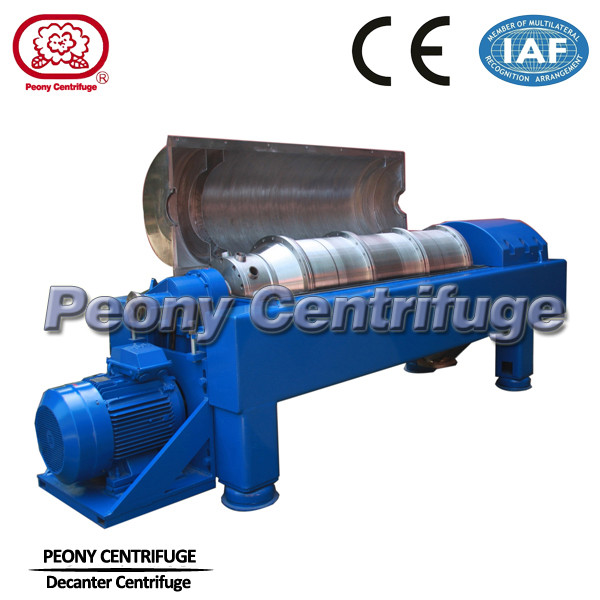
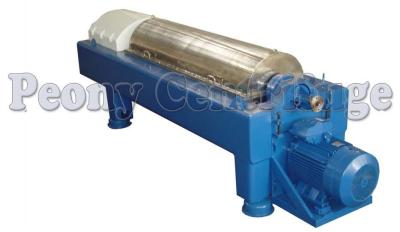
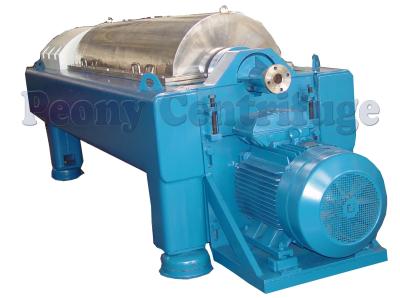
The Peony Decanter Centrifuge for Calcium Carbonate Slurry Dewatering is designed for continuous thickening, dewatering, and recovery of calcium carbonate slurry from grinding, classification, coating, precipitation, washing, and mineral processing lines.
It is suitable for both ground calcium carbonate (GCC) and precipitated calcium carbonate (PCC) slurry where continuous solids recovery and process-water reduction are required.
For very fine PCC, coating-grade calcium carbonate, or slurry with low settling velocity, feed conditioning or polymer dosing may be required to improve recovery and clarified liquid quality.
Peony provides the continuous solid-liquid separation section between calcium carbonate slurry preparation and downstream filtration, drying, storage, or water recycle.
Calcium Carbonate Grinding / Precipitation → Classification / Washing → Slurry Tank → Optional Polymer Dosing → Decanter Centrifuge → Thickened Calcium Carbonate Solids → Filter Press / Dryer / Storage
Clarified Liquid → Process Water Tank → Recycle to Grinding, Washing, or Slurry Preparation
Peony can provide:
Calcium carbonate slurry enters the rotating bowl through a controlled feed pipe.
An agitated slurry tank is normally used upstream to prevent sedimentation and maintain a stable solids concentration.
Inside the high-speed bowl, centrifugal force separates calcium carbonate particles from the liquid phase.
The solid particles settle against the bowl wall, while the clarified liquid forms the inner liquid layer.
The internal screw conveyor rotates at a controlled differential speed relative to the bowl.
This differential movement transports the settled calcium carbonate solids toward the conical end for continuous discharge.
The separated liquid flows toward the liquid outlet.
Depending on process requirements, it can be returned to the grinding circuit, washing section, process-water tank, settling system, or further treatment stage.
The concentrated calcium carbonate solids are discharged continuously from the solids outlet.
The final solids concentration depends on particle size, feed concentration, slurry viscosity, bowl speed, differential speed, pond depth, polymer use, and required throughput.

| Model | Diameter (mm) | Length (mm) | Length-to-diameter rate | G force | Max solid discharge (m³/h) | Weight (kg) | Dimension (L*W*H) (mm) |
|---|---|---|---|---|---|---|---|
| PDC-10 | 250 | 1000 | 4 | 4080 | 0.4 | 1000 | 2410*800*1080 |
| PDC-12 | 4200 | 1350 | 4 | 3500 | 0.6 | 1200 | 2610*800*1080 |
| PDC-12 | 4200 | 1350 | 4.5 | 3180 | 1.2 | 1800 | 3495*840*1180 |
| PDC-18 | 4000 | 1600 | 4.5 | 3180 | 1.2 | 3200 | 3497*1020*1385 |
| PDC-18 | 450 | 2150 | 4 | 2500 | 2 | 3800 | 4447*1080*1385 |
| PDC-20 | 400 | 2250 | 4.5 | 2500 | 3.5 | 4000 | 4580*1140*1470 |
| PDC-21 | 530 | 2280 | 4.3 | 2500 | 5 | 5000 | 4924*1170*1540 |
| PDC-26 | 655 | 2800 | 4.3 | 2270 | 8 | 7000 | 4300*1900*1350 |
Ground calcium carbonate and precipitated calcium carbonate can have different particle size, morphology, settling behavior, and water retention characteristics. These factors affect centrifuge selection.
Fine PCC or coating-grade calcium carbonate may settle more slowly than coarser GCC particles. Fine-particle recovery requirements should be confirmed before equipment selection.
Stable feed concentration is important for consistent solids discharge and clarified liquid quality. Large concentration changes may require feed control or buffer tank adjustment.
High-viscosity slurry may affect sedimentation and scroll conveying performance. Differential speed and torque protection should be selected according to the actual slurry condition.
A decanter centrifuge is suitable for continuous thickening and primary dewatering. When very low moisture is required for powder production, it is usually followed by a filter press, vacuum filter, flash dryer, spray dryer, or other drying equipment.
The decanter centrifuge continuously recovers calcium carbonate solids from process slurry, reducing manual handling and batch operation.
The centrifuge can be configured for different calcium carbonate grades, including ground calcium carbonate, precipitated calcium carbonate, coating-grade material, and industrial filler products.
Bowl speed, differential speed, pond depth, and feed rate can be adjusted to balance throughput, solids recovery, liquid clarity, and discharged solids concentration.
Recovered liquid can be routed back to grinding, washing, slurry preparation, or other process-water reuse points when water quality allows.
For slurry containing silica, quartz sand, or abrasive mineral impurities, wear protection can be applied to the feed zone, scroll flights, bowl cone, and solids discharge section.
Please provide the following information for a suitable calcium carbonate slurry dewatering solution:
Yes. It can be configured for both ground calcium carbonate and precipitated calcium carbonate slurry. Final selection depends on particle size, slurry concentration, settling behavior, and required recovery performance.
It depends on the final moisture target. A decanter centrifuge is suitable for continuous thickening and primary dewatering. A filter press or dryer may still be required when lower final moisture is needed.
Not always. Polymer dosing may be considered for very fine particles, low-solids slurry, difficult settling behavior, or higher clarified liquid quality requirements.
Yes. The clarified liquid can be returned to the grinding, washing, or slurry preparation section when water quality meets process requirements.
Wear protection is recommended when the slurry contains quartz sand, silica, grit, or other abrasive mineral impurities. The scroll flights, feed zone, cone, and solids discharge port are common wear areas.
Peony welcomes distributor and agent cooperation with calcium carbonate producers, mineral processing plants, paper coating material suppliers, plastic and rubber filler manufacturers, grinding-system contractors, and industrial separation partners.
We support partners with slurry testing, decanter centrifuge selection, polymer dosing design, wear-resistant configuration, feed and recycle system integration, installation guidance, commissioning support, spare parts, and after-sales service.
Send us your calcium carbonate type, particle size, slurry solids concentration, viscosity, required capacity, clarified-water target, final moisture requirement, and downstream handling arrangement. Our engineering team will recommend a suitable Decanter Centrifuge solution for your calcium carbonate slurry dewatering process.