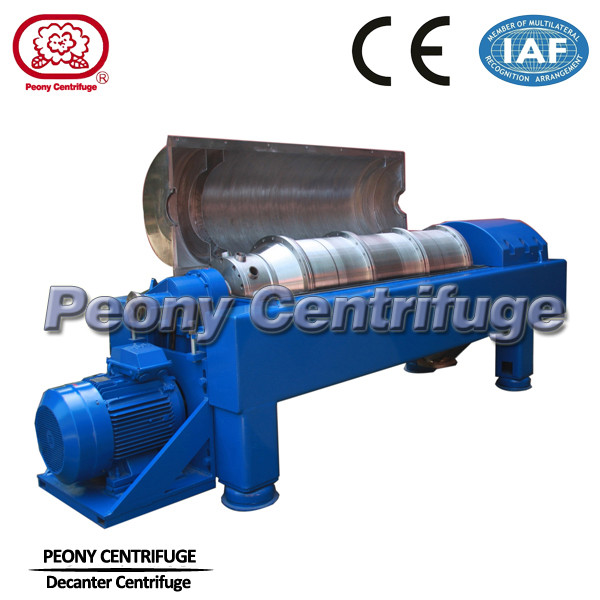
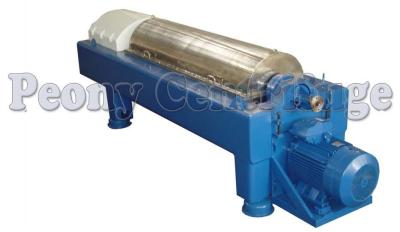
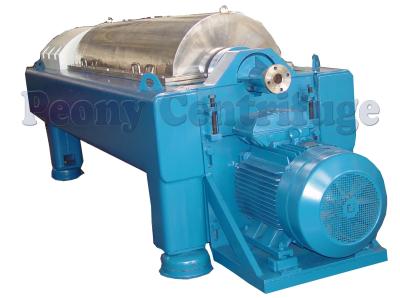
The Decanter Centrifuge for Caustic Soda Production is designed for solid-liquid separation in caustic soda manufacturing processes, especially for brine purification residue treatment and chemical precipitation separation before membrane electrolysis.
It continuously removes insoluble impurities and precipitation solids from purified brine systems, helping maintain stable membrane cell operation, improve brine quality, and reduce contamination risks in caustic soda production.
Low-level impurities in brine can affect membrane performance and increase electrolysis maintenance.
Chemical purification generates fine CaCO₃ and Mg(OH)₂ particles that require efficient separation.
High chloride concentration requires corrosion-resistant equipment materials.
Continuous impurity removal is required to maintain consistent caustic soda production.
Raw Brine
→ Chemical Purification Process
→ Decanter Centrifuge
→ Purified Brine + Dewatered Residue
Purified Brine → Membrane Electrolysis
Dewatered Residue → Recovery / Disposal
Brine containing precipitation solids enters the rotating bowl through a controlled feeding system.
Under centrifugal force, dense impurities move toward the bowl wall and form a concentrated solids layer.
Separated brine remains in the inner liquid zone and flows toward the clarified liquid area.
The scroll continuously transports separated solids toward the discharge end.
Clarified brine and concentrated purification residue are continuously separated for further processing.

| Model | Diameter (mm) | Length (mm) | Length-to-diameter rate | G force | Max solid discharge (m³/h) | Weight (kg) | Dimension (L*W*H) (mm) |
|---|---|---|---|---|---|---|---|
| PDC-10 | 250 | 1000 | 4 | 4080 | 0.4 | 1000 | 2410*800*1080 |
| PDC-12 | 4200 | 1350 | 4 | 3500 | 0.6 | 1200 | 2610*800*1080 |
| PDC-12 | 4200 | 1350 | 4.5 | 3180 | 1.2 | 1800 | 3495*840*1180 |
| PDC-18 | 4000 | 1600 | 4.5 | 3180 | 1.2 | 3200 | 3497*1020*1385 |
| PDC-18 | 450 | 2150 | 4 | 2500 | 2 | 3800 | 4447*1080*1385 |
| PDC-20 | 400 | 2250 | 4.5 | 2500 | 3.5 | 4000 | 4580*1140*1470 |
| PDC-21 | 530 | 2280 | 4.3 | 2500 | 5 | 5000 | 4924*1170*1540 |
| PDC-26 | 655 | 2800 | 4.3 | 2270 | 8 | 7000 | 4300*1900*1350 |
Efficient removal of purification residues helps maintain stable membrane cell operation.
Continuous solid separation reduces impurity accumulation in the brine system.
Materials such as 316L stainless steel, duplex stainless steel, or titanium can be selected according to chloride conditions.
The decanter centrifuge supports continuous operation for large-scale caustic soda plants.
Removing precipitation solids helps reduce fouling and cleaning frequency.
Please provide:
It helps remove precipitation solids from brine purification systems and maintain stable electrolysis operation.
It can separate calcium carbonate, magnesium hydroxide, salt particles, and other purification residues.
Yes. Material selection can be customized for chloride-rich and corrosive process conditions.
It is mainly used in brine purification and residue treatment sections before membrane electrolysis.
Depending on process conditions, a decanter centrifuge can provide continuous separation with lower manual operation requirements.
Peony cooperates with caustic soda producers, chlor alkali plants, EPC contractors, and process partners.
We also welcome qualified global agents and local partners for industrial separation solutions.
Contact us with your project requirements and market information to explore long-term cooperation opportunities.