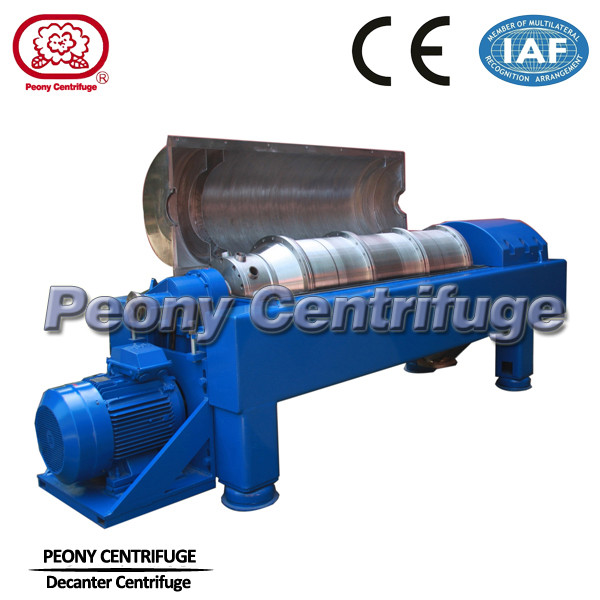
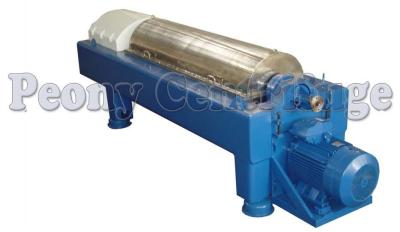
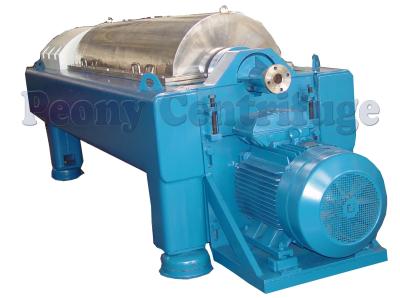
The Decanter Centrifuge for Feldspar Slurry Dewatering is designed for continuous slurry thickening, feldspar fines recovery, filter-feed preparation, and process-water clarification.
It can be installed after feldspar washing, grinding, desliming, classification, flotation, or tailings treatment. Feldspar ores commonly contain quartz, mica, clay, kaolin, and iron-bearing impurities, so the centrifuge configuration must consider fine-particle content, flotation reagents, abrasion, and product-quality requirements.
Kaolin, clay, and ultrafine mineral particles can remain suspended and reduce clarified-water quality. Upstream desliming or suitable flocculation may be required.
Quartz and mica are commonly associated with feldspar ores. The decanter removes them from the liquid together with other solids but does not selectively purify feldspar from these minerals.
Collectors, frothers, depressants, dispersants, and pH regulators can change slurry stability and settling behavior. Feldspar flotation may use chemically conditioned and acidic circuits, so the actual process liquor must be reviewed before equipment selection.
Quartz, silica sand, and hard mineral particles can wear the feed zone, scroll conveyor, conical section, and solids-discharge ports.
Slurry concentration can change between washing, classification, concentrate, and tailings streams. Automatic torque and differential-speed control help maintain stable discharge.
Peony provides continuous separation solutions for feldspar concentrate dewatering, fine-particle recovery, tailings thickening, and process-water clarification.
Feldspar Washing / Grinding / Desliming / Classification / Flotation
→ Agitated Slurry Tank
→ Optional Flocculant Dosing or Slurry Conditioning
→ Decanter Centrifuge
→ Thickened Feldspar Solids
→ Filter Press / Dryer / Storage / Further Beneficiation
Clarified Liquid
→ Process-Water Tank
→ Recycle to Washing, Grinding, or Flotation / Polishing Treatment
Feldspar slurry enters the rotating bowl through a controlled feed pipe.
An agitated tank keeps mineral particles suspended and reduces sudden changes in feed concentration.
High-speed bowl rotation forces feldspar, quartz, mica, clay, and other suspended solids toward the bowl wall.
The liquid phase remains closer to the bowl center.
Settled mineral particles form a compact layer inside the bowl.
The solids concentration increases as the material moves toward the conical section.
The screw conveyor rotates at a differential speed relative to the bowl and continuously transports the solids toward the discharge end.
Thickened mineral solids leave through the solids ports.
Clarified liquid leaves from the opposite end and can be sent to process-water reuse, polishing clarification, or wastewater treatment.

| Model | Diameter (mm) | Length (mm) | Length-to-diameter rate | G force | Max solid discharge (m³/h) | Weight (kg) | Dimension (L*W*H) (mm) |
|---|---|---|---|---|---|---|---|
| PDC-10 | 250 | 1000 | 4 | 4080 | 0.4 | 1000 | 2410*800*1080 |
| PDC-12 | 4200 | 1350 | 4 | 3500 | 0.6 | 1200 | 2610*800*1080 |
| PDC-12 | 4200 | 1350 | 4.5 | 3180 | 1.2 | 1800 | 3495*840*1180 |
| PDC-18 | 4000 | 1600 | 4.5 | 3180 | 1.2 | 3200 | 3497*1020*1385 |
| PDC-18 | 450 | 2150 | 4 | 2500 | 2 | 3800 | 4447*1080*1385 |
| PDC-20 | 400 | 2250 | 4.5 | 2500 | 3.5 | 4000 | 4580*1140*1470 |
| PDC-21 | 530 | 2280 | 4.3 | 2500 | 5 | 5000 | 4924*1170*1540 |
| PDC-26 | 655 | 2800 | 4.3 | 2270 | 8 | 7000 | 4300*1900*1350 |
The decanter captures feldspar particles carried in washing water, desliming overflow, or classification slurry.
Continuous thickening provides a more stable solids concentration for downstream filtration.
Flotation tailings and clay-rich residues can be concentrated before storage, transport, or disposal.
Recovered liquid may be returned to grinding, washing, or flotation after checking suspended solids and residual reagent levels.
Carbide and ceramic protection can be installed in areas exposed to quartz, silica, and abrasive mineral particles.
Please provide:
No. A decanter separates suspended solids from liquid. Feldspar and quartz purification must be completed by flotation, magnetic separation, or another beneficiation method before or after dewatering.
It can be installed on the concentrate stream, desliming overflow, classification overflow, or tailings stream. The correct position depends on whether the target is product recovery, filter-feed preparation, or water clarification.
Yes. Recovery depends on particle size, clay content, feed concentration, and settling behavior. Ultrafine solids may require flocculation.
They may affect slurry dispersion, settling, foam, and clarified-water quality. The reagent type, dosage, and pH should be provided during selection.
It depends on suspended-solids content, residual reagents, ion concentration, and flotation-water requirements. Polishing clarification or water-quality adjustment may be required before reuse.
Peony welcomes distributor and agent cooperation with feldspar mines, ceramic raw-material producers, glass manufacturers, mineral beneficiation plants, flotation contractors, wastewater treatment companies, and industrial separation partners.
We support partners with feldspar slurry testing, decanter centrifuge selection, wear-resistant configuration, flocculant dosing design, process-water recycling, filter press integration, installation guidance, commissioning, spare parts, and after-sales service.
Send us your feldspar slurry information, including the process stage, mineral composition, particle-size distribution, solids concentration, clay and quartz content, flotation reagents, required capacity, clarified-water target, and downstream equipment. Our engineering team will recommend a suitable decanter centrifuge solution for feldspar concentrate dewatering, fine-particle recovery, or tailings thickening.