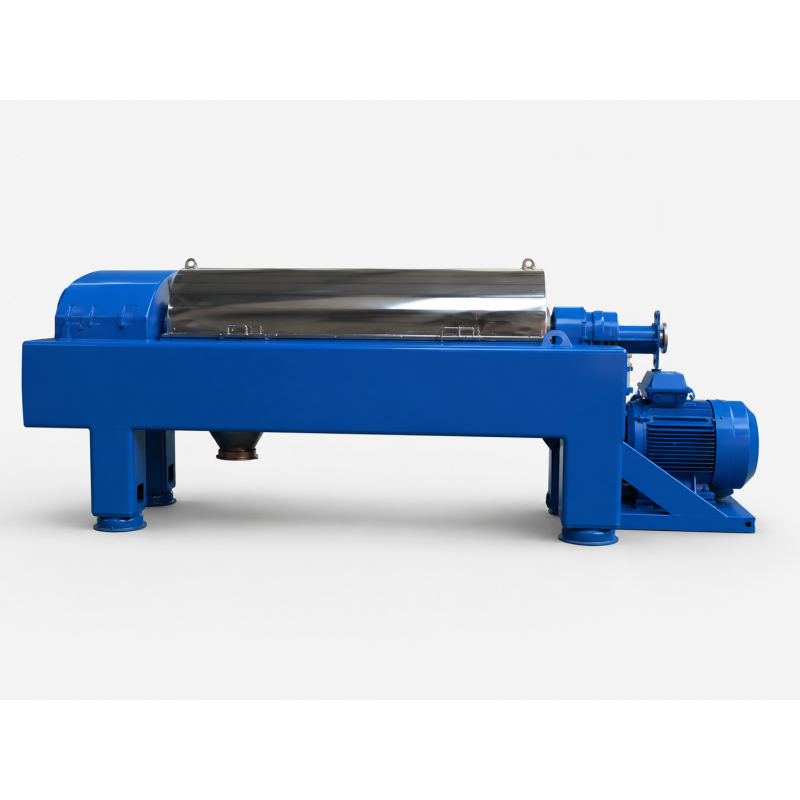
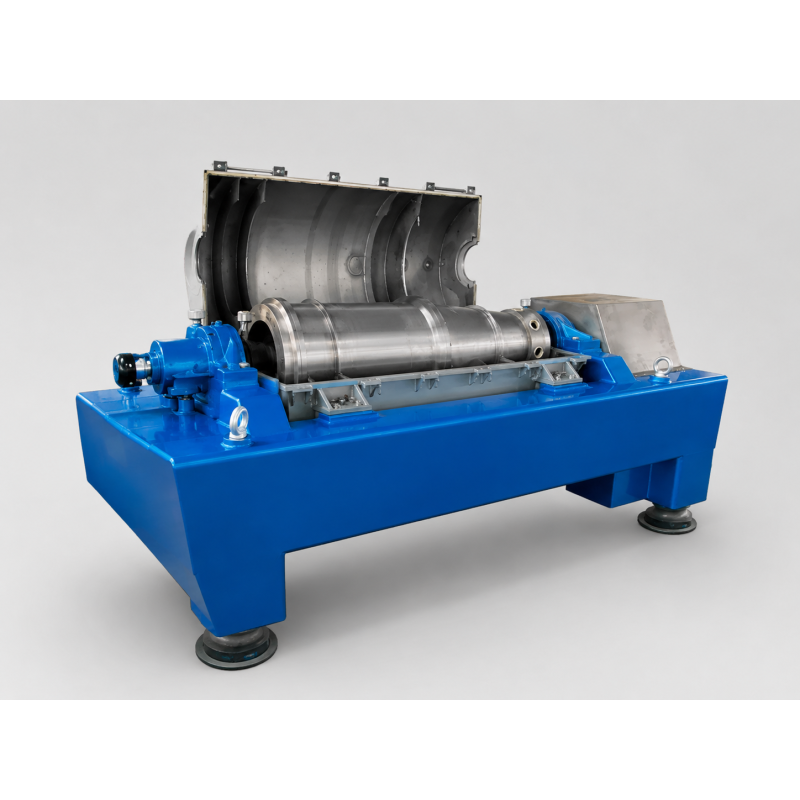
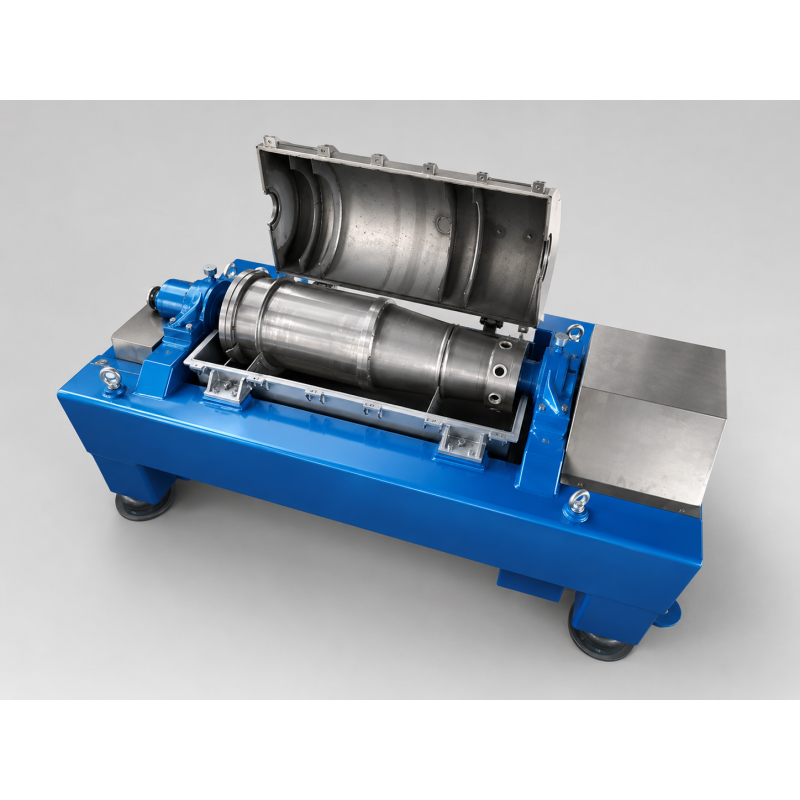
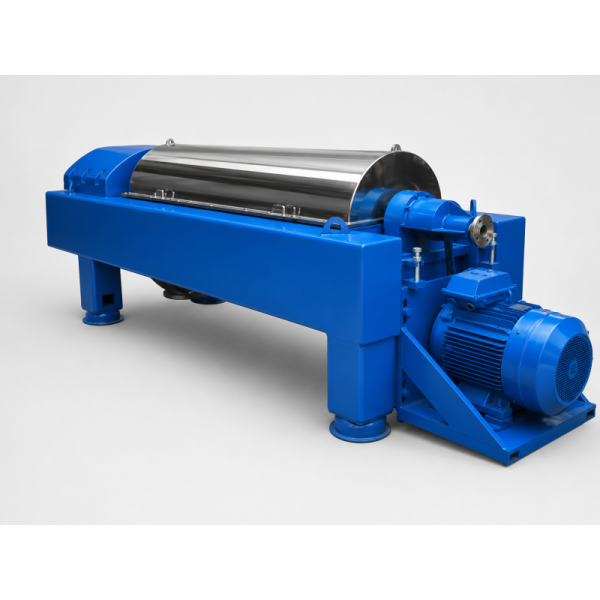
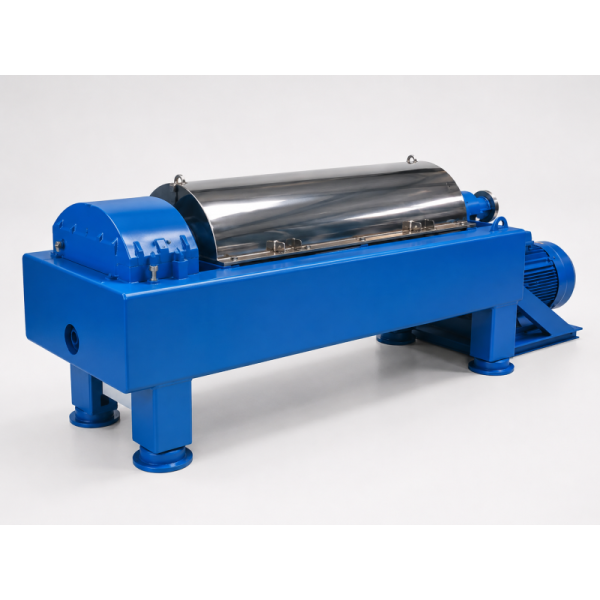
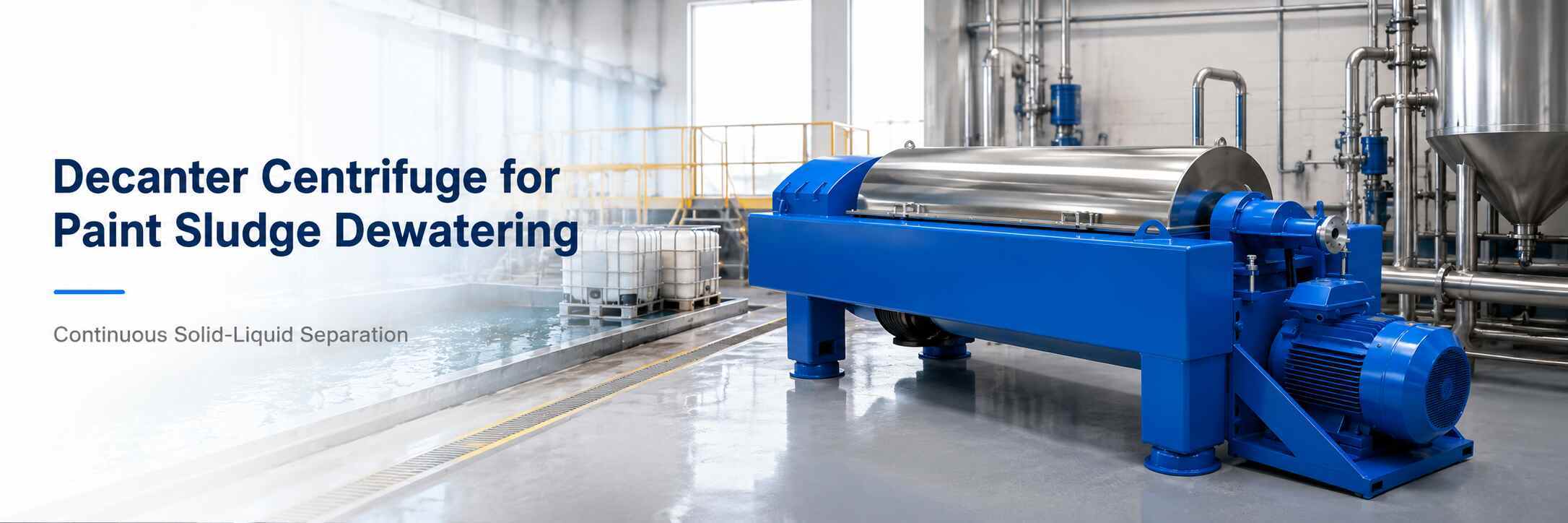
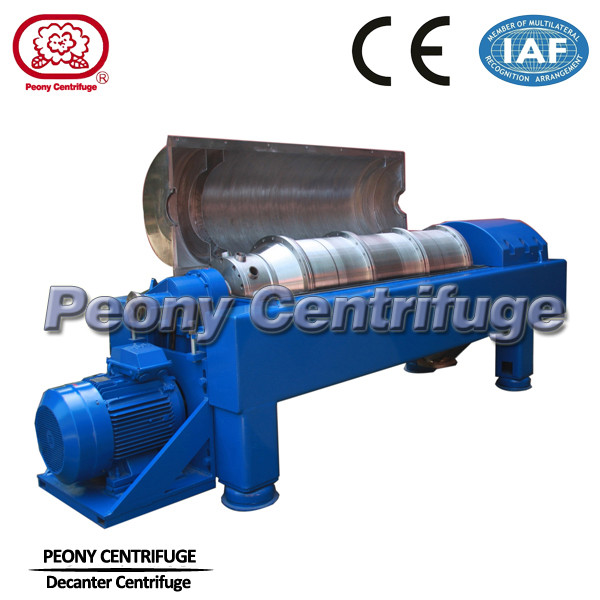
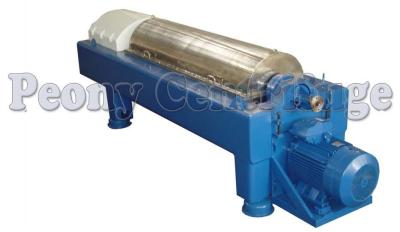
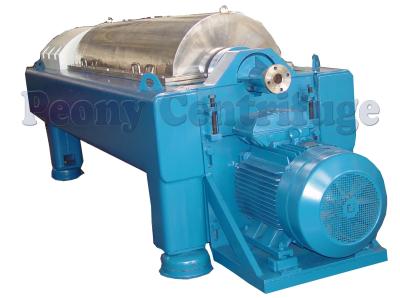
The Decanter Centrifuge for Paint Sludge Dewatering is designed for continuous paint-sludge thickening, pigment and resin solids separation, wastewater clarification, and filter-press feed preparation.
It is suitable for paint manufacturing, automotive spray booths, coating lines, equipment-cleaning wastewater, overspray treatment, and off-spec paint disposal.
Paint sludge may contain acrylic, epoxy, polyurethane, alkyd, latex, or other resins.
These materials can adhere to the bowl, conveyor, and discharge area. Stable feeding, suitable differential speed, and regular flushing help reduce deposits.
Fine pigments may remain dispersed in the liquid, especially in water-based paint wastewater.
pH adjustment, coagulation, and flocculation are often used before centrifugation to form larger, separable solids.
Wastewater properties may change during product switching and equipment cleaning.
An agitated equalization tank helps stabilize solids concentration, pH, viscosity, and feed flow.
Solvent-based paint sludge may contain flammable liquids or vapors.
A sealed machine, explosion-proof electrical system, grounding, vapor collection, and nitrogen protection can be provided when required.
Some paint streams may contain chromium, zinc, copper, lead, or other metal compounds.
The centrifuge removes suspended or precipitated solids but does not directly remove dissolved metals or dissolved organic pollutants.
Peony provides continuous separation solutions for paint-sludge thickening, wastewater clarification, sludge-volume reduction, and downstream filtration preparation.
Paint Booth / Coating Line / Equipment Cleaning
→ Wastewater Collection
→ Agitated Equalization Tank
→ pH Adjustment
→ Coagulation and Flocculation
→ Decanter Centrifuge
→ Thickened Paint Sludge
→ Filter Press / Dryer / Recovery / Disposal
Clarified Liquid
→ Intermediate Water Tank
→ DAF / Oxidation / Biological Treatment / UF / RO
→ Reuse or Discharge
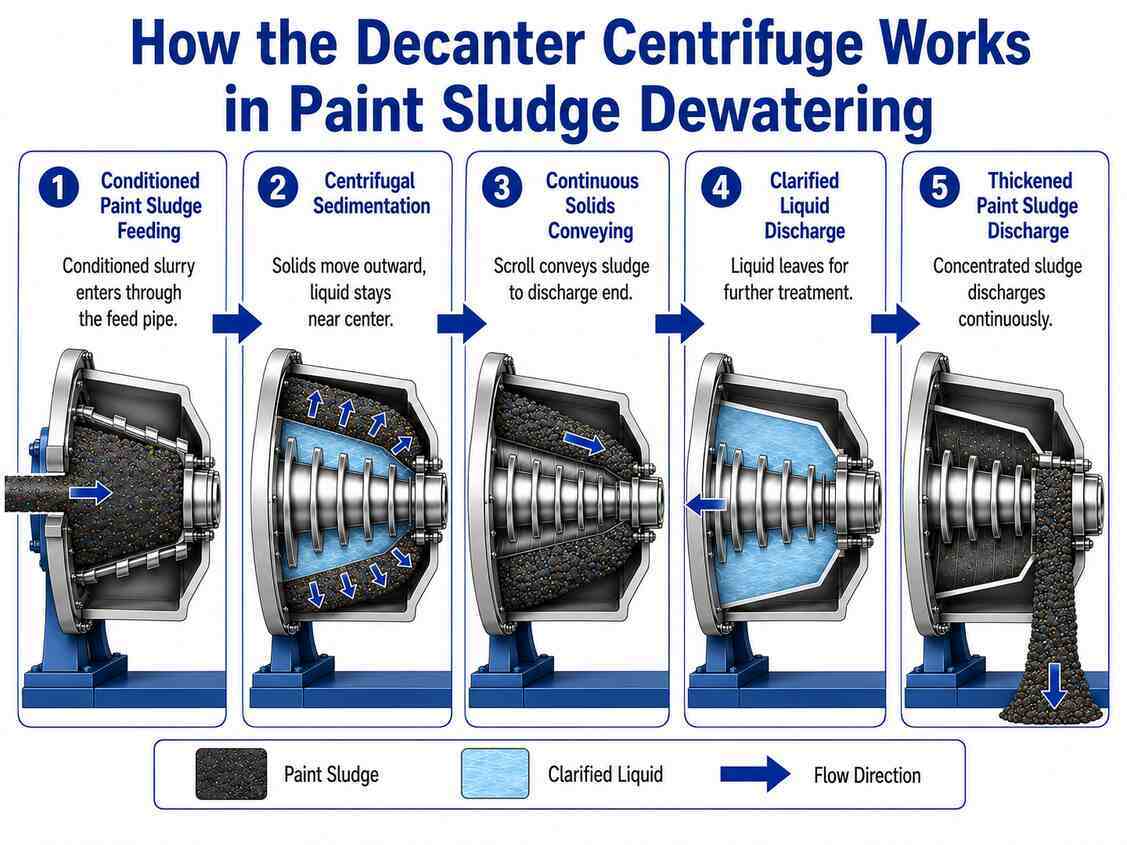
Conditioned paint wastewater enters the rotating bowl through a controlled feed pipe.
An agitated tank maintains stable solids concentration and prevents pigment and resin solids from settling.
High-speed rotation separates coagulated pigments, fillers, and resin particles from the liquid phase.
The denser solids move outward and form a sludge layer against the bowl wall.
The screw conveyor rotates at a controlled differential speed.
It continuously transports settled paint sludge toward the conical end for further thickening.
The separated liquid leaves through the liquid outlet.
It can be transferred to flotation, oxidation, biological treatment, membrane filtration, or water-recovery treatment.
Concentrated paint sludge is discharged continuously.
It can be sent to a filter press, dryer, recovery process, sludge container, incineration system, or controlled disposal.

| Model | Diameter (mm) | Length (mm) | Length-to-diameter rate | G force | Max solid discharge (m³/h) | Weight (kg) | Dimension (L*W*H) (mm) |
|---|---|---|---|---|---|---|---|
| PDC-10 | 250 | 1000 | 4 | 4080 | 0.4 | 1000 | 2410*800*1080 |
| PDC-12 | 4200 | 1350 | 4 | 3500 | 0.6 | 1200 | 2610*800*1080 |
| PDC-12 | 4200 | 1350 | 4.5 | 3180 | 1.2 | 1800 | 3495*840*1180 |
| PDC-18 | 4000 | 1600 | 4.5 | 3180 | 1.2 | 3200 | 3497*1020*1385 |
| PDC-18 | 450 | 2150 | 4 | 2500 | 2 | 3800 | 4447*1080*1385 |
| PDC-20 | 400 | 2250 | 4.5 | 2500 | 3.5 | 4000 | 4580*1140*1470 |
| PDC-21 | 530 | 2280 | 4.3 | 2500 | 5 | 5000 | 4924*1170*1540 |
| PDC-26 | 655 | 2800 | 4.3 | 2270 | 8 | 7000 | 4300*1900*1350 |
Continuously concentrates pigment and resin solids while reducing sludge volume.
Pre-thickening reduces hydraulic load and provides a more stable filter press feed.
Flushing connections and suitable internal surfaces help reduce resin and sludge deposits.
Removing suspended paint solids reduces the load on flotation, oxidation, biological, and membrane systems.
Sealed, explosion-proof, and nitrogen-protected configurations are available for suitable solvent-containing streams.
Please provide:
Yes. It can continuously thicken overspray sludge after detackification, coagulation, or flocculation.
Sticky acrylic, epoxy, polyurethane, or alkyd resins may cause buildup. Proper differential speed, flushing, and anti-stick surfaces help maintain discharge.
Yes, but separate collection and thorough cleaning are recommended when color contamination affects sludge recovery or reuse.
The solvent type, concentration, and flash point must be checked. Gas-tight construction, explosion-proof components, grounding, and nitrogen protection may be required.
It depends on solvent, heavy-metal, and hazardous-waste content. The sludge may require filter pressing, drying, recovery, incineration, or regulated disposal.
Peony welcomes distributor and agent cooperation with automotive plants, paint manufacturers, coating lines, spray-booth contractors, wastewater-treatment companies, and industrial separation partners.
We support partners with sludge testing, centrifuge selection, chemical-conditioning design, anti-stick configuration, solvent-safe design, filter press integration, commissioning, spare parts, and after-sales service.
Send us your paint sludge information, including paint type, solids concentration, viscosity, solvent content, required capacity, liquid-quality target, and downstream treatment arrangement. Our engineering team will recommend a suitable decanter centrifuge solution for your paint sludge dewatering process.