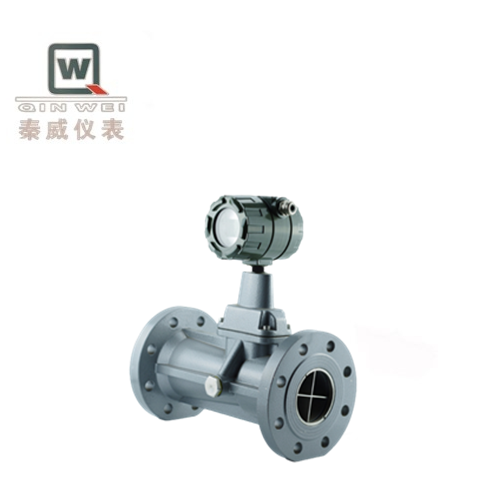
High-Precision Wide-Range Ratio Waist Wheel Flowmeter Suitable For High Viscosity Media
The waist wheel flowmeter (also known as the Roots flowmeter) is a high-precision volumetric flow measurement instrument. It divides the fluid into fixed volume units for measurement by rotating a pair of 8-shaped waist wheels driven by fluid pressure difference.
advantage
- High Precision: Extremely high precision, generally achievable to ±0.5%, and even up to ±0.2% or higher. It is a trade settlement-grade measuring instrument.
- Wide range ratio: The range ratio is very wide, typically up to 20:1 or even higher. This means high accuracy can be maintained over a wide range of flow rates.
- Suitable for high-viscosity media: insensitive to viscosity changes, making it ideal for measuring viscous fluids such as crude oil and heavy oil.
- Low pressure loss: Due to the non-contact between the lobes, the operational resistance is relatively small, resulting in a lower pressure loss compared to elliptical gear flowmeters.
- Low vibration and noise: It operates smoothly, with noise and vibration levels significantly lower than those of elliptical gear flowmeters.
- Low starting flow rate: Due to the gap between rotors and the low starting friction, it is capable of measuring very small flow rates.
Characteristics
| Characteristics |
Elliptic gear flowmeter |
Waist wheel flowmeter |
| Core structure |
Two directly meshing elliptical gears |
Two non-contacting waist-shaped rotors, driven by external synchronous gears |
| Operating principle |
The gears mesh with each other to drive, similar to a gear pump. |
The rotor forms a sealed chamber under the control of synchronous gears |
| Vibration and noise |
Larger (direct gear mesh impact) |
Smaller (non-contact, smooth operation) |
| Pressure loss |
relatively large |
relatively small |
| Wear and tear |
There is wear and tear on the gear meshing surface. |
The main wear and tear is on the bearings and synchronous gears, while the rotor itself experiences minimal wear and tear |
| Cost |
Relatively low |
relatively high, especially for large diameters |
| Applicable caliber |
Commonly used for small and medium-sized calibers. |
The caliber range is wider, covering from small to large sizes |
| Application focus |
Universal high-viscosity process metering, high cost-effectiveness |
trade settlement, high-precision, high-reliability requirements |
Typical application scenarios
- Waist wheel flowmeters are commonly used for trade settlement and high-precision process control due to their high accuracy and wide measurement range ratio.
- Oil and natural gas: trade settlement for crude oil transportation, precise metering of refined oil products (diesel, gasoline), and metering of liquefied petroleum gas (LPG) and liquefied natural gas (LNG).
- Chemical industry: metering of various chemical raw materials, solvents, and polymers.
- Food : Edible oil, syrup, chocolate, dairy products, etc.
- Urban gas: High-pressure gas metering for industrial and large users.
- Others: Any occasion requiring high-precision and high-repetitiveness volume measurement.
Precautions for model selection and installation
- Filters are essential: It is emphasized again that filters (usually recommended to be 100μm or finer, depending on product requirements) must be installed upstream of the flowmeter. This is the lifeline to ensure its long-term accurate operation.
- Installation direction: Most require horizontal installation, ensuring that the direction of the arrow on the flowmeter housing is consistent with the fluid flow direction. The meter head is usually facing up for easy reading.
- Exhaust: Before startup, it is essential to fully exhaust the flowmeter and pipeline to prevent gas from occupying the metering chamber, which could lead to measurement errors and equipment damage.
- Maintenance: Regular inspection of the wear condition of bearings and synchronizing gears is required, along with calibration.
summary
The waist wheel flowmeter is a "high-end product" within the family of volumetric flowmeters. It achieves extremely high accuracy, smooth operation, and a wide measurement range ratio through its non-contact waist wheel and synchronous gear design. Although its manufacturing cost and cleanliness requirements are relatively high, it is undoubtedly one of the preferred solutions in fields such as crude oil trade and fine chemicals, where measurement accuracy and reliability are highly demanded.