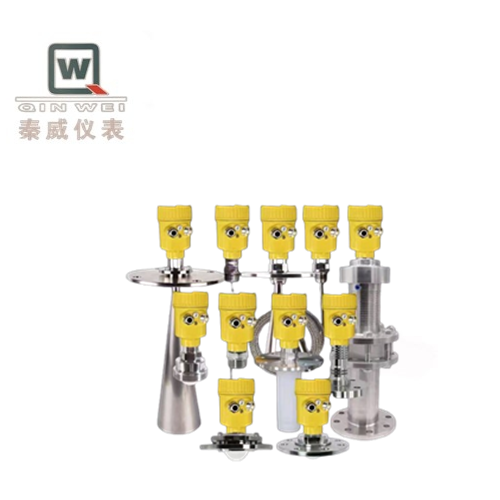
The General-Purpose Top-Mounted Radar Level Gauge Has A Simple And Intuitive Calculation Method
The top-mounted radar level gauge refers to the installation method where the radar sensor (including the antenna and electronic unit) is directly fixed on the opening at the top of the container through a flange or thread for non-contact measurement from top to bottom. This is the most common and mainstream installation method.
Why is top mounting the mainstream? - Core advantages
- Most in line with measurement logic: Directly measure the space distance from the tank top to the liquid surface, with simple and intuitive calculation (liquid level = tank height - measurement value).
- Convenient installation and maintenance: Only need to open a hole at the tank top, install and wire from the outside, no need to enter the tank, safe and labor-saving.
- Avoid medium contact and contamination: For non-contact antennas (such as horn antennas), the instrument does not come into contact with the medium at all, suitable for corrosive, high-temperature, high-pressure, high-viscosity, and easily crystallized and other complex media.
- Applicable to various container types: Dome tanks, floating roof tanks (special design required), spherical tanks, reactors, silos, water tanks, etc. can all adopt top mounting.
- Flexible antenna selection: Can freely choose the most suitable antenna type according to the working conditions to achieve the best measurement effect.
Typical application scenarios (covering almost all industrial fields)
- Oil and storage and transportation: Large storage tanks for crude oil, refined oil, and chemical products.
- Chemical and pharmaceutical industries: Various reaction vessels, intermediate tanks, finished product tanks, and solvent storage tanks.
- Power industry: Coal bunkers, limestone silos, fly ash silos, and desulfurization towers.
- Water and wastewater treatment: Clear water tanks, wastewater tanks, dosing tanks, and sludge tanks.
- Food and beverage: Sugar storage tanks, fermentation tanks, and water storage tanks.
- Metallurgy and cement: Mineral powder silos, cement silos, and raw material homogenization silos.
Top-mounted vs. Side-mounted (Bypass Pipe Installation)
| Characteristics |
Top-mounted |
Side-mounted/Bypass Pipe-mounted |
| Installation Position |
Top of the container |
Side wall of the container or bypass pipe |
| Measurement Path |
Vertically downward |
Horizontally or at an angle |
| Applicable Conditions |
General-purpose, suitable for the vast majority of situations |
- The top of the tank cannot be drilled or installed.
- The gas phase space inside the tank has extremely harsh conditions (such as high temperature, vacuum, severe crystallization), making top installation of the sensor unsuitable.
- Close-range measurement of small liquid levels is required.
|
| Advantages |
Installation and maintenance are convenient, intuitive, and there are many antenna options |
Can avoid the influence of harsh gas phase environments on the instrument, and sometimes installation is more flexible |
| Disadvantages |
May be affected by complex gas phase conditions inside the tank |
Requires additional installation of a bypass pipe, with leakage points and maintenance points; measurement is not direct and may have errors |
Top-mounted radar level gauges are the most standard, reliable and widely used form of radar level measurement technology. They perfectly embody the core advantages of radar measurement, including non-contact, high precision and high reliability.